Home
Class 12
MATHS
The random variable X can take only the ...

The random variable X can take only the values 0,1,2. If
`P(X=0)=P(X=1)=p and E(X^(2))=E[X]`,
then find valu of p.

Text Solution

Verified by Experts
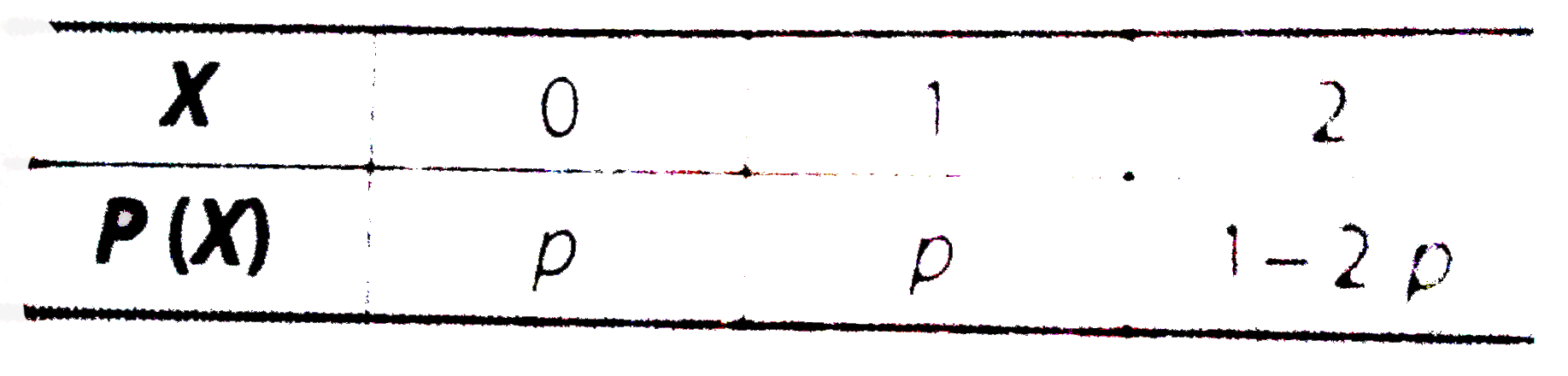
Since, X=0,1,2 and P(X) at X =0 and 1 is p, let at X=2,P(X) is x.
`rArr P+P+x=1`
`rArrx=1-2p`
We get, the following distribution.

`therefore E[X]=sumXP(X)`
`=0cdotp+1cdotp+2(1-2p)`
and `E(X^(2))=sumX^(2)P(X)`
`=0cdotP+1cdotp+4cdot(1-2p)`
`=p+4-8p=4=-7p`
Also, given that`E(X^(2))=E[X]`
`rArr4-7p=2-3p`
`rArr4p=2rArrp=1/2`
Promotional Banner

Topper's Solved these Questions

  • PROBABILITY

    NCERT EXEMPLAR ENGLISH|Exercise Long Answer Type Questions|15 Videos
  • PROBABILITY

    NCERT EXEMPLAR ENGLISH|Exercise Objective Type Questions|38 Videos
  • MATRICES

    NCERT EXEMPLAR ENGLISH|Exercise Solved example|101 Videos
  • RELATIONS AND FUNCTIONS

    NCERT EXEMPLAR ENGLISH|Exercise Fillers|15 Videos

Similar Questions

Explore conceptually related problems

The random variable X can take only the values 0, 1, 2. Given that P(X=0) = P(X= 1) = p and E(X^2) = E(X) , then find the value of p

The random variable X can take only the values 0, 1,2 . Given that P(X=0) = P(X=1) = p and that E(X^2) = E(X) ; find the value of p .

The random variable X can the values 0, 1, 2, 3, Give P(X = 0) = P(X = 1)= p and P(X = 2) = P(X = 3) such that sum p_i x_i^2=2sum p_i x_i then find the value of p

A random variable X takes the values 0,1,2,3 and its mean = 1,3 .If P(X=3) =2P(X=1) and P(X=2) = 0.3 then P(X=0) is

The random variable takes the values 1,2,3,…….m. If P(X=n)=(1)/(m) to each n, then the variance of X is

A randomm variable X takes the value -1,0,1. It's mean is 0.6. If (X=0)=0.2 then P(X=1)=

A random variate X takes the values 0, 1, 2, 3 and its mean is 1.3. If P(X= 3) = 2P(X= 1) and P(X= 2) = 0.3 , then P(X= 0) is equal to

A random variable X takes the values 0,1,2,3,..., with prbability PX(=x)=k(x+1)((1)/(5))^x , where k is a constant, then P(X=0) is.

The range of a random variable X is {0, 1, 2}. Given that P(X=0)=3c^(3),P(X=1)=4c-10c^(2),P(X=2)=5c-1 where c is constant. Find (i) the value of c (ii) P(X lt 1) (iii) P(1lt X le2) (iv) P(0lt X le3)

If X is a random variable with probability distribution P(X=k)=((k+1)C)/(2^(k)),K=0,1,2,…. then find C.

