Home
Class 12
CHEMISTRY
(i) Out of (CH(3))(3), C-Br and (CH(3))(...

(i) Out of `(CH_(3))_(3)`, C-Br and `(CH_(3))_(3)` C-I, which one is more reactive towards `S_(N)1` and why?
(ii) Write the product formed when P-nitrochlorobenzene is heated with aqueous NaOH at 443K followed by acidification.
(iii) Why dextro and laevo-rotatory isomers of Butan-2-ol are difficult to separate by fractional distillation?

Text Solution

Verified by Experts
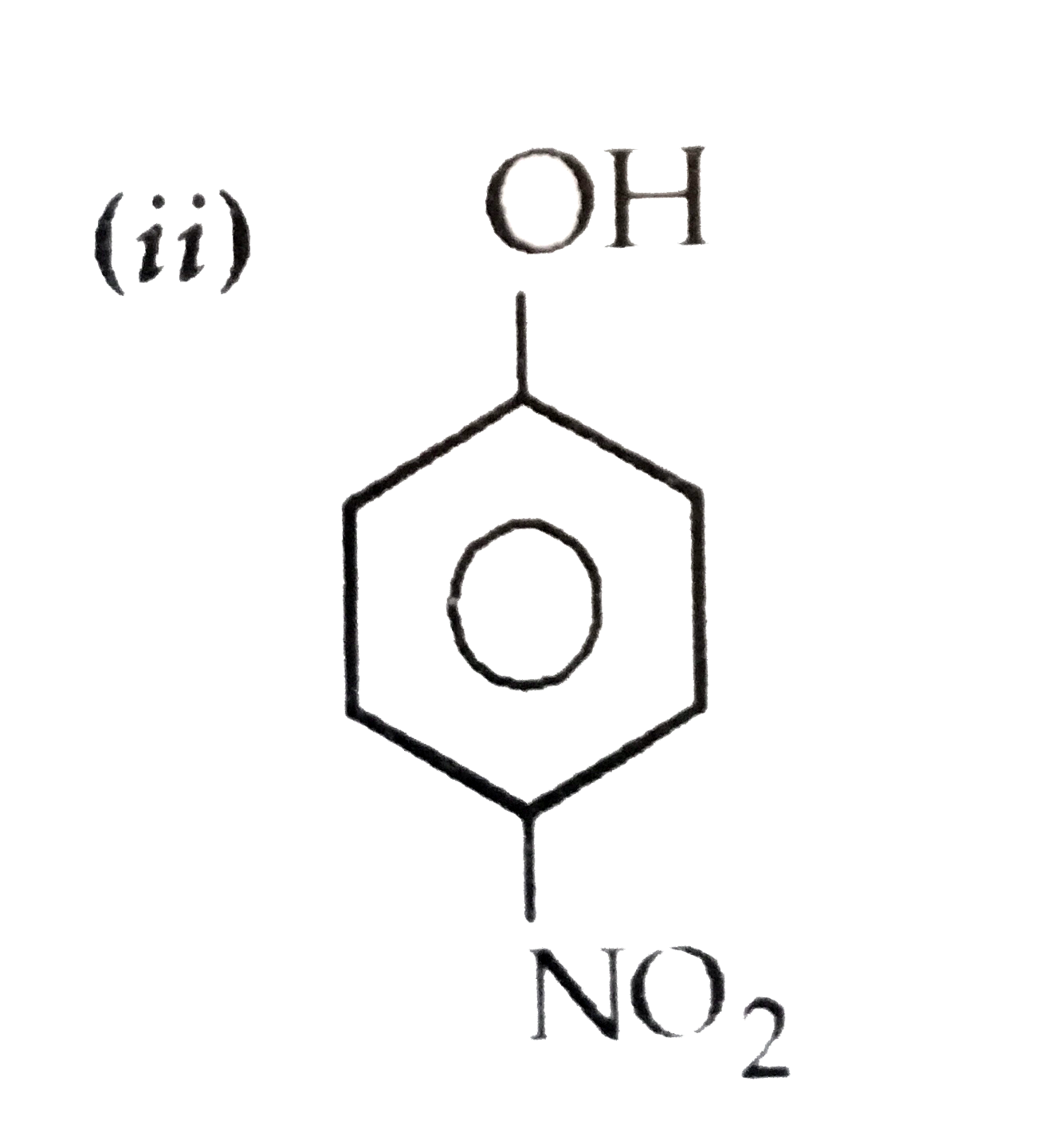
(i) `(CH_(3))_(3) C-Br and (CH_(3))_(3)` C-I both are `3^(@)` but one which have better living group would be more reactive so I is the better living group. Hence `(CH_(3))_(3)`, C-1is more reactive towards `S_(N)1`.

(iii) dextro and laevo rotutory isomers of Butan-2-ol have same boiling point. So they are difficult to separate by fractional distillation.
Promotional Banner

Topper's Solved these Questions

  • XII BOARDS

    XII BOARD PREVIOUS YEAR PAPER ENGLISH|Exercise SECTION-D|12 Videos
  • XII BOARDS

    XII BOARD PREVIOUS YEAR PAPER ENGLISH|Exercise CHEMISTRY (Theory) [SET - I]|34 Videos
  • XII BOARDS

    XII BOARD PREVIOUS YEAR PAPER ENGLISH|Exercise SECTION-B|22 Videos
  • SAMPLE PAPER 2019

    XII BOARD PREVIOUS YEAR PAPER ENGLISH|Exercise SECTION: D|1 Videos

Similar Questions

Explore conceptually related problems

Out CH_(3)-underset(CH_(3))underset(|)(CH)-CH_(2)-Cl and CH_(3)-CH_(2)-underset(CH_(3))underset(|)(CH)-Cl , which is more reactive towards S_(N)1 reaction and why?

Of the two bromoderivatives, C_6H_5CH(CH_3)Br and C_6H_5CH(C_6H_5)Br , which one is more reactive in SN' substitution reaction and why?

Consider the equation : (CH_3)_3C Cloverset(aq. NaOH)to (CH_3)_3COH Which of these reactions follow S_(N^1) mechanism and which the S_(N^2) mechanism ?

Which one of the following compounds is more reactive towards S_(N)2 reaction and why ? CH_3CH(Cl) CH_2CH_3 or CH_3CH_2CH_2Cl

(a) Write the chemical reaction involved in Wolf-Kishner reduction. (b) Arrange the following in the increasing order of their reactivity towards nucleophilic addition reaction : C_(6)H_(5)COCH_(3), CH_(3)-CHO, CH_(3)COCH_(3) (c) Why carboxylic acid does not give reactions of carbonyl group ? (d) Write the product in the following reaction. CH_(3)CH_(2)CH=CH-CH_(2)CN overset(1.(i-Bu)_(2)"AlH")underset(2. H_(2)O)(to) (e) A and B are two functional isomers of compound C_(3)H_(6)O . On heating with NaOH and I_(2) , isomer B forms yellow precipitate of iodoform whereas isomer A does not form any precipitate. Write the formulae of A and B.

A : When C_(2) H_(5) - O- CH_(3) is reacted with one mole of Hl then C_(2)H_(5)OH & CH_(3) I is formed . R : It is S_(N)1 reaction

(i) Complete the following reaction and suggest a suitable mechanism for the reaction : CH_3CH_2OHoverset(H^+,443K)to (ii) Why ortho-Nitrophenil is steam volatile while para-Nitrophenil is less volatile ?

C_(6)H_(4)(NO_(2))CH_(3) can form different isomers. Write three isomers. (i) ......... (ii) ....... (iii) .......

Predict the order of reactivity of the following halides with (a) NaI in acetone (b) aq.alcoholic AgNO_3 (i) CH_3Br (ii) C_2H_5Br (iii) PhCH_2Br (iv) .

Dehydrohalogenation involves removal of the halogenn atom together with a hydrogen atom from carbon adjacent to the one with halogen atom. Alcoholic KOH is used for dehydrohalogenation. According to saytzeff's rule, when two alkenes may be formed, the alkene which is most substituted is the major product. Q. Arrange the following alkyl halides in decreasing order of the rate of beta -elimination reaction with alcoholik KOH. underset((i))(CH_(3)CH_(2)CH_(2)Br) underset((ii))(CH_(3)-underset(CH_(3))underset(|)(C)H-CH_(2)Br) underset((iii))(CH_(3)-CH_(2)-underset(Br)underset(|)(C)H-CH_(3))

XII BOARD PREVIOUS YEAR PAPER ENGLISH-XII BOARDS-SECTION-C
  1. (i) What type of drug is used in sleeping pills? (ii) What type of d...

    Text Solution

    |

  2. Define the following terms with a suitable example in each: (i) Broa...

    Text Solution

    |

  3. (i) Out of (CH(3))(3), C-Br and (CH(3))(3) C-I, which one is more reac...

    Text Solution

    |

  4. An aromatic compound A on heating with Br, and KOH forms a compound B ...

    Text Solution

    |

  5. Complete the following reactions: (i) (ii) (C(6)H(5)CH(2))(2)Cd+2...

    Text Solution

    |

  6. Write chemical equations for the following reactions: (i) Propanone ...

    Text Solution

    |

  7. Differentiate between the following: (i) Amylose and Amylopectin. ...

    Text Solution

    |

  8. Write chemical reaction to show that open structure of D-glucose conta...

    Text Solution

    |

  9. Chromium metal can be plated out from an acidic solution containing Cr...

    Text Solution

    |

  10. Give reasons for the following : (a) Leather gets hardened after tan...

    Text Solution

    |

  11. What is the role of : ( i) Depressants in froth floatation ? (b) Ca...

    Text Solution

    |

  12. Write chemical reactions taking place in the extraction of Aluminium f...

    Text Solution

    |

  13. Explain the method of preparation of sodium dichromate from chromite o...

    Text Solution

    |

  14. Complete the following reactions: (a) MnO2+KOH +O2 rarr (b)I^-+MnO4...

    Text Solution

    |

  15. Write the hybridization and magnetic character of the following comple...

    Text Solution

    |

  16. Give reasons for the following (a) The presence of -NO2 group at or...

    Text Solution

    |

  17. (i)Write equation for preparation of 1-iodobutane from 1- chlorobutane...

    Text Solution

    |

  18. How will you synthesise the following alcohol from appropriate alkene:

    Text Solution

    |

  19. Give any one property of glucose that cannot be explained by the open ...

    Text Solution

    |

  20. Define the following with suritable example of each ( a) Antiseptic...

    Text Solution

    |

