Home
Class 12
PHYSICS
How does an unpolarised light get polari...

How does an unpolarised light get polarised when passed through a polaroid ?
Two polaroids are set in crossed positions . A third polaroid is placed between the two making an angle `theta` with the pass axis of the first polaroid . Write the expression for the intensity of light transmitted from the second polaroid . In what orientations will the transmitted intensity be (i) minimum and (ii) maximum ?

Text Solution

Verified by Experts
If an unpolarised light wave is incident on a polaroid then the light get linearly polarised with the electric vector oscillating along a direction perpendicular to the aligned molecules .
If the light from an ordinary source (like a sodium lamp) passes through a polaroid sheet `P_(1)`, it is observed that its intensity is reduced by half.Rotating `P_(1)` has no effect on the transmitted beam and transmitted intensity constant .
Let an identical piece of polaroid `P_(2)` be placed before `P_(1)` , the light from the lamp is reduced in intensity on passing through `P_(2)` alone . But rotating `P_(1)` has effect on the light coming from `P_(2)`.
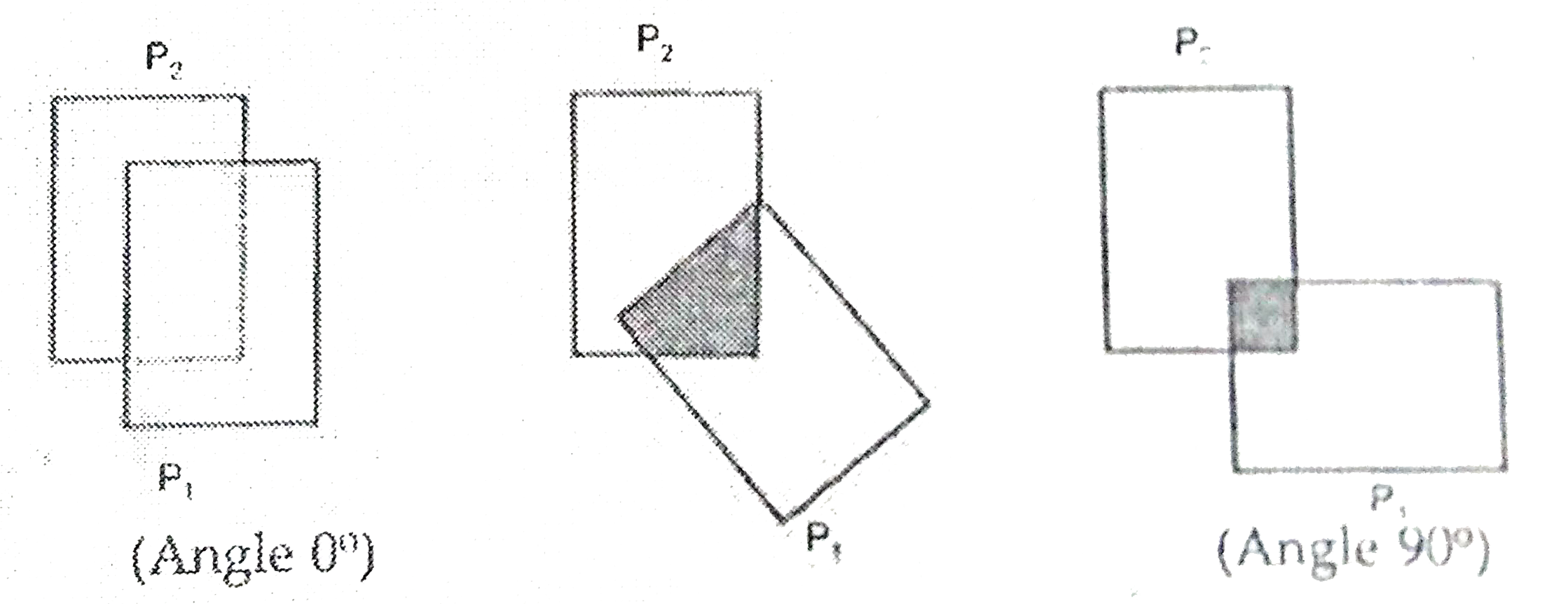
In one position , the intensity transmitted by `P_(2)` followed by `P_(1)` is nearly zero . When turned by `90^(@)` from this position `P_(1)` transmits nearly the full intensity emerging from `P_(2)` as shown in fig.

Graph : The graph between intensity of light and the angle between polariser and analyser is shown in the figure .
When the polaroid is rotated in the path of plane polarised light , its intensity will vary from maximum (When the vibrations of the plane polarised light are parallel to the axis of the polaroid ) to minimum (When the direction of vibrations becomes perpendicular to the axis of the crystal).
Let `I_(0)` be the intensity of polarised light after passing through first polariser `P_(1) ` . Then intensity of light after passing through second polariser `P_(2)` is given by `I = I_(0) cos^(2) theta`.
Promotional Banner

Topper's Solved these Questions

  • XII BOARDS

    XII BOARD PREVIOUS YEAR PAPER ENGLISH|Exercise SET -II|9 Videos
  • XII BOARDS

    XII BOARD PREVIOUS YEAR PAPER ENGLISH|Exercise SET -III|4 Videos
  • XII BOARDS

    XII BOARD PREVIOUS YEAR PAPER ENGLISH|Exercise SET-III DELHI BOARD|10 Videos
  • SAMPLE PAPER 2019

    XII BOARD PREVIOUS YEAR PAPER ENGLISH|Exercise SECTION D|6 Videos
XII BOARD PREVIOUS YEAR PAPER ENGLISH-XII BOARDS-SET -I
  1. How are electromagnetic waves produces by oscillating charges ? Draw a...

    Text Solution

    |

  2. Show that the electric field at the surface of a charged conductor is ...

    Text Solution

    |

  3. Two identical loops , one of copper and the other of aluminium , are r...

    Text Solution

    |

  4. A proton and deuteron are accelerated by same potential difference.Fin...

    Text Solution

    |

  5. A carrier wave of peak voltage 12 V is used to transmit a message sign...

    Text Solution

    |

  6. Write Einstein's photoelectric equation. State clearly any two salient...

    Text Solution

    |

  7. Draw a plot of potential energy of a pair of nucleons as a function of...

    Text Solution

    |

  8. Draw a plot of the binding energy per nucleon as a function of mass nu...

    Text Solution

    |

  9. Which mode of propagation is used by short wave broadcast services ha...

    Text Solution

    |

  10. (i) Draw a neat labelled ray diagram of an astronomial telescope in no...

    Text Solution

    |

  11. (i) Draw a neat labelled ray diagram of a compound microscope . Explai...

    Text Solution

    |

  12. In Young's double slit experiment, the two slits 0.15 mm apart are il...

    Text Solution

    |

  13. Using kirchhoff's rules wire the experssion for the current I(1) ,I(...

    Text Solution

    |

  14. (a) Write symbolically the beta-decay process of ""(15)^(32)P. (b) ...

    Text Solution

    |

  15. How does an unpolarised light get polarised when passed through a pola...

    Text Solution

    |

  16. An illuminated object and a screen are placed 90 cm apart. What is the...

    Text Solution

    |

  17. Answer the following: (a) With the help of a diagram , explain the p...

    Text Solution

    |

  18. (a) Derive an expression for the force between two long parallel curre...

    Text Solution

    |

  19. Draw a schematic diagram of a step-up transformer . Explain its worki...

    Text Solution

    |

  20. (a) Draw the circuit arrangement for studying the input and output cha...

    Text Solution

    |