Home
Class 12
PHYSICS
Describe Young's double slit experiment ...

Describe Young's double slit experiment to produce interference pattern due to a monochromatic source of light. Deduce the expression for the fringe width.

Text Solution

Verified by Experts
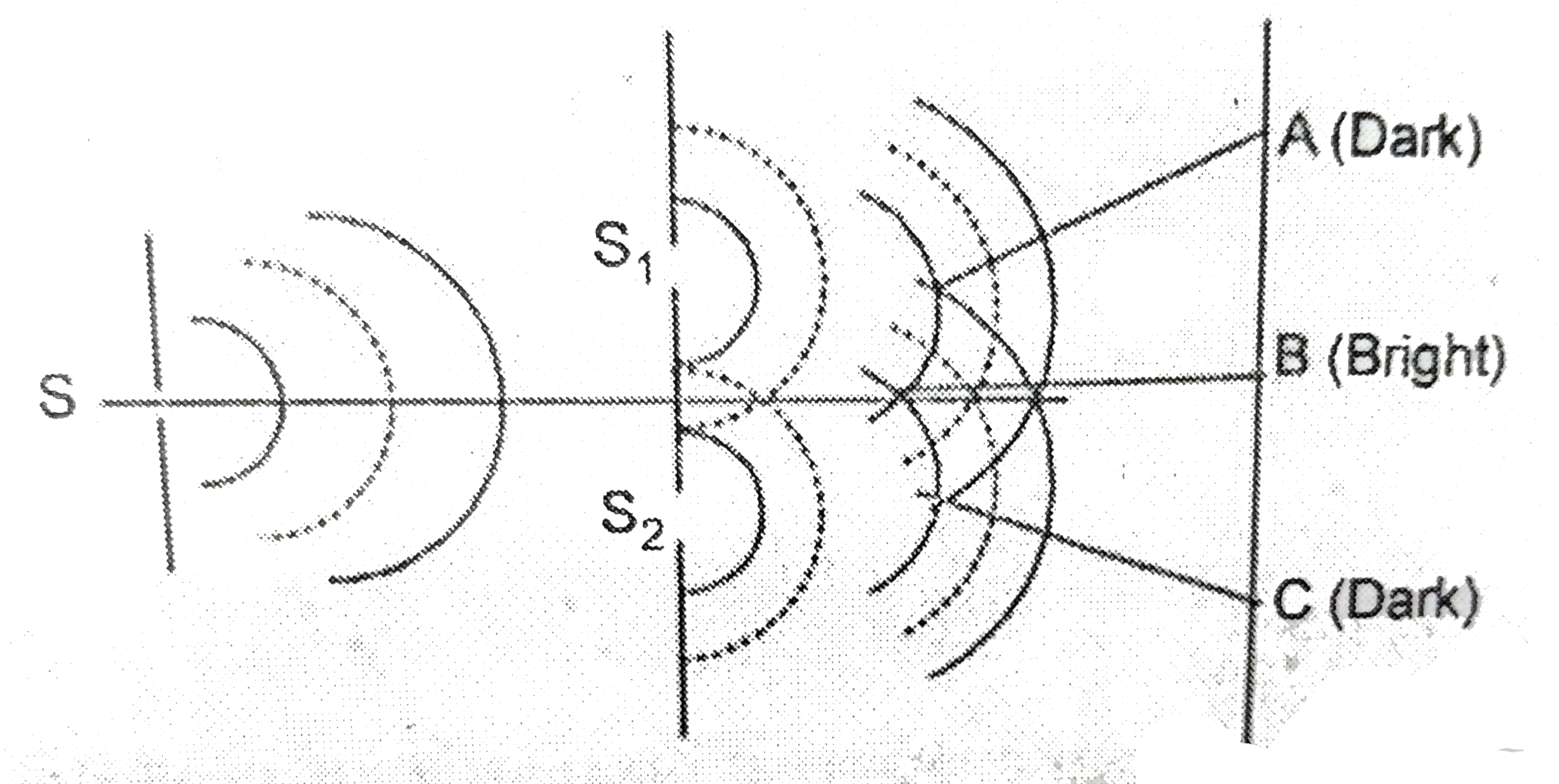
Simplest experiment to show interference of light is Young's double slit experiment : `delta` is a narrow slit (of width about 1 mn) illuminated by a monochromatic source of light. At a suitable distance (`~~10mm`) form `delta," two slits " S_1 and S_2` are placed parallel to S. When a screen is placed at a large distance (about 2m) from the slit `S_1 and S_2`, alternate dark and bright bands appear on the screen. These are the interference bands or fringas. The bond disappear when either slit is covered.
Explanation : According to Huygen's pricipal, the monochromatic source of light illuminating the slit S tends out spherical wavefront.
The two waves of same amplitude and same freqency superimpose on each other.
Dark fringes appear on the screen when the crest of one wave falls on the trough of other and they neutralise the effect of each other.
Bright fringes appear on the screen when the crest of one wave coincides with the crest of other and they reinforce each other.
Expression for the fringe width :
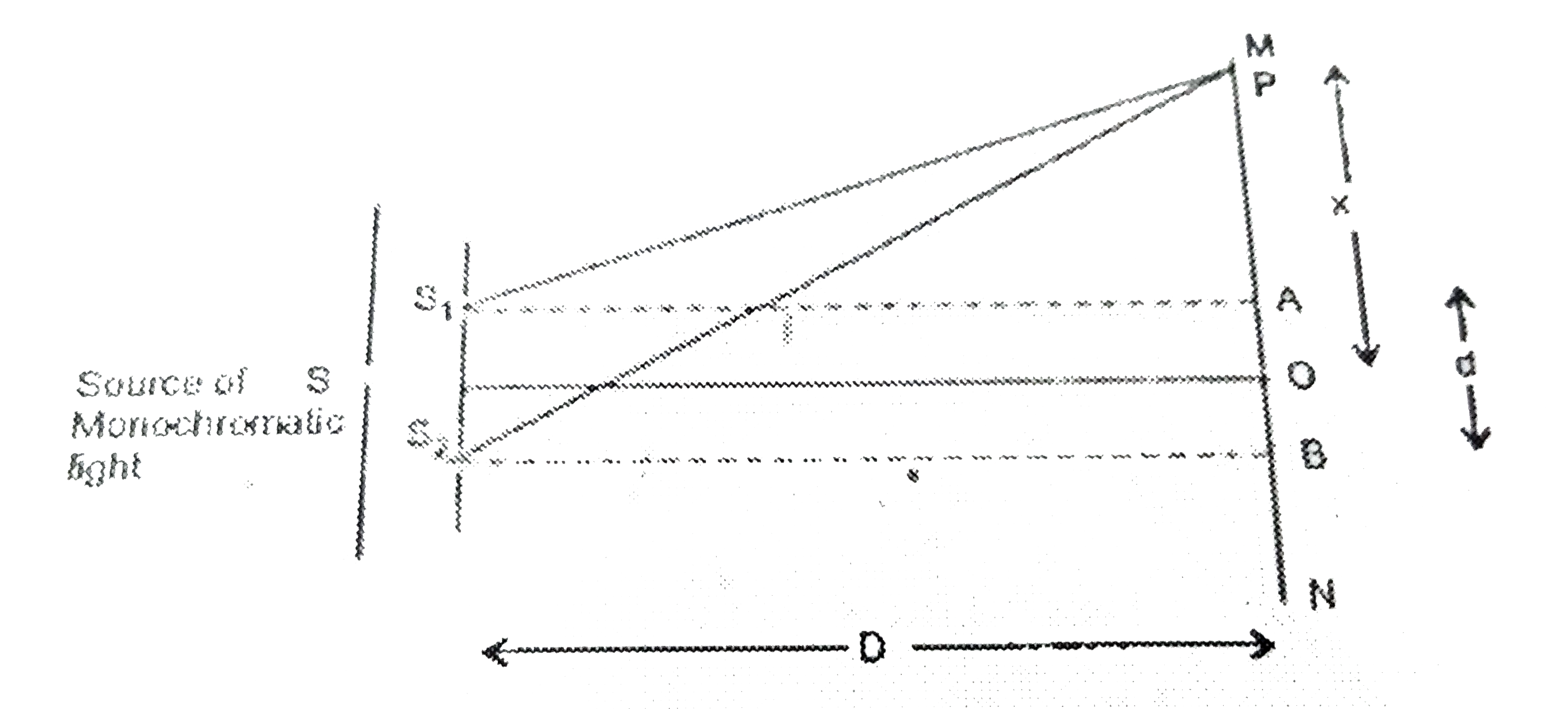
Let d= distance between slits `S_1 and S_2`
D= distance of screen from two slits
and x = distance between the central maxima O and observation point P.


Light waves spread out from S and fall on both `S_1 and S_2`. The spherical waves emanating from `S_1 and S_2` will produce interference frings on the screen MN.
In right `Delta S_1 AP`, we have,
`(S_1P)^2=(S_1A)^2+(AP)^2`
`S_1P=sqrt(D^2+(x-d/2)^2)=sqrt(D^2[1+((x-d/2)^2)/D^2])`
`S_1P=D[1+((x-d/2)^2)/D^2]=D+((x-d/2)^2)/(2D)`
Similarly `S_2P=D+((x+d/2)^2)/(2D)`
Hence, path difference `= S_2P-S_1P`
`=D+((x+d/2)^2)/(2D)-D-((x-d/2)^2)/(2D)=1/(2D)[x^2+d^2/4+xd-x^2-d^2/4+xd]`
`=1/(2D).2xd=(xd)/D`.
Now the intesity at point P is maximum or minimum according as the path difference is an integral multiple of wavelength or an odd intefral multiple of half wavelength.
(i) For Brigth fringe (constructive interference) : We will have constructive interference resulting in a bright fringe when path difference `=nlambda`
`(xd)/D=nlambdarArrx=(nlambdaD)/d`
`:. _n=(nlambdaD)/d`
where, `n=0pm1pm2...`
Since, the separation between the centres of two consecutive bright fringes is called fringe width. It is denoted by `beta`
`:. " Fringe width, " beta=x_(n+1)-x_n`.
`beta=((m+1)lambdaD)/d(nlambdaD)/d=(lambdaD)/d(n+1-n)`
`:. beta=(lambdaD)/d`
(ii) For Dark fringe (destructive interference): We will have destructive interference resulting in a dark fringe when path difference
`=(2n+1)lambda/2`
`(xd)/D =(2n+1)lambda/2rArr x=((2n+1)lambdaD)/(2d)`
`:. x_n=((2n+1)lambdaD)/(2d)`,
where, `n=0,pm1,pm2,...`
Fringe width `beta=x_(n+1)-x_n`
`=([2(n+1)+1]lambdaD)/(2d)-((2n+1)lambdaD)/(2d)=(2n+2+1-2n-1)(lambdaD)/(2d)=(2lambdaD)/(2d)`
`:. beta=(lambdaD)/d`
Hence, all bright and dark fringes are of equal width.
Observations :
(i) Fringe width is directly proportional to the wavalength of light i.e. `betaalphalambda`.
(ii) Fringe width is inversely proportional to the distance between screen and two sourves i.e. `betaalpha1/d`.
(iii) Fringe width is directly proportional to the distance between screen and two sources i.e. `betaalphaD`
Promotional Banner

Topper's Solved these Questions

  • XII BOARDS

    XII BOARD PREVIOUS YEAR PAPER ENGLISH|Exercise SET-II, DELHI BOARD|4 Videos
  • XII BOARDS

    XII BOARD PREVIOUS YEAR PAPER ENGLISH|Exercise SET-III, DELHI BOARD|4 Videos
  • XII BOARDS

    XII BOARD PREVIOUS YEAR PAPER ENGLISH|Exercise SET -III|4 Videos
  • SAMPLE PAPER 2019

    XII BOARD PREVIOUS YEAR PAPER ENGLISH|Exercise SECTION D|6 Videos
XII BOARD PREVIOUS YEAR PAPER ENGLISH-XII BOARDS-PHYSICS (Theory) [SET -I]
  1. Define the term 'wattles current'.

    Text Solution

    |

  2. When monochromatic light travels from one medium to another, its wavel...

    Text Solution

    |

  3. In the youngs double slit experiment ,the slit sepration is 1mm ,the d...

    Text Solution

    |

  4. A magnetic needle free to rotate in a vertical plane parallel to magne...

    Text Solution

    |

  5. Two convex lenses of same focal length but of aperture A(1) and A(2)(A...

    Text Solution

    |

  6. Name the semiconductor device that can be used to regulate an irregula...

    Text Solution

    |

  7. How are infrared waves produced? Why are these referred to as 'heat wa...

    Text Solution

    |

  8. Draw the tramsfer characteristic curve of a base biased transistor in ...

    Text Solution

    |

  9. Define modulation index. Why is it generally kept less than one ?

    Text Solution

    |

  10. A conductor of length L is connected to a dc source of emf epsilon. If...

    Text Solution

    |

  11. Using Gauss's law obtain the expression for the electric field due to ...

    Text Solution

    |

  12. An electron and a photon each have a wavelength 1.00 nm. Find (i) ...

    Text Solution

    |

  13. Draw a schematic diagram showing the (i) ground wave (ii) sky wave and...

    Text Solution

    |

  14. Describe Young's double slit experiment to produce interference patter...

    Text Solution

    |

  15. (a) Describe briefly, with the help of suitable diagram, how the tran...

    Text Solution

    |

  16. State the law of radioactive decay. Plot a graph showing the number (N...

    Text Solution

    |

  17. State Biot-Savart law, giving the mathematical expression for it. Us...

    Text Solution

    |

  18. (a) Draw a ray diagram to show regraction of a ray of monochromatic l...

    Text Solution

    |

  19. (a) Obtain lens makers formula using the expression n2/v-n1/u=((n2-...

    Text Solution

    |

  20. (i) with the help of a labelled diagram, describe briefly the underly...

    Text Solution

    |