Home
Class 12
PHYSICS
(a) Describe briefly, with the help of ...

(a) Describe briefly, with the help of suitable diagram, how the transverse nature of light can be demonstrated by the phenomenon of polarization.
(b) When unpolarized light passes from air to a transparent medium, under what condition does the reflected light get polarized?

Text Solution

Verified by Experts
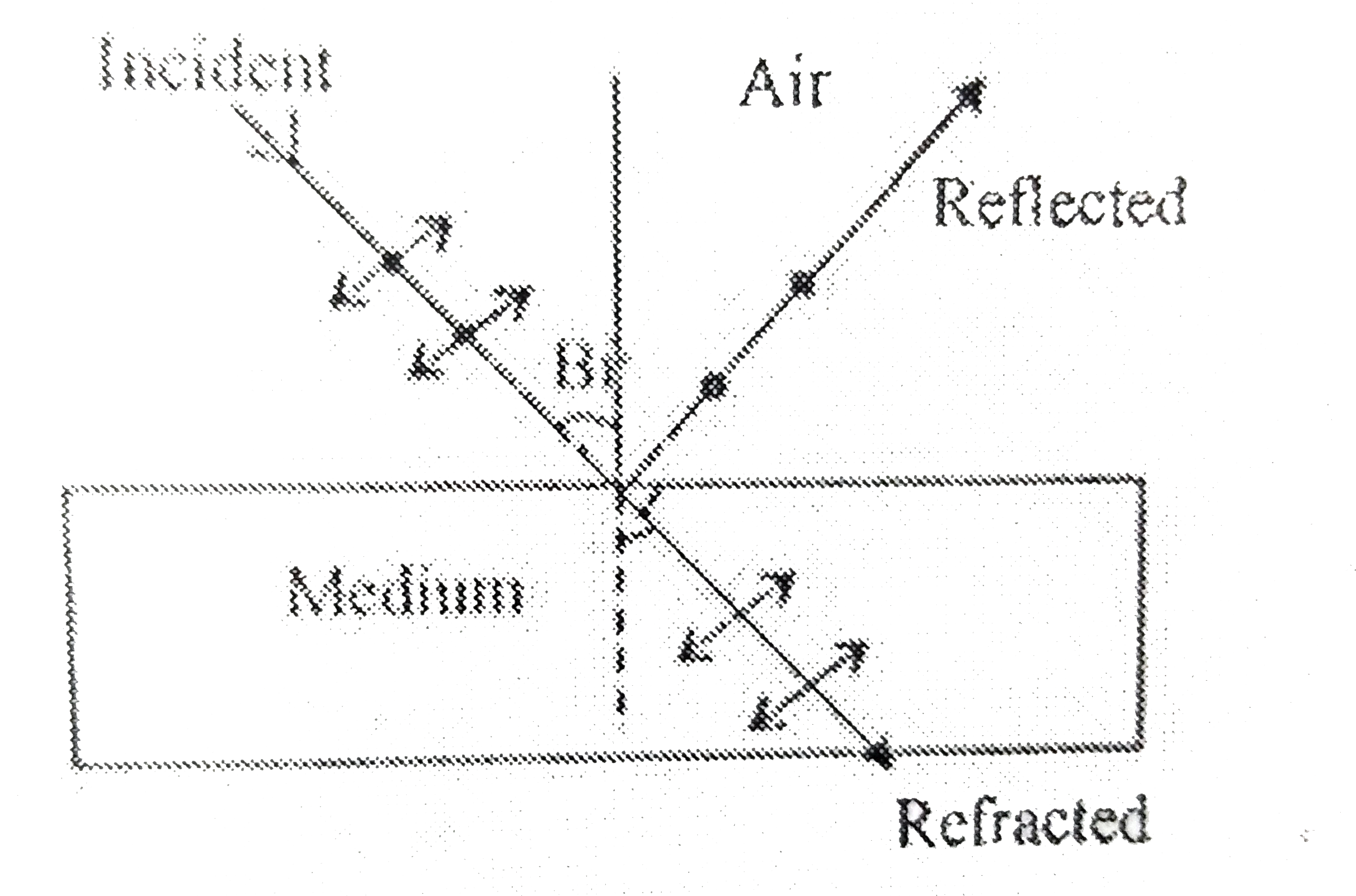
(a) Polarization : The dots and arrow indicates that both polarization are present in the incident and refracted waves.
Only transverse wave can be polarized. And the transverse nature of light can be demonstrated by the polarization. Light can be polarized by reflecting it from a transparent medium. The extend of polarization by reflecting it from a transparent medium. The extend of polarization depend on the angle of incient, at a particular angle of incidence, called Brewster

(b) Unpolarized light : The independent light waves whose planes of vibrations are randomly oriented about the direction of propagation are said to be unpolarized light.
When unpolarized light is incident on the boundary between two transparent media, the reflected light i polarized with electric vector perpendicular to the plane of incidence when the refracted and reflected rays make a right angle with each other.
Promotional Banner

Topper's Solved these Questions

  • XII BOARDS

    XII BOARD PREVIOUS YEAR PAPER ENGLISH|Exercise SET-II, DELHI BOARD|4 Videos
  • XII BOARDS

    XII BOARD PREVIOUS YEAR PAPER ENGLISH|Exercise SET-III, DELHI BOARD|4 Videos
  • XII BOARDS

    XII BOARD PREVIOUS YEAR PAPER ENGLISH|Exercise SET -III|4 Videos
  • SAMPLE PAPER 2019

    XII BOARD PREVIOUS YEAR PAPER ENGLISH|Exercise SECTION D|6 Videos

Similar Questions

Explore conceptually related problems

(a) Using the phenomenon of polarization, show, how, transverse nature of light can be demonstrated. (b) Two polaroids P_(1) and P_(2) are placed with their pass axes perpendicular to each other. Unpolarised light of intensity 10 is incident on P1. A third polaroid P3 is kept in between P_(1) and P_(2) such that its pass axis makes an angle of 30^(@) with that of P_(1) . Determine the intensity transmitted through P_(1),P_(2) and P_(3) .

(a) How does an unpolarized light incident on polaroid get polarized ? Describe briefly, with the help of necessary diagram, the polarization of light by reflection from a transparent medium. (b) Two polaroids 'A' and 'B' are kept in crossed position. How should a third polaroid 'C' be placed between them so that the inlensity of polarized light transmitted by polaroid B reduces to 1//8^(th) of the intensity of unpolarized incident on A?

Explain briefly, with the help of a neat labelled diagram, how does white light get dispersed by a prism. On which surface of a prism, there is both dispersion and deviation of light, and on which surface of the prism, there is only deviation of light?

A ray of light is incident on a transparent medium at polarizing angle. What is the angle between the reflected ray and the refracted ray .

(a) How does one demonstrate, using a suitable diagram, that unpolarised light when passed through a Polaroid gets polarised? (b) A beam of unpolarised light is incident a glass-air interface. Show using a suitable ray diagram, that light reflected from the interface is totally polarised, when mu=tani_(B) , when mu is the refractive index of glass with respect to air and i_(B) , is the Brewster's angle.

(a) When an unpolarized light of intensity I_(0) is passed through a polaroid , what is the intensity of the linearly polarized light ? Does it depend on the orintation of the polaroid ? Explain your answer. (b) A plane polarized beam of light is passed through a polaroid . Show graphically the variation of the intensity of the transmitted light with angle of rotation of the polaroid in complete one rotation.

(a) State Huygen's principle . Using this principle draw a diagram to show how a plane wave front incident at the interface of the media gets refracted when it propagates from a rarer to a denser medium. Hence verify Snell's law of refraction. (b) When monochromatic light travels from a rarer to a denser medium, explain the following, giving reasons- (i) Is the frequency of reflected and refracted light same as the frequency of incident light? (ii) Does the decrease in speed imply a reduction in the energy carried by light wave?

(a) What is linearly polarized light ? Describe briefly using a diagram how sunlight is polarised. (b) Unpolarised light is incident on a polaroid. How would the intensity of transmitted light change when the polaroid is rotated?

Explain the following giving reasons : (i) When monochromatic light is incident on a surface separating two media, the reflected and refracted light both have the same frequency as the incident frequency. (ii) When ligjt travels from a rarer to a denser medium, the speed decreases. Does this decrease in speed imply a reduction in the energy carried by the wave ? (iii) In the wave picture of light, intensity of light is determined by the square of the amplitude of the wave. What determines the intensity in the photon picture of light ?

(a) What is plane polarised light? Two polaroid sare placed at 90^(@) to each other and the transmitted intensity is zero. What happens when one more polaroid is placed between these two, bisecting the angle between them? How will the intensity of transmitted light vary on further rotating the third polaroid? (b) If a light beam shows no intensity variation when transmitted through a polaroid which is rotated, does it mean that the light is un-polarised? Explain briefly.

XII BOARD PREVIOUS YEAR PAPER ENGLISH-XII BOARDS-PHYSICS (Theory) [SET -I]
  1. Define the term 'wattles current'.

    Text Solution

    |

  2. When monochromatic light travels from one medium to another, its wavel...

    Text Solution

    |

  3. In the youngs double slit experiment ,the slit sepration is 1mm ,the d...

    Text Solution

    |

  4. A magnetic needle free to rotate in a vertical plane parallel to magne...

    Text Solution

    |

  5. Two convex lenses of same focal length but of aperture A(1) and A(2)(A...

    Text Solution

    |

  6. Name the semiconductor device that can be used to regulate an irregula...

    Text Solution

    |

  7. How are infrared waves produced? Why are these referred to as 'heat wa...

    Text Solution

    |

  8. Draw the tramsfer characteristic curve of a base biased transistor in ...

    Text Solution

    |

  9. Define modulation index. Why is it generally kept less than one ?

    Text Solution

    |

  10. A conductor of length L is connected to a dc source of emf epsilon. If...

    Text Solution

    |

  11. Using Gauss's law obtain the expression for the electric field due to ...

    Text Solution

    |

  12. An electron and a photon each have a wavelength 1.00 nm. Find (i) ...

    Text Solution

    |

  13. Draw a schematic diagram showing the (i) ground wave (ii) sky wave and...

    Text Solution

    |

  14. Describe Young's double slit experiment to produce interference patter...

    Text Solution

    |

  15. (a) Describe briefly, with the help of suitable diagram, how the tran...

    Text Solution

    |

  16. State the law of radioactive decay. Plot a graph showing the number (N...

    Text Solution

    |

  17. State Biot-Savart law, giving the mathematical expression for it. Us...

    Text Solution

    |

  18. (a) Draw a ray diagram to show regraction of a ray of monochromatic l...

    Text Solution

    |

  19. (a) Obtain lens makers formula using the expression n2/v-n1/u=((n2-...

    Text Solution

    |

  20. (i) with the help of a labelled diagram, describe briefly the underly...

    Text Solution

    |

