Home
Class 12
PHYSICS
(a) Differentiate between three segments...

(a) Differentiate between three segments of a transistor on the basis of their size and level of doping.
(b) How is a transistor biased to be in active state?
(c) With the help of a necessary circuit diagram, describe briefly how n-p-n transistor in CE configuration amplifies a small sinusoidal input voltage. Write the expression for the ac current gain.

Text Solution

Verified by Experts
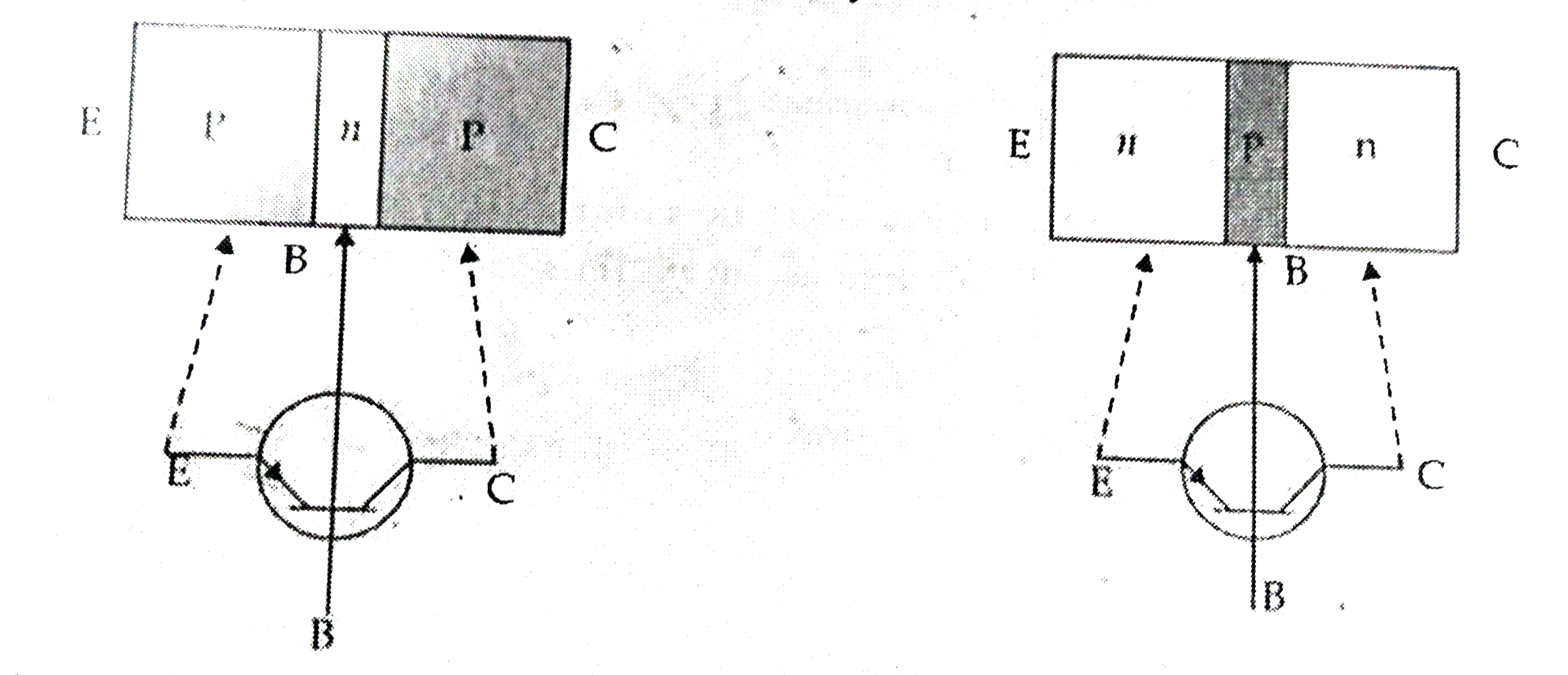
(a) Emitter (E) : It is the left hand side thick layer of the transistor, which is heavily doped.

Base (B) : It is the central thin layer of the transistor, which is lightly doped.
Collector (C) - It is the right hand side thick layer of the transistor, which is moderately dope.
(b) There are two conditions for a transistor to be into an active region.
1. The input circuit should be forwed biased by using a low voltage battery.
2. The output circuit should be reverse biased by using a high voltage battery.
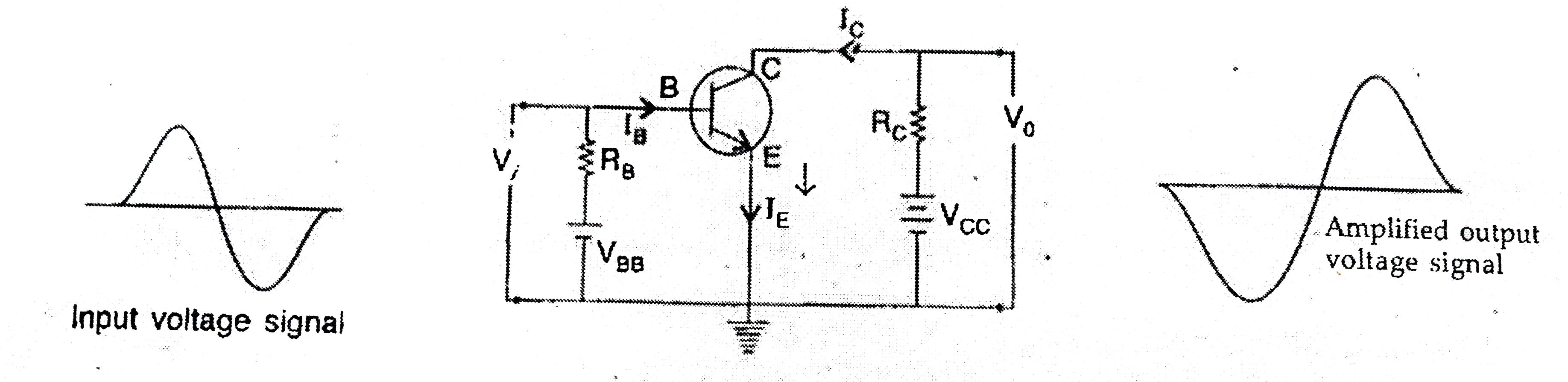
(c) C.E. configuration (Transistor as an Amplifier). The current diagram of a common emitter amplifier using n-p-n transistor is shown in Figure.

The input (base-emitter) circuit is forwed biased and the output (collector-emiiter) circuit is reverse blased.
When no a.c. signal is applied, the potential difference `V_("CC")` between the collector and emitter is given by
`V_("CC")=V_(CB)+I_(C)R_(C)`.
When an a.c. signal is fed to the input circuit, the forward bias increases during the positive half cycle of the input. This results in increases in `I_(C)` and decrease in `V_("CC")`. Thus, during positive half cycle of the input, the collector becomes less positive.
During the negative half cycle of the input, the forward bias is decreased resulting in decrease in `I_(E)` and hence `I_(C)`. Thus `V_("CC")` would increase making the collector more positive. Hence in a common-emitter amplifier, the output voltage is `180^(@)` out of phase with the input voltage.
(i) Input signal voltage `V_(i)=I_(B)R_(B)`.
(ii) Output signal voltage `V_(0)=I_(C)R_(C)`.
(iii) Voltage gain `(A_(V))` of the amplifier is
`A_(V)=(V_(0))/(V_(i))=(I_(C)R_(C))/(I_(V)R_(B))=beta((R_(C))/(R_(B)))...[becausebeta=(I_(C))/(I_(B))]`
Promotional Banner

Topper's Solved these Questions

  • XII BOARDS

    XII BOARD PREVIOUS YEAR PAPER ENGLISH|Exercise [SET - II DELHI BOARD]|5 Videos
  • XII BOARDS

    XII BOARD PREVIOUS YEAR PAPER ENGLISH|Exercise [SET - III, DELHI BOARD]|6 Videos
  • XII BOARDS

    XII BOARD PREVIOUS YEAR PAPER ENGLISH|Exercise SET-II|33 Videos
  • SAMPLE PAPER 2019

    XII BOARD PREVIOUS YEAR PAPER ENGLISH|Exercise SECTION D|6 Videos

Similar Questions

Explore conceptually related problems

Give a circuit diagram of a common emitter amplifier using an n-p-n transistor. Draw the input and output wavefroms of the signal. Write the expression for its voltage gain.

Draw a circuit diagram of n-p transistor amplifier in CE configuration. Under what condition does the transistor acts as an amplifier?

Draw a circuit diagram of C.E. transistor amplifier. Briefly explain its working and write the expression for (i) current gain (ii) voltage gain of the amplifier.

Draw a labelled circuit diagram of n - p - n germanium transistor in common emitter configuration. Explain briefly, how this transistor is used as a voltage amplifier.

(i) Draw a circuit diagram to study the input and output characteristics of an n-p-n transistor in its common emitter configuration. Draw the typical input and output characteristics. (ii) Explain, with the hepl of a circuit diagram, the working of n-p-n transistor as a common emitter amplifier.

(a) Describe briefly the functions of the three segments of n-p-n transistor. (b) Draw the circuit arrangment for studying the output characterstics of n-p-n transistor in CE configuration. Explain how the output characterstics is obtained.

Describe briefly with the help of a circuit diagram, how the flow of current carriers in a p-n-p transistor is regulated with emitter-base junction forward biased and base-collector junction reverse biased.

In the following common emitter configuration an n-p-n transistor with current gain beta=100 is used. What is the output voltage of the amplifier ?

(i) Write the functions of three segments of a transistor. (ii) Draw the ciruit diagram or studying the input and output characteristics of n-p-n transisfor in common emitter configuration . Using the circuit explain how input characteristics are obtained .

Draw the typical input and output characterisitics of an n-p-n transistor in CE configurtion . Show how these characteristic can be used to determine (a) the input resistance (r_(1)) and (b) current amplification factor (beta) .

XII BOARD PREVIOUS YEAR PAPER ENGLISH-XII BOARDS-[SET - I]
  1. Given a uniform electric field vecE=5xx10^(3)hatiN//C, find the flux o...

    Text Solution

    |

  2. For a single slit of width ''a'' the first minimum of the interference...

    Text Solution

    |

  3. Write the truth table for the combination of the getes shown. Name the...

    Text Solution

    |

  4. Identify the logic gates marked P and Q in the circuit Fig. Write the ...

    Text Solution

    |

  5. A proton and deuteron are accelerated through the same accelerating po...

    Text Solution

    |

  6. (i) Mono chromatic light of frequency 6.0xx10^(14)Hz is produced by a ...

    Text Solution

    |

  7. A 12.5 eV electron beam is used to bombard gaseous hydrogen at room te...

    Text Solution

    |

  8. When Sunita, a class XII student, came to know that her parents are pl...

    Text Solution

    |

  9. A potentiometer wire of length 1 m has a resistance of 10Omega. It is ...

    Text Solution

    |

  10. (a) Draw a labelled ray diagram showing the formation of a final image...

    Text Solution

    |

  11. (a) A mobile phone lies along the principal axis of a concave mirror. ...

    Text Solution

    |

  12. Derive an expression for the magnetic moment (vec mu) of an electron r...

    Text Solution

    |

  13. (a) State Ampere's circuital law, expressing it in the integral form. ...

    Text Solution

    |

  14. Answer the following : (a) Name the em waves which are suitable for ...

    Text Solution

    |

  15. Deduce the expression, N=N(0)^(-lambdat) for the law of radioactive de...

    Text Solution

    |

  16. (a) How does one demonstrate, using a suitable diagram, that unpolaris...

    Text Solution

    |

  17. (a) Describe a simple experiment (or activity) to show that the polari...

    Text Solution

    |

  18. Draw a schematic sketch of an generator describing its basic elements....

    Text Solution

    |

  19. Using the necessary circuit diagram, show how the V-I characteristics ...

    Text Solution

    |

  20. (a) Differentiate between three segments of a transistor on the basis ...

    Text Solution

    |