Home
Class 10
PHYSICS
A student is viewing under a microscope ...

A student is viewing under a microscope a permanent slide showing various stages of asexual reproduction by building in yeast. Draw diagrams of what he observes. (In proper sequence)

Text Solution

Verified by Experts
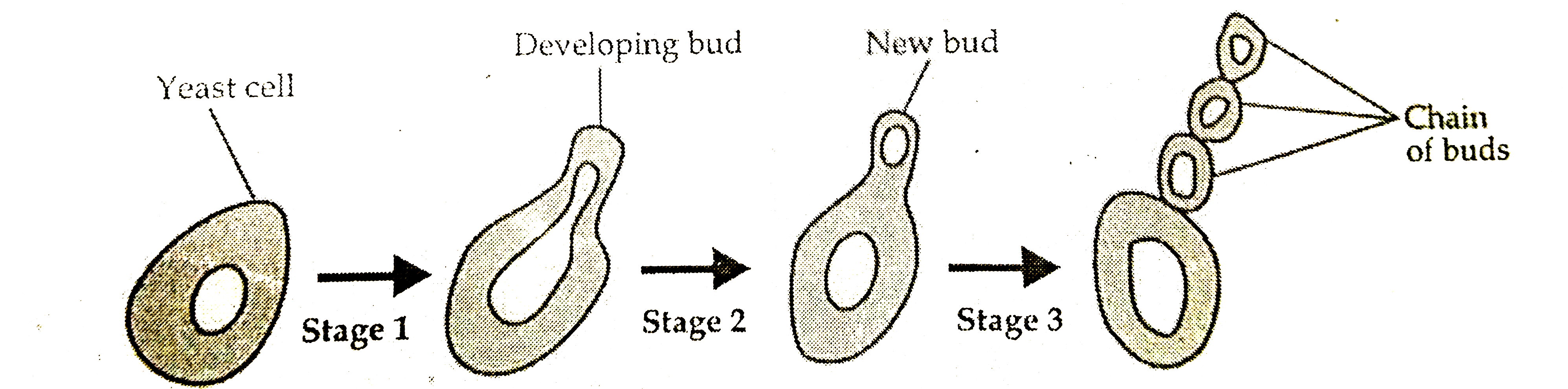
The process of reprodution in yeast is budding.
Promotional Banner

Similar Questions

Explore conceptually related problems

Draw diagrams showing reproduction in yeast in proper sequence.

Draw a labelled diagram of a sectional view of human ovary showing various stages of follicles growing in it.

A student is observing the temporary mount of a leaf peel under a microscope. Draw labelled diagram of the structure (of stomata) as seen under the microscope.

A student was given a sample of two tissues. He observes the tissues under the microscope and draws their figures (1 and 2) as shown below . Identify the tissues (1 and 2)

A student measures the thickness of a human hair using a microscope of magnification 100. He makes 20 observations and find that the average thickness (as viewed in the microscope) is 3.5 mm. What is the estimate of the thickness of hair?

Given below are diagrams showing the different stages in the process of fertilisation of an egg in the human female reproductive tract. Study the diagrams and answer the questions (i) Arrange the letters given below each diagram in a logical sequence to show the correct order in the process of fertilisation. (ii) Where does fertilisation normally take place? What is 'Implantation' that follows fertilisation ? (iii) Mention the chromosome number of the egg and zygote in humans. (iv) Explain the term 'Gestation'. How long does Gestation last in humans ? (v) Draw a neat, labelled diagram of a mature human sperm.

A student wants to project the image of a candle flame on a screen 60cm in front of a mirror by keeping the flame at a distance of 15 cm from its pole. (i) Write the type of mirror he should use. (ii) Find the liner magnification of the image produced. (iii) What is the distance between the object and its image ? (iv) Draw a ray diagram to show the image formation in this case.

A student focussed the flame of a candle on a screen with the help of a convex lens. He noted the positions of candle, lens and screen on the scale as given below: Position of candle = 14.0 cm, Position of convex lens = 50.0 cm, Position of screen = 86.0 cm (i) Find the focal length of the lens. (ii) If under the given condition, height of the flame is 1.5 cm, what would be the height of image obtained on the screen? (iii) If he displaces the candle to 32.0 cm, where will the image be formed and what will be its nature? Give reason for your answer. (iv) After this if he further displaces the candle towards the lens, what will be the nature of the image formed and where will it be? (v) Draw a ray diagram to show the formation of image in the above mentioned case. [Hints. (i) u = (50-14) cm = 36 cm, v = (86 - 50) cm = 36 cm. Thus the object is at 2f. Therefore f = 18cm (ii) Height will be same, i.e., 1.5 cm (iii) u = 50-32 = 18 cm. Thus, object will be at focus. Therefore, image will be at infinity and is real, inverted and enlarged. (iv) Object will come in between focus and optical centre. Image will be virtual, erect and enlarged and formed on the same side of lens as the object.

Tarun observed a slide of white blood cells under microscope. His teacher asked him to draw the diagram. Select the diagram which should be drawn by Tarun.

