Home
Class 12
MATHS
Using lim(theta -> 0) (sintheta/theta)=...

Using `lim_(theta -> 0) (sintheta/theta)=1` prove that the area of circle of radius `R` is `piR^2` (Figure)

Text Solution

Verified by Experts
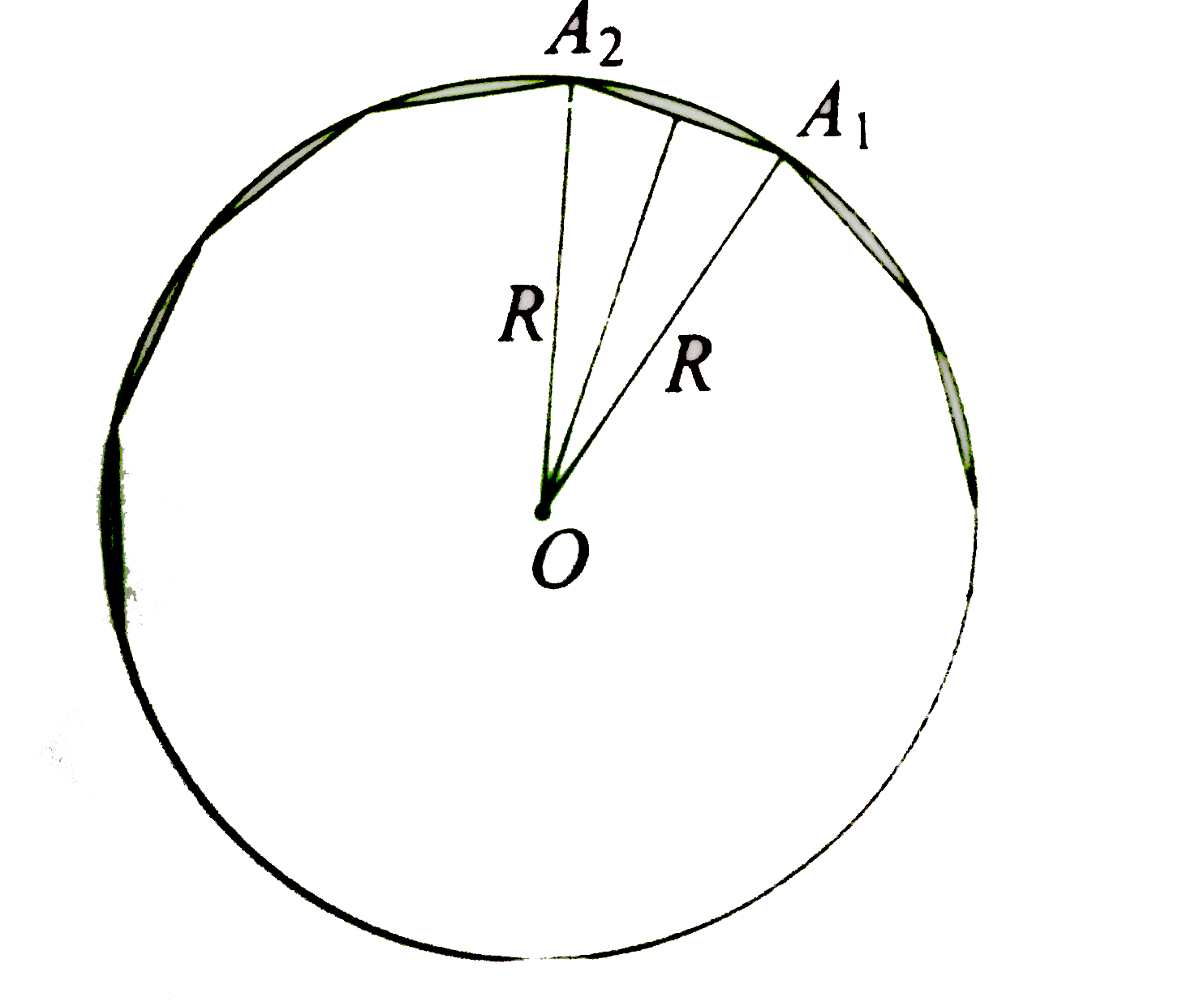
In the following figure regular polygon on n sides is inscribed in the circle of radius R.

In the figure, `OA_(1)=OA_(2)=R" and "angleA_(1)OA_(2)=2pi//n` Clearly area of polygon
`Delta=nxx("Area of the "DeltaOA_(1)A_(2))`
`=nxx(1)/(2)RxxRxx"sin"(2pi)/(n)`
`:. " "Delta=(nR^(2))/(2)"sin"(2pi)/(n)`
We know that circle is regular palygon having infinite number of sides. So, from above formula
`underset(ntooo)lim(nR^(2))/(2)"sin"(2pi)/(n)=underset(ntooo)limpiR^(2)("sin"(2pi)/(n))/((2pi)/(n))`
`piR^(2)underset(ntooo)lim("sin"(2pi)/(n))/((2pi)/(n))`
`=piR^(2)xx1" "( :.underset(thetato0)lim(sintheta)/(theta)=1)`
`=piR^(2)`
Thus, area of circle having radius R is `piR^(2).`
Promotional Banner

Topper's Solved these Questions

  • LIMITS

    CENGAGE ENGLISH|Exercise Solved Examples|15 Videos
  • LIMITS

    CENGAGE ENGLISH|Exercise EXERCISE 2.1|10 Videos
  • JEE 2019

    CENGAGE ENGLISH|Exercise Chapter 10|9 Videos
  • LINEAR COMBINATION OF VECTORS, DEPENDENT AND INDEPENDENT VECTORS

    CENGAGE ENGLISH|Exercise DPP 1.2|10 Videos

Similar Questions

Explore conceptually related problems

If sintheta+sin^2theta=1 , prove that cos^2theta+cos^4theta=1

int_0^(pi//2)(theta/sintheta)^2d theta=

Prove: (sintheta)/(1-costheta)=cos e c\ theta+cottheta

Statement 1 lim_(x to pi//2)(sin(cot^(2)x))/((pi-2x)^(2))=1/2 Statement 2: lim_(theta to 0)(sin theta)/(theta)=1 and lim_(theta to 0)(tan theta)/(theta)=1 , where theta is measured in radians.

lim_( r to 0) pir^(2)

Prove: (1+costheta-sin^2theta)/(sintheta(1+costheta))= cottheta

If 3tan^(2)theta-2sintheta=0 , then general value of theta is:

Simplify: (1+tan^(2)theta)(1-sintheta)(1+sintheta)

Write the formula for the area of a sector of angle theta (in degrees) of a circle of radius r .

(lim)_(theta->pi//2)(1-sintheta)/((pi//2-theta)costheta) is equal to a. 1 b. -1 c. -1/2 d. 1/2

