Home
Class 12
MATHS
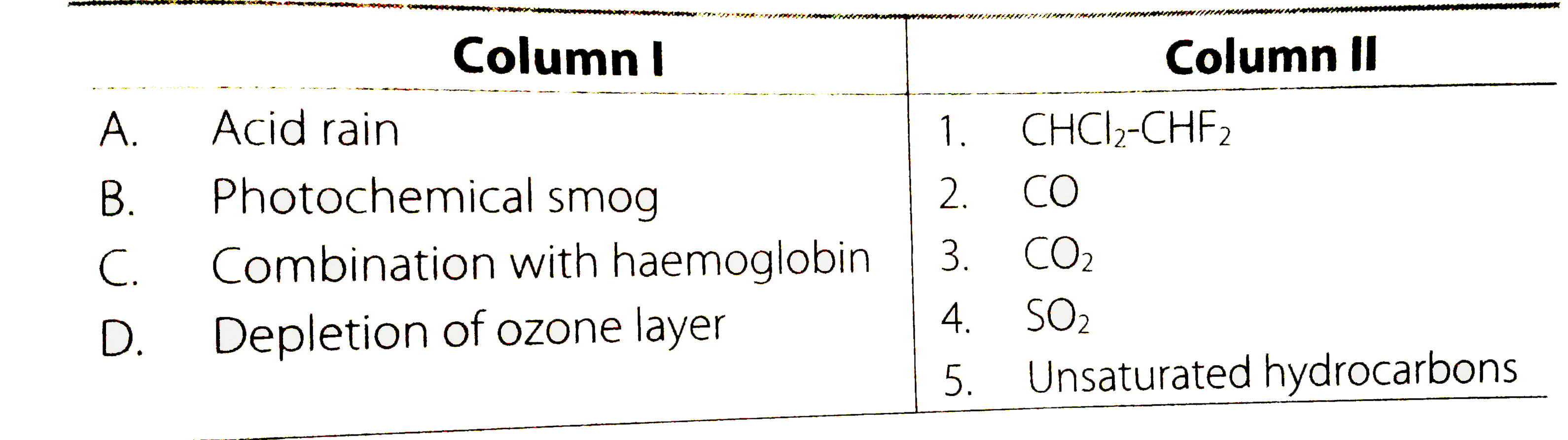
Match the terms given in Column I with t...

Match the terms given in Column I with the compound given in Column II.

Text Solution

Verified by Experts

The correct Answer is:

4

a. Let `f(x)=ax^(2)+bx ( :' f(0)=0)`
Given `int_(0)^(1)f(x)dx=1`
`=2a+3b=6`
`=(a,b)=(0,2)` and `(3,0)`
b. `f(x)=sin(x^(2))+cos(x^(2))`
`=sqrt(2)cos(x^(2)-(pi)/4)`
For maximum value `x^(2)-(pi)/4=2n pi, n epsilonZ`
`impliesx^(2)=2n pi+(pi)/4,n epsilon Z`
`implies x=+-sqrt(x/4)+-sqrt((9pi)/4)` as `x epsilon[-sqrt(13),sqrt(13)]`
c. `I=int_(-2)^(2)(3x^(2))/((1+e^(x)))dx`...............1
`=int_(-2)^(2)(3(-x)^(2))/(1+e^(-x))dx`
`:. I=int_(-2)^(2)(e^(x)(3x)^(2))/(e^(x)+1)dx`............2
Addding 1 and 2
`impliesI+I=int_(-2)^(2)(3x^(2))/((1+e^(x)))dx+int_(-2)^(2)(e^(x)(3x^(2)))/(e^(x)+1)dx`
`=int_(-2)^(2)3x^(2)dx=2int_(0)^(2)3x^(2)dx=16`
`implies I=8`
d. We have `I=(int_(1//2)^(1//2)cos2x.log((1+x)/(1-x))dx)/(int_(0)^(1//2)cos2x.log((1+x)/(1-x))dx)`
Let `f(x)=cos2xI((1+x)/(1-x))`
`:.f(-x)=cos(-2x)In((1-x)/(1+x))`
`=-cos(2x)In((1+x)/(1-x))=-f(x)`
Thus, `f(x)` is an odd function.
`impliesI=0`
Promotional Banner

Topper's Solved these Questions

  • DEFINITE INTEGRATION

    CENGAGE ENGLISH|Exercise JEE MAIN|12 Videos
  • CURVE TRACING

    CENGAGE ENGLISH|Exercise EXERCISES|24 Videos
  • DETERMINANT

    CENGAGE ENGLISH|Exercise Multiple Correct Answer|5 Videos

Similar Questions

Explore conceptually related problems

Match the terms given in Column I with the items given in Column II. (One to one match only)

Match the terms given in column I with the units given in column II.

Match the terms given in Column-I with their descriptions given in Column-II and select the correct option from the codes given below.

Match the reactions given in Column I with the names given in Column II.

match the items given in column I with the items given in column II.

Match the property given in Column I with the element given in Column II.

match the items given in column I with the items given in column II.

Match the reactions given in Column I with the names givn in Column II.

Match the statement given in Column I with the phenomenon given in Column II.

Match the properties given in Column I with the metals given in Column II.

CENGAGE ENGLISH-DEFINITE INTEGRATION -JEE ADVANCED
  1. find the period of sin(x/2)-cos(x/3) is

    Text Solution

    |

  2. Let f: Rvec(0,1) be a continuous function. Then, which of the followin...

    Text Solution

    |

  3. If Isum(k=1)^(98)intk^(k+1)(k+1)/(x(x+1))dx ,t h e n: (a) I<(49)/(50...

    Text Solution

    |

  4. If g(x)=int(sinx)^("sin"(2x))sin^(-1)(t)dt ,t h e n : (a) g^(prime)(...

    Text Solution

    |

  5. Given that for each a epsilon(0,1),lim(hto 0^(+)) int(h)^(1-h)t^(-a)(1...

    Text Solution

    |

  6. Given that for each a epsilon(0,1),lim(hto 0^(+)) int(h)^(1-h)t^(-a)(1...

    Text Solution

    |

  7. Let F:RtoR be a thrice differntiable function. Suppose that F(1)=0,F(3...

    Text Solution

    |

  8. Let F:RtoR be a thrice differntiable function. Suppose that F(1)=0,F(3...

    Text Solution

    |

  9. Match the terms given in Column I with the compound given in Column II...

    Text Solution

    |

  10. For any real number x, let [x] denote the largest integer less than or...

    Text Solution

    |

  11. Let y^(prime)(x)+y(x)g^(prime)(x)=g(x)g^(prime)(x),y(0),x in R , wher...

    Text Solution

    |

  12. The value of int0^1 4x^3{(d^2)/(dx^2)(1-x^2)^5}dx is

    Text Solution

    |

  13. Let f: R rarr R be a continuous odd function, which vanishes exactly a...

    Text Solution

    |

  14. If alpha=int0^1(e^(9x+3tan^(-1)x))((12+9x^2)/(1+x^2))dx where tan^(-1)...

    Text Solution

    |

  15. Let F(x)=intx^[x^2+pi/6](2cos^2t)dt for all x in R and f:[0,1/2] -> [0...

    Text Solution

    |

  16. Let f: RvecR be a function defined by f(x)={[x],(xlt=2) \ \ (0,x >2) ...

    Text Solution

    |

  17. The total number for distinct x epsilon[0,1] for which int(0)^(x)(t^(2...

    Text Solution

    |

  18. Let f: R -> R be a differentiable function such that f(0) = 0,f(pi/2)=...

    Text Solution

    |

  19. For each positive integer n , let yn=1/n((n+1)(n+2)dot(n+n))^(1/n) ...

    Text Solution

    |

  20. The value of the integral int0^(1/2)(1+sqrt(3))/(((x+1)^2(1-x)^6)^(...

    Text Solution

    |
