Home
Class 12
MATHS
A B C D is a square whose vertices are A...

`A B C D` is a square whose vertices are `A(0,0),B(2,0),C(2,2),` and `D(0,2)` . The square is rotated in the `X Y-p l a n e` through an angle `30^0` in the anticlockwise sense about an axis passing though `A` perpendicular to the `X Y-p l a n e` . Find the equation of the diagonal `B D` of this rotated square.

Text Solution

Verified by Experts
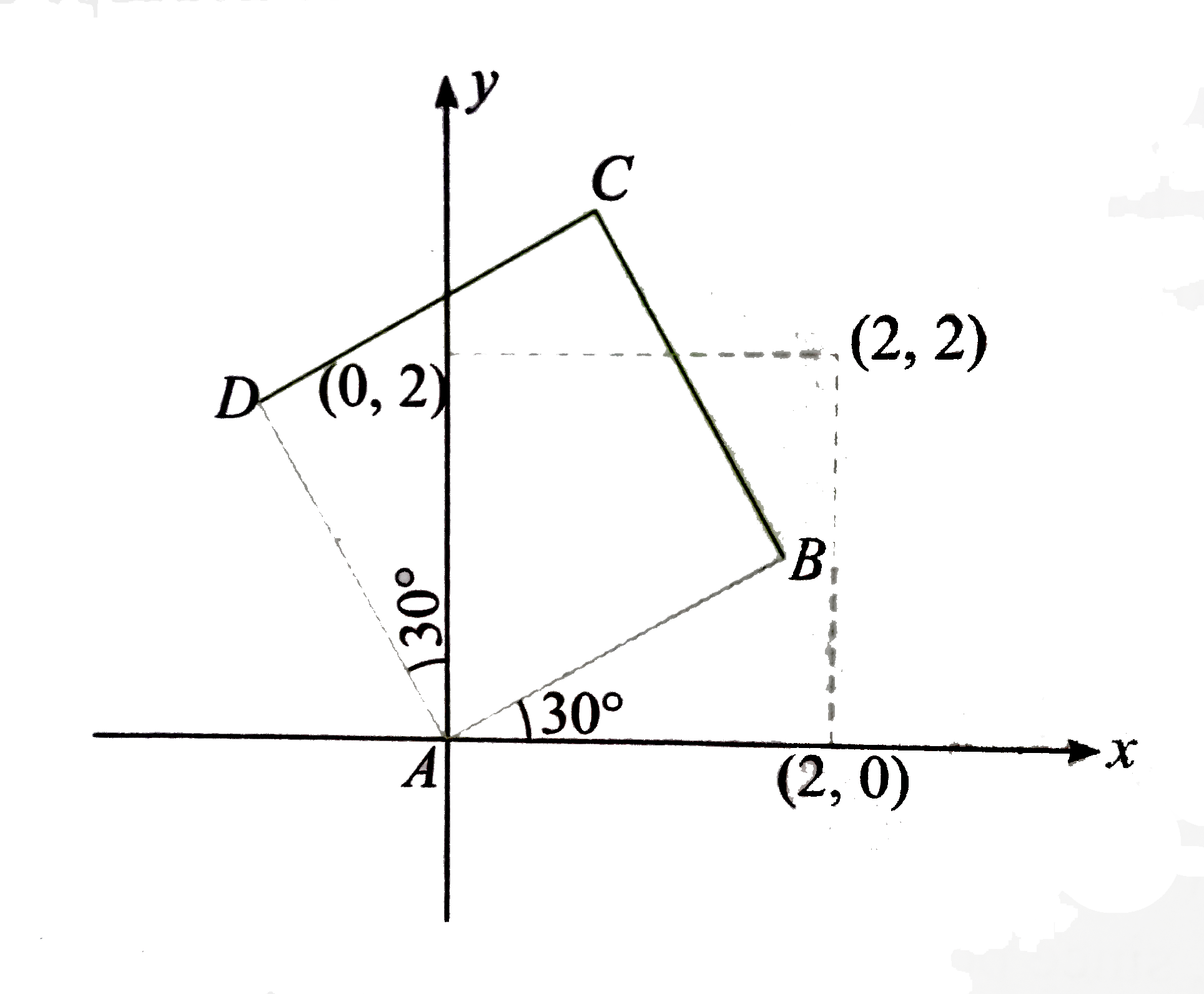
We have
`"B" -= (2cos 30^(@), 2sin 30^(@)) = (sqrt(3),1)`
`"D" -= (-2 sin 30^(@), 2 cos 30^(@)) = (-1, sqrt(3))`
Hence, the equation of BD is

`y-1 = (sqrt(3)-1)/(-(sqrt(3) + 1))(x-sqrt(3))`
`=(sqrt(3)-2)(x-sqrt(3))`
i.e., `(2-sqrt(3))x+y = 2sqrt(3) - 2`
Promotional Banner

Topper's Solved these Questions

  • STRAIGHT LINES

    CENGAGE ENGLISH|Exercise EXAMPLE|12 Videos
  • STRAIGHT LINES

    CENGAGE ENGLISH|Exercise CONCEPT APPLICATION EXERCISE 2.1|23 Videos
  • STRAIGHT LINE

    CENGAGE ENGLISH|Exercise Multiple Correct Answers Type|8 Videos
  • THEORY OF EQUATIONS

    CENGAGE ENGLISH|Exercise JEE ADVANCED (Numerical Value Type )|1 Videos

Similar Questions

Explore conceptually related problems

Show that the points A(2, 1), B(0,3), C(-2, 1) and D(0, -1) are the vertices of a square.

The line segment joining A(3, 0) and B(5, 2) is rotated about A in the anticlockwise direction through an angle of 45^0 so that B goes to C . If D is the reflection of C in y-axis, find the coordinates of D .

The area (in square units ) of the triangle formed by y-axis , the straight line L passing through (1,1) and (2,0) and the straight line perpendicular to the line L and passing through (1/2, 0) , is

Find the equation of a straight line passing through the point of intersection of x+2y+3=0\ a n d\ 3x+4y+7=0 and perpendicular to the straight line x-y+9=0.

The line P Q whose equation is x-y=2 cuts the x-axis at P ,a n dQ is (4,2). The line P Q is rotated about P through 45^0 in the anticlockwise direction. The equation of the line P Q in the new position is y=-sqrt(2) (b) y=2 x=2 (d) x=-2

A B C is an equilateral triangle with A(0,0) and B(a ,0) , (a>0). L, M and N are the foot of the perpendiculars drawn from a point P to the side A B ,B C ,a n dC A , respectively. If P lies inside the triangle and satisfies the condition P L^2=P MdotP N , then find the locus of Pdot

A B C is an equilateral triangle with A(0,0) and B(a ,0) , (a>0). L, M and N are the foot of the perpendiculars drawn from a point P to the side A B ,B C ,a n dC A , respectively. If P lies inside the triangle and satisfies the condition P L^2=P MdotP N , then find the locus of Pdot

Find the equation of the circle passing through the point of intersection of the lines x+3y=0\ a n d\ 2x-7y=0 and whose centre is the point of intersection of the lines x+y+1=0\ a n d\ x-2y+4=0.

The medians A D\ a n d\ B E of a triangle with vertices A(0, b),\ B(0,0)\ a n d\ C(a ,0) are perpendicular to each other, if a=b/2 b. b=a/2 c. a b=1 d. a=+-sqrt(2)b

Determine the point in X Y-p l a n e whcih is equidistant from three points A(2,0,3),B(0,3,2)a n dC(0,0,1)dot

