Home
Class 12
MATHS
A line L is a drawn from P(4,3) to meet ...

A line `L` is a drawn from `P(4,3)` to meet the lines `L-1a n dL_2` given by `3x+4y+5=0` and `3x+4y+15=0` at points `Aa n dB` , respectively. From `A` , a line perpendicular to `L` is drawn meeting the line `L_2` at `A_1dot` Similarly, from point `B_1dot` Thus, a parallelogram `AA_1B B_1` is formed. Then the equation of `L` so that the area of the parallelogram `AA_1B B_1` is the least is `x-7y+17=0` `7x+y+31=0` `x-7y-17=0` `x+7y-31=0`

Text Solution

Verified by Experts
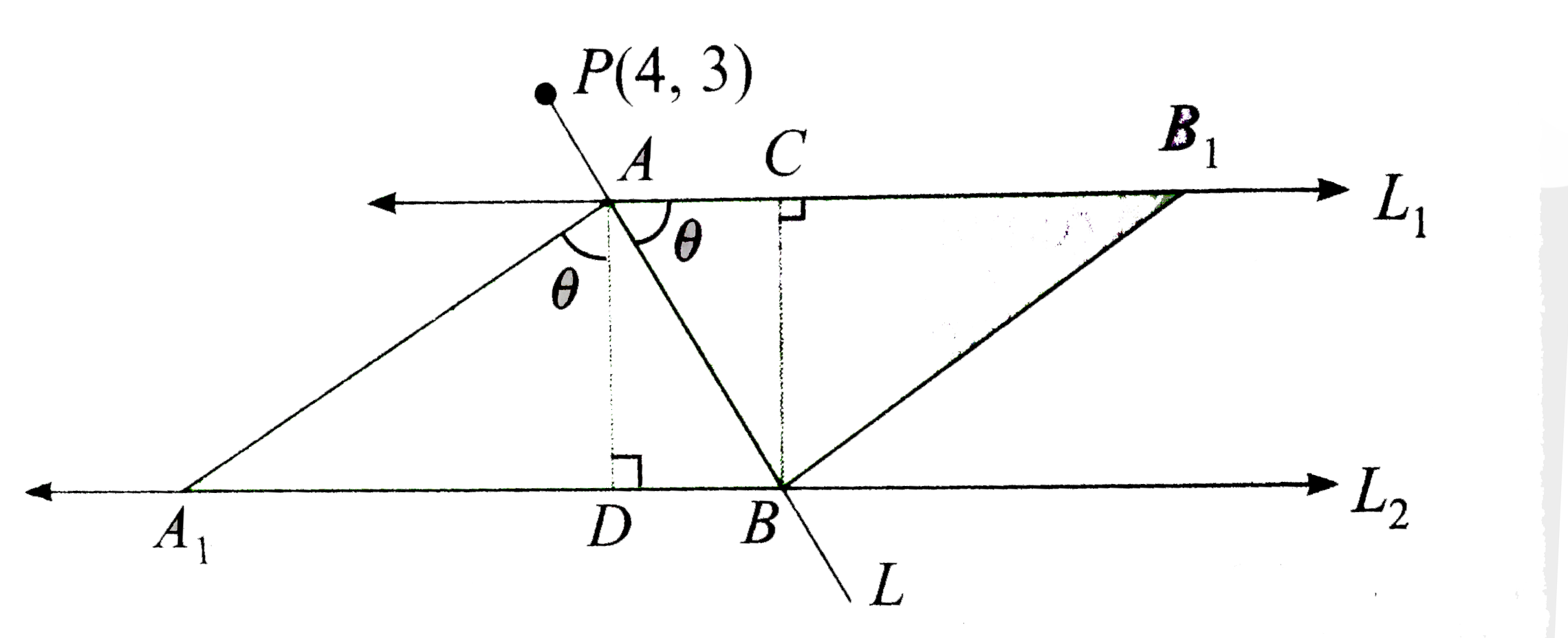

The given lines `(L_(1) " and" L_(2))` are parallel and the distance between them (BC or AD) is (15-5)/5 = 0 units. Let `angle BAC = theta.` So, AB = BC cosec `theta = 2` cosec `theta " and AA"_(1) = AD " sec " theta = 2 " sec " theta.` Now, the area of parallelogram `"AA"_(1)BB_(1)` is
`Delta = AB xx "AA"_(1) = 4 "sec " theta " cosec" theta`
` = (8)/("sin" 2 theta)`
` " Clearly", Delta " is the least for" theta = pi//4. " Let the slope of AB be m. Then,"`
`tan45^(@) = |(m+3//4)/(1-(3m//4))|`
` " or " 4m+3= +-(4-3m) or m = (1)/(7) or -7`
Hence, the equation of L is
x-7y+17=0
or 7x + y -31=0
Promotional Banner

Topper's Solved these Questions

  • STRAIGHT LINES

    CENGAGE ENGLISH|Exercise EXAMPLE|12 Videos
  • STRAIGHT LINES

    CENGAGE ENGLISH|Exercise CONCEPT APPLICATION EXERCISE 2.1|23 Videos
  • STRAIGHT LINE

    CENGAGE ENGLISH|Exercise Multiple Correct Answers Type|8 Videos
  • THEORY OF EQUATIONS

    CENGAGE ENGLISH|Exercise JEE ADVANCED (Numerical Value Type )|1 Videos

Similar Questions

Explore conceptually related problems

A line is a drawn from P(4,3) to meet the lines L_1 and l_2 given by 3x+4y+5=0 and 3x+4y+15=0 at points A and B respectively. From A , a line perpendicular to L is drawn meeting the line L_2 at A_1 Similarly, from point B_1 Thus a parallelogram AA_1 B B_1 is formed. Then the equation of L so that the area of the parallelogram AA_1 B B_1 is the least is (a) x-7y+17=0 (b) 7x+y+31=0 (c) x-7y-17=0 (d) x+7y-31=0

A variable line L drawn through O(0,0) to meet line l1: y-x-10=0 and L2:y-x-20=0 at the point A and B respectively then locus of point p is ' such that (OP)^(2) = OA . OB,

Find the values of the parameter a so that the point (a, 2) is an interior point of the triangle formed by the lines x+y-4=0, 3x-7y-8=0and 4x-y-31 = 0.

A variable line L is drawn through O(0,0) to meet the line L_(1) " and " L_(2) given by y-x-10 =0 and y-x-20=0 at Points A and B, respectively. Locus of P, if OP^(2) = OA xx OB , is a. (y+x)^(2) = 50 b. (y-x)^(2) = 200 c. (y-x)^(2) = 100 d. none of these

Find the length of perpendicular drawn from point (2,-1) to the line 3x+4y-11=0 .

Find the equation of the line parallel to yaxis and drawn through the point of intersection of the lines x-7y+5=0 and 3x+y=0 .

A line through A(-5,-4) meets the lines x+3y+2=0,2x+y+4=0a n dx-y-5=0 at the points B , Ca n dD respectively, if ((15)/(A B))^2+((10)/(A C))^2=(6/(A D))^2 find the equation of the line.

A variable line L is drawn through O (0,0) to meet the lines L 1 ​ :y−x−10=0 and L 2 ​ :y−x−20=0 at the points A and B respectively. A point P is taken on L such that OP 2 ​ = OA 1 ​ + OB 1 ​ and P,A,B lies on same side of origin O. The locus of P is

Find the equation of the line parallel to y-axis and drawn through the point of intersection of the lines x-7y+5=0\ a n d\ 3x+y=0.

Find the equation of the line parallel to y-axis and drawn through the point of intersection of the lines x-7y+5=0\ a n d\ 3x+y=0.

