Home
Class 12
MATHS
Let A B C be a triangle with A B=A Cdot ...

Let `A B C` be a triangle with `A B=A Cdot` If `D` is the midpoint of `B C ,E` is the foot of the perpendicular drawn from `D` to `A C ,a n dF` is the midpoint of `D E ,` then prove that `A F` is perpendicular to `B Edot`

Text Solution

Verified by Experts
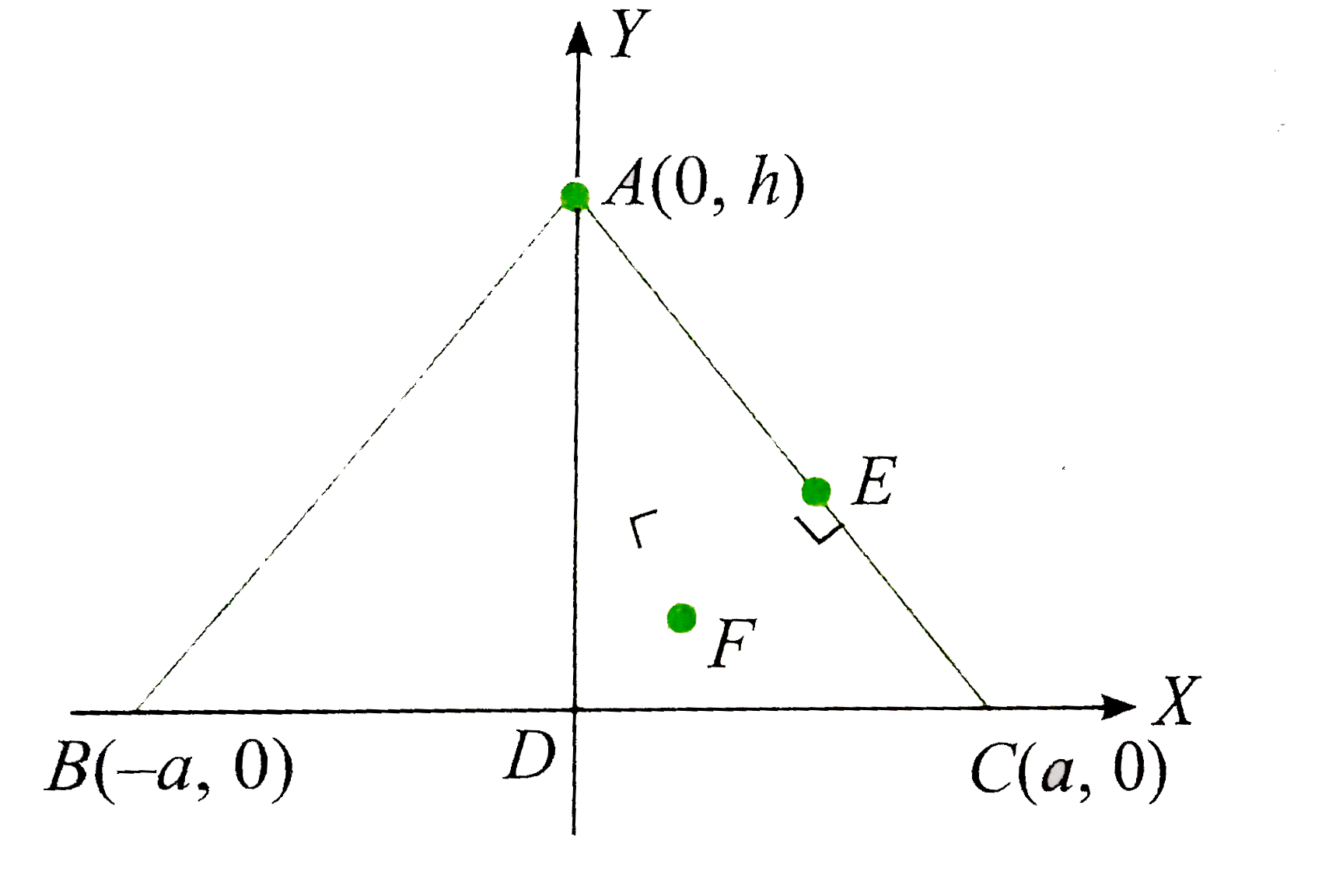

Let BC be taken as the x-axis with the origin at D. Let A be taken on y-axis. Let BC=2a. Now AB=AC, then the coordinates of B and C are (-a,0) and (a,0), respectively. Let DA =h. Then the coordiantes of A are (0,h).
Hene, the equation of AC is ltbgt `(x)/(a)+(y)/(h)=1 " " (1)`
and the equation of DE perpendicular to AC and passing through the origin is
`(x)/(h)-(y)/(a)=0`
`" or " x=(hy)/(a) " " (2)`
Solving (1) and (2), we get the coordinates of E as follows:
`(hy)/(a^(2)) +(y)/(h)=1`
`" or " h^(2)y+a^(2)y = a^(2)h`
`" or " y=(a^(2)h)/(a^(2) + h^(2)) `
`therefore x=(ah)/(a^(2) + h^(2)) `
`therefore E-=((ah^(2))/(a^(2) + h^(2)),(a^(2)h)/(a^(2) + h^(2))) `
Since F is the midpoint of DE, its coordinates are
`((ah^(2))/(2(a^(2) + h^(2))),(a^(2)h)/(2(a^(2) + h^(2)))) `
The slope of AF is
`m_(1) = (h-(a^(2)h)/(2(a^(2)+h^(2))))/(0-(ah^(2))/(2(a^(2)+h^(2))))`
`(2h(a^(2) +h^(2))-a^(2)h)/(-ah^(2)) = (a^(2) + 2h^(2))/(ah) " " (1)`
and the slope of BE is
`m_(2) = ((a^(2)h)/(a^(2)+h^(2))-0)/((ah^(2))/(a^(2)+h^(2)) + a)`
`= (a^(2)h)/(ah^(2)+a^(3)+ah^(2)) = (ah)/(a^(2)+2h^(2)) " " (2)`
From (1) and (2), we have
`m_(1)m_(2) = -1`
` " or " AF bot BE`
Promotional Banner

Topper's Solved these Questions

  • STRAIGHT LINES

    CENGAGE ENGLISH|Exercise CONCEPT APPLICATION EXERCISE 2.1|23 Videos
  • STRAIGHT LINES

    CENGAGE ENGLISH|Exercise CONCEPT APPLICATION EXERCISE 2.2|4 Videos
  • STRAIGHT LINES

    CENGAGE ENGLISH|Exercise ARCHIVES (NUMERICAL VALUE TYPE)|1 Videos
  • STRAIGHT LINE

    CENGAGE ENGLISH|Exercise Multiple Correct Answers Type|8 Videos
  • THEORY OF EQUATIONS

    CENGAGE ENGLISH|Exercise JEE ADVANCED (Numerical Value Type )|1 Videos

Similar Questions

Explore conceptually related problems

A B C is a triangle and D is the mid-point of B C . The perpendiculars from D to A B and A C are equal. Prove that the triangle is isosceles.

A B C is a triangle and D is the mid-point of B C . The perpendiculars from D to A B and A C are equal. Prove that the triangle is isosceles.

A B C is a triangle in which D is the mid-point of B C and E is the mid-point of A Ddot Prove that area of B E D=1/4a r e aof A B Cdot

In Figure, if A B||D C\ a n d\ P is the mid-point B D , prove that P is also the midpoint of A C

In Figure, A B C is a right triangle right angled at B and D is the foot of the the perpendicular drawn from B on A C . If D M_|_B C and D N_|_A B , prove that: (i) D M^2=D NxxM C (ii) D N^2=D MxxA N

Let A B C be an isosceles triangle with A B=A C and let D ,\ E ,\ F be the mid points of B C ,\ C A\ a n d\ A B respectively. Show that A D_|_F E\ a n d\ A D is bisected by F E .

In Figure, A D is a median and B L ,\ C M are perpendiculars drawn from B\ a n d\ C respectively on A D\ a n d\ A D produced. Prove that B L=C M

If A B C is an isosceles triangle with A B=A Cdot Prove that the perpendiculars from the vertices B\ a n d\ C to their opposite sides are equal.

O A B C is regular tetrahedron in which D is the circumcentre of O A B and E is the midpoint of edge A Cdot Prove that D E is equal to half the edge of tetrahedron.

O A B C is regular tetrahedron in which D is the circumcentre of O A B and E is the midpoint of edge A Cdot Prove that D E is equal to half the edge of tetrahedron.

