Home
Class 12
MATHS
For points P-=(x1,y1) and Q-=(x2,y2) of ...

For points `P-=(x_1,y_1)` and `Q-=(x_2,y_2)` of the coordinates plane, a new distance d (P,Q) is defined by `d(P,Q) =|x_1-x_2|+|y_1-y_2|`. Let `O-=(0,0)` and `A-=(3,2)`. Consider the set of points P in the first quadrant which are equidistant (with respect to the new distance) from O and A.
The set of poitns P consists of

A

one -one and onto function

B

many one and onto function

C

one-one and into function

D

relation but not function

Text Solution

Verified by Experts

The correct Answer is:
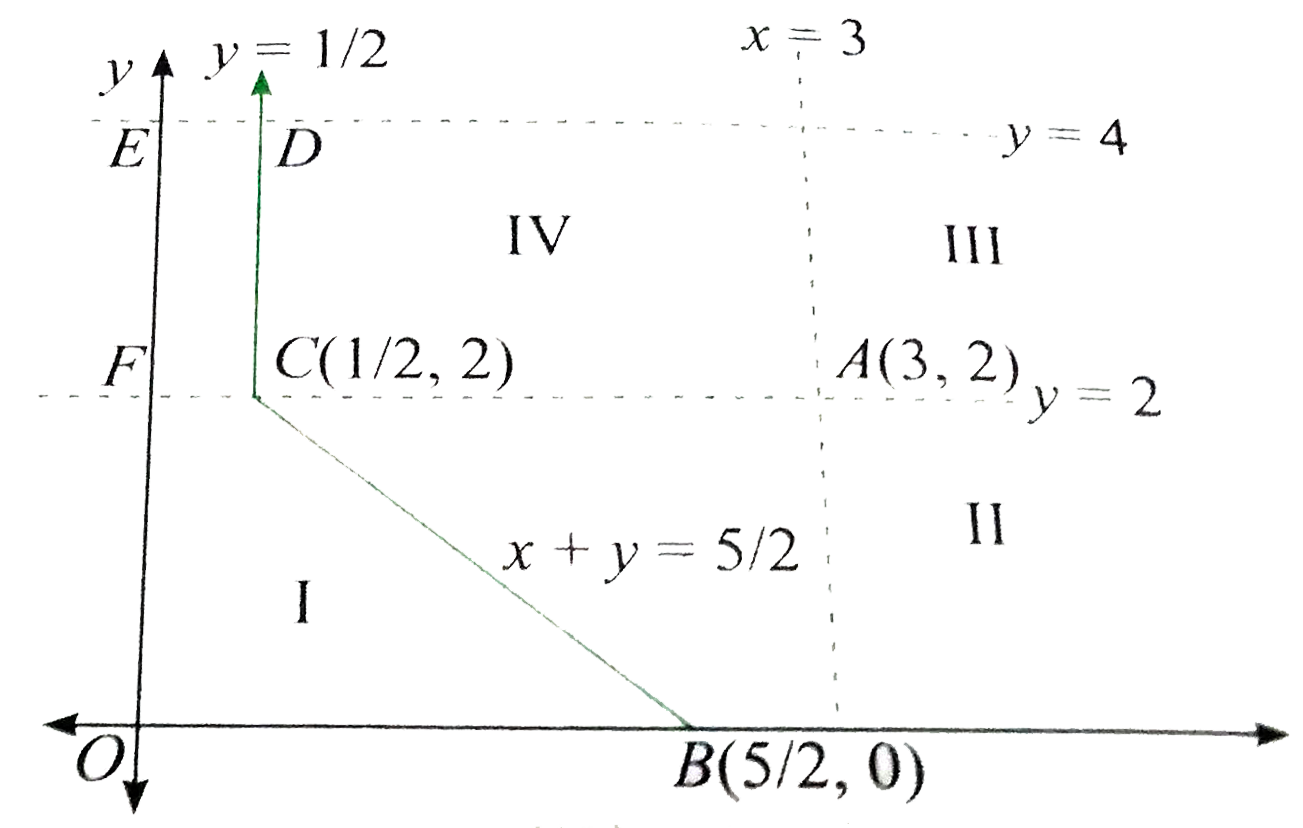
D


Obviously, the locus of P is a relation but not a function.
Promotional Banner

Topper's Solved these Questions

  • COORDINATE SYSYEM

    CENGAGE ENGLISH|Exercise Matrix match type|4 Videos
  • COORDINATE SYSYEM

    CENGAGE ENGLISH|Exercise Numerical value|12 Videos
  • COORDINATE SYSYEM

    CENGAGE ENGLISH|Exercise Multiple correct|13 Videos
  • COORDINATE SYSTEM

    CENGAGE ENGLISH|Exercise Multiple Correct Answers Type|2 Videos
  • CROSS PRODUCTS

    CENGAGE ENGLISH|Exercise DPP 2.2|13 Videos

Similar Questions

Explore conceptually related problems

For points P-=(x_1,y_1) and Q-=(x_2,y_2) of the coordinates plane, a new distance d (P,Q) is defined by d(P,Q) =|x_1-x_2|+|y_1-y_2| . Let O-=(0,0) and A-=(3,2) . Consider the set of points P in the first quadrant which are equidistant (with respect to the new distance) from O and A. The area of the ragion bounded by the locus of P and the line y=4 in the first quadrant is

For points P-=(x_1, y_1) and Q-=(x_2, y_2) of the coordinate plane, a new distance d(P ,Q)=|x_1-x_1|+|y_1-y_2| . Let O=(0,0) and A=(3,2) . Prove that the set of points in the first quadrant which are equidistant (with respect to the new distance) from O and A consists of the union of a line segment of finite length and an infinite ray. Sketch this set in a labelled diagram.

For points P -= (x_(1) ,y_(1)) and Q = (x_(2),y_(2)) of the coordinate plane , a new distance d (P,Q) is defined by d(P,Q) = |x_(1)-x_(2)|+|y_(1)-y_(2)| Let O -= (0,0) ,A -= (1,2), B -= (2,3) and C-= (4,3) are four fixed points on x-y plane Let R(x,y) such that R is equidistant from the point O and A with respect to new distance and if 0 le x lt 1 and 0 le y lt 2 , then R lie on a line segment whose equation is

For points P -= (x_(1) ,y_(1)) and Q = (x_(2),y_(2)) of the coordinate plane , a new distance d (P,Q) is defined by d(P,Q) = |x_(1)-x_(2)|+|y_(1)-y_(2)| . Let O -= (0,0) ,A -= (1,2), B -= (2,3) and C-= (4,3) are four fixed points on x-y plane Let S(x,y) such that S is equidistant from points O and B with respect to new distance and if x ge 2 and 0 le y lt 3 then locus of S is

For points P -= (x_(1) ,y_(1)) and Q = (x_(2),y_(2)) of the coordinate plane , a new distance d (P,Q) is defined by d(P,Q) = |x_(1)-x_(2)|+|y_(1)-y_(2)| Let O -= (0,0) ,A -= (1,2) B -= (2,3) and C-= (4,3) are four fixed points on x-y plane Le T(x,y) such that T is equisdistant from point O and C with respect to new distance and if T lie in first quadrant , then T consists of the union of a line segment of finite length and an infinite ray whose labelled diagram is

Q is the image of point P(1, -2, 3) with respect to the plane x-y+z=7 . The distance of Q from the origin is.

The point P(1,1) is transiated parallel to 2x=y in the first quadrant through a unith distance. The coordinates of the point in new position are

If O is the origin and P(x_(1),y_(1)), Q(x_(2),y_(2)) are two points then OPxOQ sin angle POQ=

Find the distance between P(x_1,\ y_1)a n d\ Q(x_2, y_2) when i. P Q is parallel to the y-axis ii. PQ is parallel to the x-axis.

If O be the origin and if P(x_1, y_1) and P_2 (x_2, y_2) are two points, the OP_1 (OP_2) sin angle P_1OP_2 , is equal to

