Home
Class 12
MATHS
If z(1), z(2) and z(3) are the vertices ...

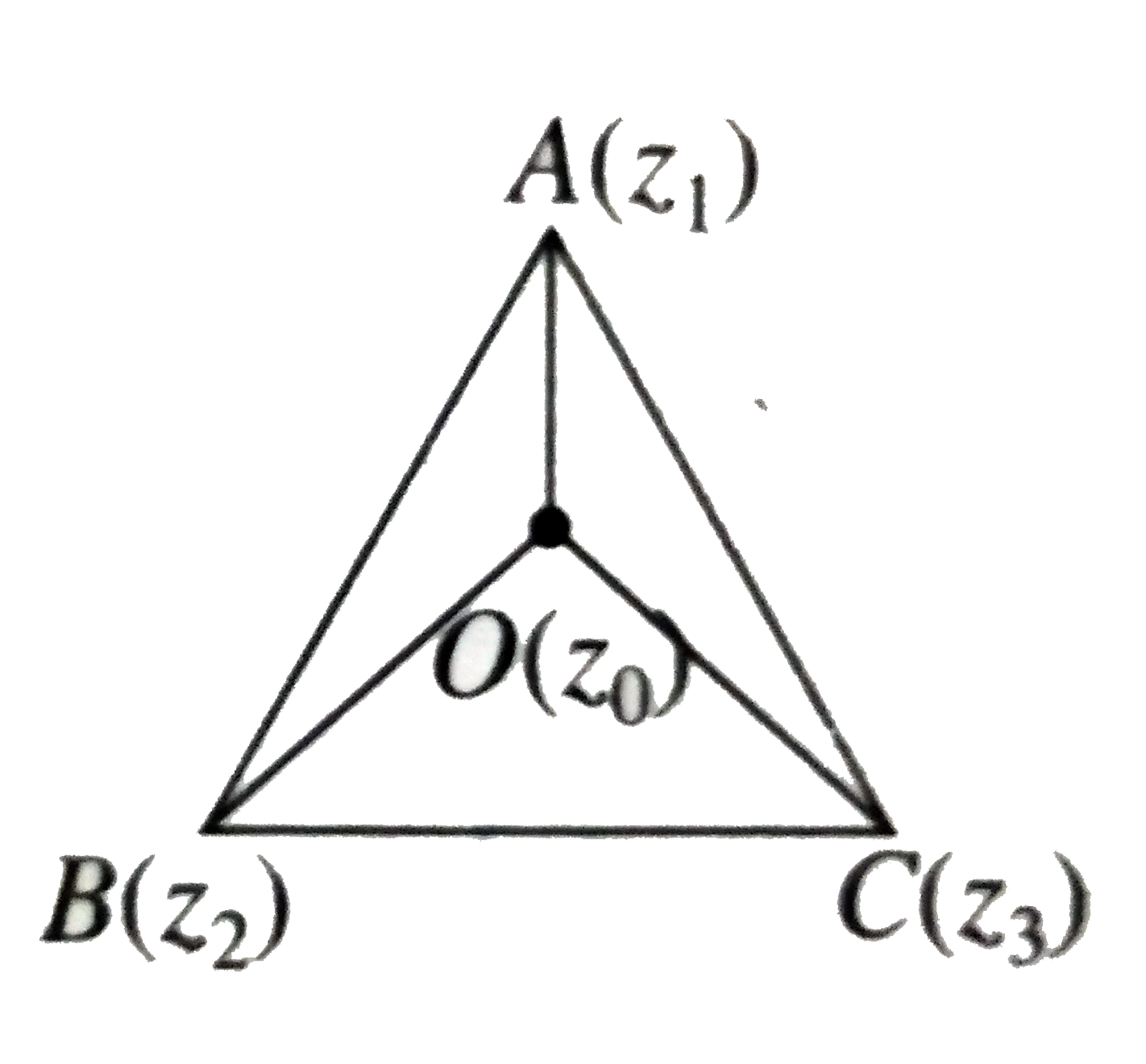
If `z_(1)`, `z_(2)` and `z_(3)` are the vertices of `DeltaABC`, which is not right angled triangle taken in anti-clock wise direction and `z_(0)` is the circumcentre, then `((z_(0)-z_(1))/(z_(0)-z_(2)))(sin2A)/(sin2B)+((z_(0)-z_(3))/(z_(0)-z_(2)))(sin2C)/(sin2B)` is equal to

A

`0`

B

`1`

C

`-1`

D

`2`

Text Solution

Verified by Experts

The correct Answer is:
C

`(c )` Takin rotation at `'O'` ltbr. `(z_(0)-z_(1))/(z_(0)-z_(2))=cos2C-isin2C`
`(z_(0)-z_(3))/(z_(0)-z_(2))=cos2A+isin2A`
Now `((z_(0)-z_(1))/(z_(0)-z_(2)))(sin2A)/(sin2B)+((z_(0)-z_(3))/(z_(0)-z_(2)))(sin2C)/(sin2B)`
`=sin2Acos2C-isin2Asin2C`
`=(+cos2Asin2C+isin2Asin2C)/(sin2B)`
`=(sin(2A+2C))/(sin2B)=-1`
Promotional Banner

Topper's Solved these Questions

  • COMPLEX NUMBERS

    CENGAGE ENGLISH|Exercise Multiple Correct Answer|11 Videos
  • COMPLEX NUMBERS

    CENGAGE ENGLISH|Exercise Comprehension|11 Videos
  • CIRCLES

    CENGAGE ENGLISH|Exercise Comprehension Type|8 Videos
  • CONIC SECTIONS

    CENGAGE ENGLISH|Exercise All Questions|101 Videos

Similar Questions

Explore conceptually related problems

If z_(1),z_(2),z_(3) are the vertices of an isoscles triangle right angled at z_(2) , then

z_(1),z_(2),z_(3) are the vertices of an equilateral triangle taken in counter clockwise direction. If its circumcenter is at (1-2i) and (z_(1)=2+i) , then z_(2)=

z_(1),z_(2),z_(3) are the vertices of an equilateral triangle taken in counter clockwise direction. If its circumference is at the origin and z_(1)=1+i , then

If the tangents at z_(1) , z_(2) on the circle |z-z_(0)|=r intersect at z_(3) , then ((z_(3)-z_(1))(z_(0)-z_(2)))/((z_(0)-z_(1))(z_(3)-z_(2))) equals

Complex numbers z_(1),z_(2)andz_(3) are the vertices A,B,C respectivelt of an isosceles right angled triangle with right angle at C. show that (z_(1)-z_(2))^(2)=2(z_1-z_(3))(z_(3)-z_(2)).

If z_(1),z_(2)andz_(3) are the affixes of the vertices of a triangle having its circumcentre at the origin. If zis the affix of its orthocentre, prove that Z_(1)+Z_(2)+Z_(3)-Z=0.

If z_(1),z_(2)andz_(3) are the vertices of an equilasteral triangle with z_(0) as its circumcentre , then changing origin to z^(0) ,show that z_(1)^(2)+z_(2)^(2)+z_(3)^(2)=0, where z_(1),z_(2),z_(3), are new complex numbers of the vertices.

Let the complex numbers z_(1),z_(2) and z_(3) be the vertices of an equailateral triangle. If z_(0) is the circumcentre of the triangle , then prove that z_(1)^(2) + z_(2)^(2) + z_(3)^(2) = 3z_(0)^(2) .

If arg (z_(1)z_(2))=0 and |z_(1)|=|z_(2)|=1 , then

Let A(z_(1)), B(z_(2)), C(z_(3) and D(z_(4)) be the vertices of a trepezium in an Argand plane such that AB||CD Let |z_(1)-z_(2)|=4, |z_(3),z_(4)|=10 and the diagonals AC and BD intersects at P . It is given that Arg((z_(4)-z_(2))/(z_(3)-z_(1)))=(pi)/2 and Arg((z_(3)-z_(2))/(z_(4)-z_(1)))=(pi)/4 Which of the following option(s) is/are correct?

