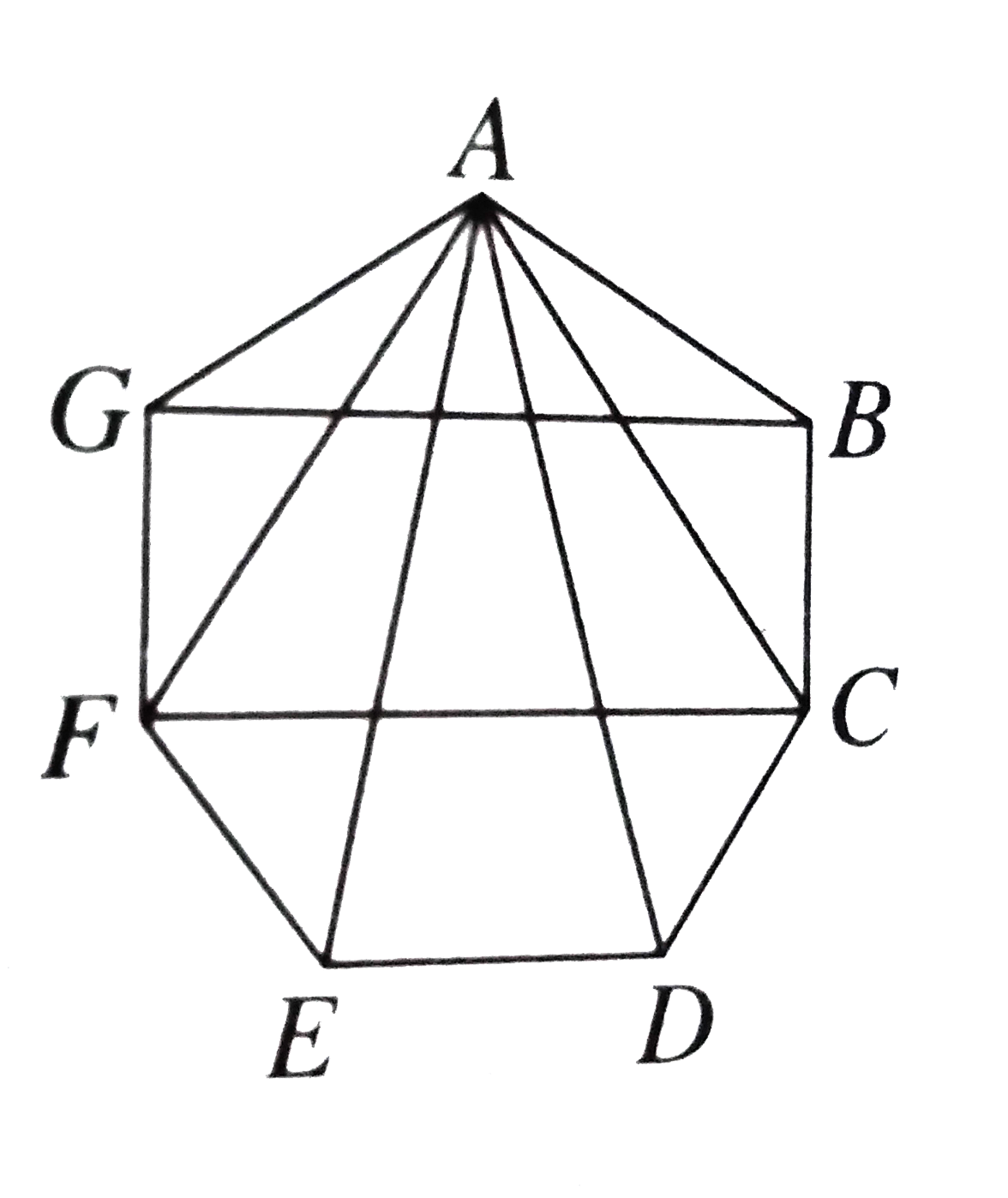
Three vertices are chosen randomly from the seven vertices of a regular `7`-sided polygon. The probability that they form the vertices of an isosceles triangle is
A
`(1)/(7)`
B
`(1)/(3)`
C
`(3)/(7)`
D
`(3)/(5)`
Text Solution
Verified by Experts
The correct Answer is:
D
`(d)` `DeltaAGB`, `DeltaAFC` and `DeltaAED` are isosceles `:. P=("^(7)C_(1)xx3)/('^(7)C_(3))=(7xx3)/((7xx6xx5)/(3xx2))=(3)/(5)`
Three vertices are chosen at random from the vertices of a regular hexagon then The probability that the triangle has exactly two sides common with the side of the hexagon is
Three of six vertices of a regular hexagon are chosen at random. Tie probability that the triangle formed by these vertices is an equilateral triangle is
Three of the six vertices of a regular hexagon are chosen the random. What is the probability that the triangle with these vertices is equilateral.
The locus of vertices of all isosceles triangles having a common base.
How many vertices are there in a triangle?
Check whether (5,-2), (6,4) and (7, -2) are the vertices of an isosceles triangle.
If the lengths of the sides of a triangle are decided by the three thrown of a single fair die,then the probability that the triangle is of maximum area given that it is an isosceles triangle, is
If four vertices a regular octagon are chosen at random, then the probability that the quadrilateral formed by them is a rectangle is
Prove that any four vertices of a regular pentagon are concyclic.
Three of six vertices of a regular hexagon are chosen at random. The probability that the triangle with three vertices is equilateral is (a) 1/2 (b) 1/5 (c) 1/10 (d) 1/20