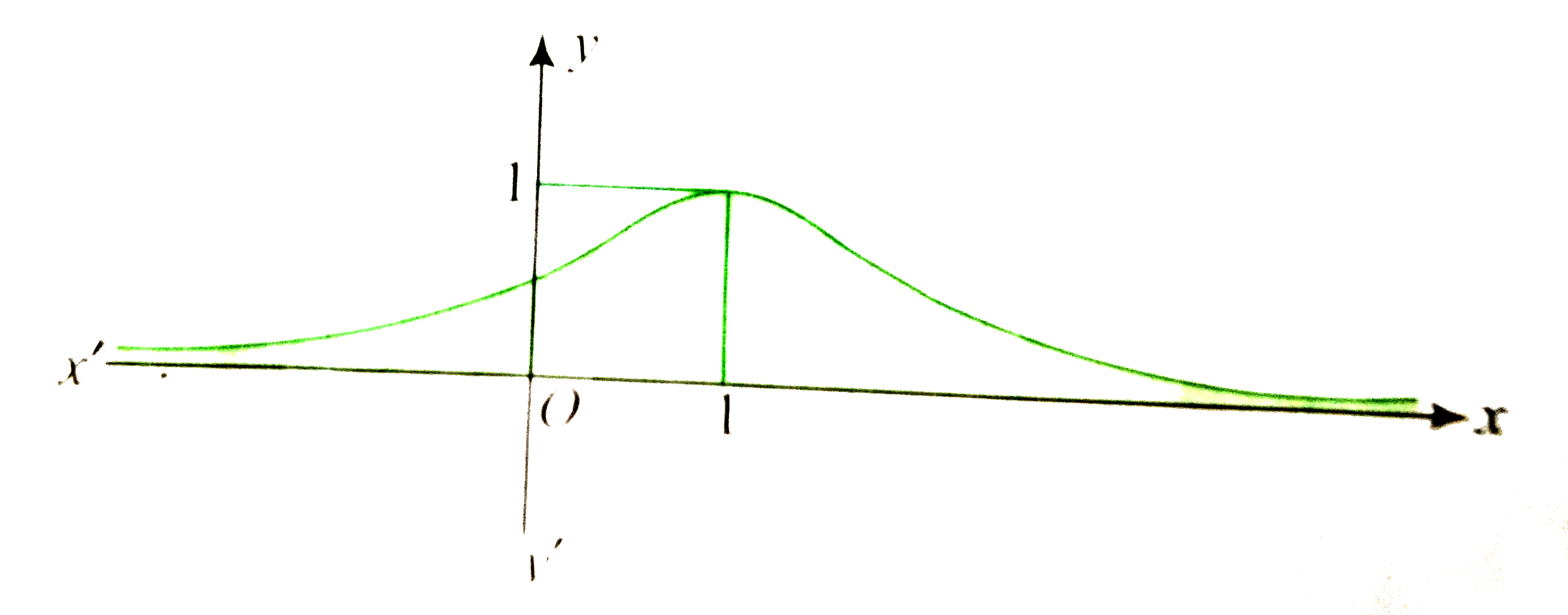
Find the area bounded by `y=1/(x^2-2x+2)`
and x-axis.
Text Solution
Verified by Experts
`y=(1)/((x-1)^(2)+1)` When `x=1, ""^(y)"max ."1` When `xrarrpmoo,yrarr0` Therefore, x-axis is the asymptote. Also `f(1+x)=f(1-x)` Hence, the graph is symmetrical about line x = 1 From these information the graph of function is as shown in the figure. `"Area "=2overset(oo)underset(1)int(1)/((x-1)^(2)+1)dx=[2tan^(-1)(x-1)]_(1)^(oo)=pi" sq. units."`
Find area bounded by y = log_(1/2) x and x-axis between x = 1 and x = 2
Find the area bounded by y=1+2 sin^(2)x,"X-axis", X=0 and x=pi .
Find the area bounded by the curve y=x^3-3x^2+2x and the x-axis.
Find the area bounded by the curve y=x(x-1)(x-2) and the x-axis.
Find the area bounded by the curve |x|+y=1 and axis of x.
(i) Find the area bounded by x^(2)+y^(2)-2x=0 and y = sin'(pix)/(2) in the upper half of the circle. (ii) Find the area bounded by the curve y = 2x^(4)-x^(2) , x-axis and the two ordinates cooreponding to the the minima to the function. (iii) Find area of the curve y^(2) = (7-x)(5+x) above x-axis and between the ordinates x = - 5 and x = 1 .
Find the area bounded by the line y=x , the x-axis and the ordinates x=-1 and x=2
Find the area bounded by the line y=x , the x-axis and the ordinates x=-1 and x=2
Find the area bounded by curves (x-1)^2+y^2=1 and x^2+y^2=1 .