Home
Class 12
MATHS
C(1) and C(2) are two concentrate circle...

`C_(1) and C_(2)` are two concentrate circles, the radius of `C_(2)` being twice that of `C_(1)`. From a point P on `C_(2)` tangents PA and PB are drawn to `C_(1)`. Prove that the centroid of the `DeltaPAB` lies on `C_(1)`

Text Solution

Verified by Experts
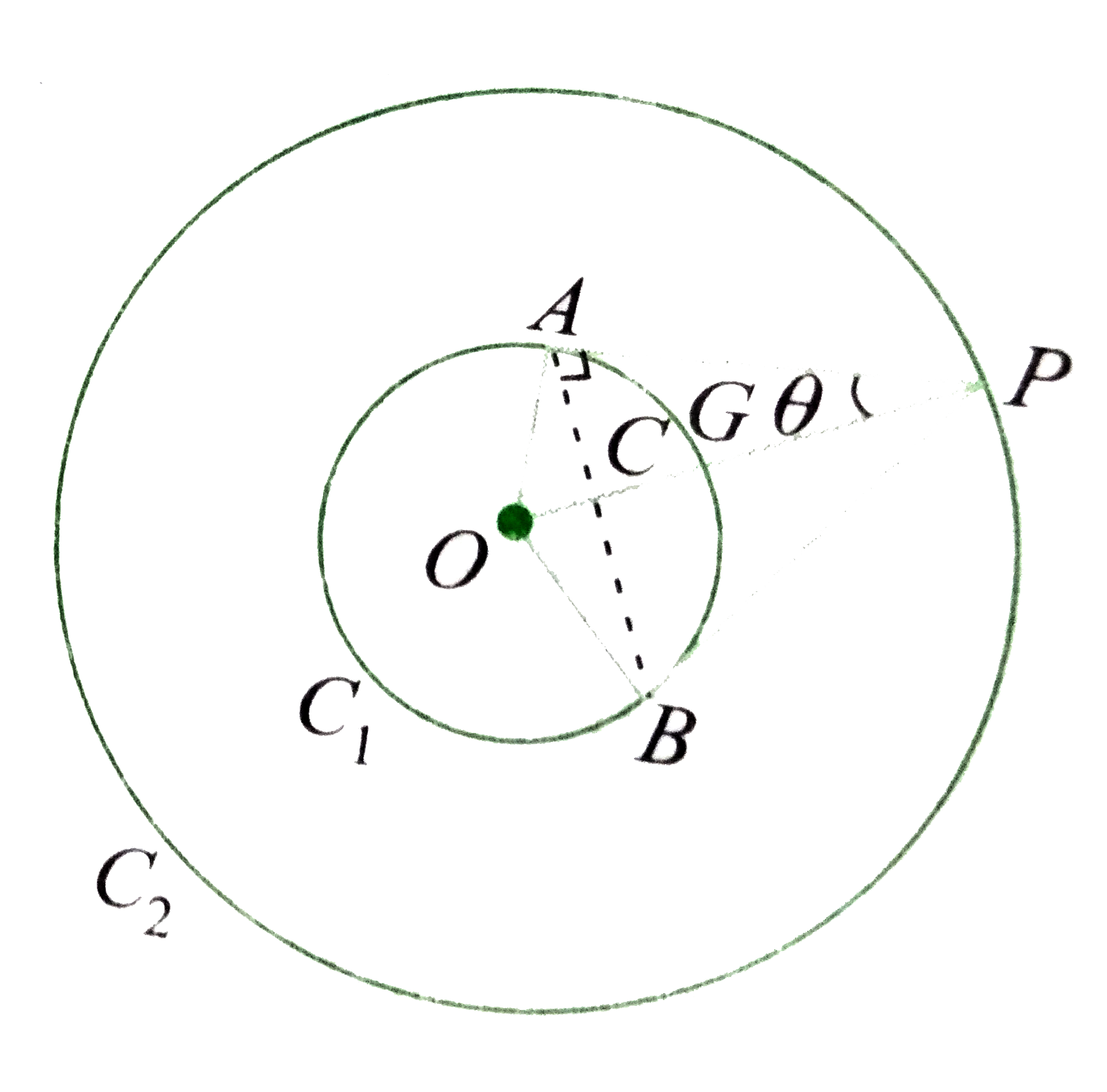
Let r be the radius of `C_(1)` and 2r be the radius of `C_(2)`.Then, `OA=OB=r`
and `OP=2r`
Since PA and PB are tangents to `C_(1)`,
`/_OAP=/_OBP=90^(@)`
Let OP meets `C_(1)` at G.
Let `/_OPA=theta`. Then,
`sin theta=(OA)/(OP)=(r)/(2r)=(1)/(2)`
or `theta =30^(@)`
or `/_ AOP =60^(@)`
In `Delta OAC`,
`cos 60^(@)=(OC)/(OA)`
or `(1)/(2)=(OC)/(r) `or `OC=(r)/(2)`
`:. PC=2r-(r)/(2)-(3r)/(2)`
Also, `CG=r-OC=r-(r)/(2)=(r)/(2)`
Clearly, `CG=(1)/(3)PC`
Therefore, G is the centroid of `Delta ABP`.
Promotional Banner

Topper's Solved these Questions

  • CIRCLE

    CENGAGE ENGLISH|Exercise Examples|13 Videos
  • CIRCLE

    CENGAGE ENGLISH|Exercise CONCEPT APPLICATION EXERCISE 4.1|1 Videos
  • BINOMIAL THEOREM

    CENGAGE ENGLISH|Exercise Matrix|4 Videos
  • CIRCLES

    CENGAGE ENGLISH|Exercise Comprehension Type|8 Videos

Similar Questions

Explore conceptually related problems

C1 and C2 are two concentric circles, the radius of C2 being twice that of C1. From a point P on C2, tangents PA and PB are drawn to C1. Then the centroid of the triangle PAB (a) lies on C1 (b) lies outside C1 (c) lies inside C1 (d) may lie inside or outside C1 but never on C1

C_1 and C_2 , are the two concentric circles withradii r_1 and r_2, (r_1 lt r_2) . If the tangents drawnfrom any point of C_2 , to C_1 , meet again C_2 , at theends of its diameter, then

From a point P outside a circle with centre at C, tangents PA and PB are drawn such that 1/(CA)^2+ 1/(PA)^2=1/16 , then the length of chord AB is

The centres of two circles C_(1) and C_(2) each of unit radius are at a distance of 6 unit from each other. Let P be the mid-point of the line segment joining the centres of C_(1) and C_(2) and C be a circle touching circles C_(1) and C_(2) externally. If a common tangent to C_(1) and C passing through P is also a common tangent to C_(2) and C, then the radius of the circle C, is

The centres of two circles C_(1) and C_(2) each of unit radius are at a distance of 6 unit from each other. Let P be the mid-point of the line segment joining the centres of C_(1) and C_(2) and C be a circle touching circles C_(1) and C_(2) externally. If a common tangent to C_(1) and C passing through P is also a common tangent to C_(2) and C, then the radius of the circle C, is

A circle C_(1) has radius 2 units and a circles C_(2) has radius 3 units. The distance between the centres of C_(1) and C_(2) is 7 units. If two points, one tangent to both circles and the other passing through the centre of both circles, intersect at point P which lies between the centers of C_(1) and C_(2) , then the distance between P and the centre of C_(1) is

Consider three circles C_1, C_2 and C_3 such that C_2 is the director circle of C_1, and C_3 is the director circle of C_2 . Tangents to C_1 , from any point on C_3 intersect C_2 , at P and Q . Find the angle between the tangents to C_2 at P and Q. Also identify the locus of the point of intersec- tion of tangents at P and Q .

There are two circles C_(1) and C_(2) touching each other and the coordinate axes, if C_(1) is smaller than C_(2) and its radius is 2 units, then radius of C_(2) , is

A (c,0) and B (-c,0) are two points . If P is a point such that PA + PB = 2a where 0 lt c lt a, then find the locus of P.

If a, b, c are in G.P. and also a, b, c are in A.P. Prove that: 1/a+1/c=2/b

