Home
Class 12
MATHS
a and b form the consecutive sides of a ...

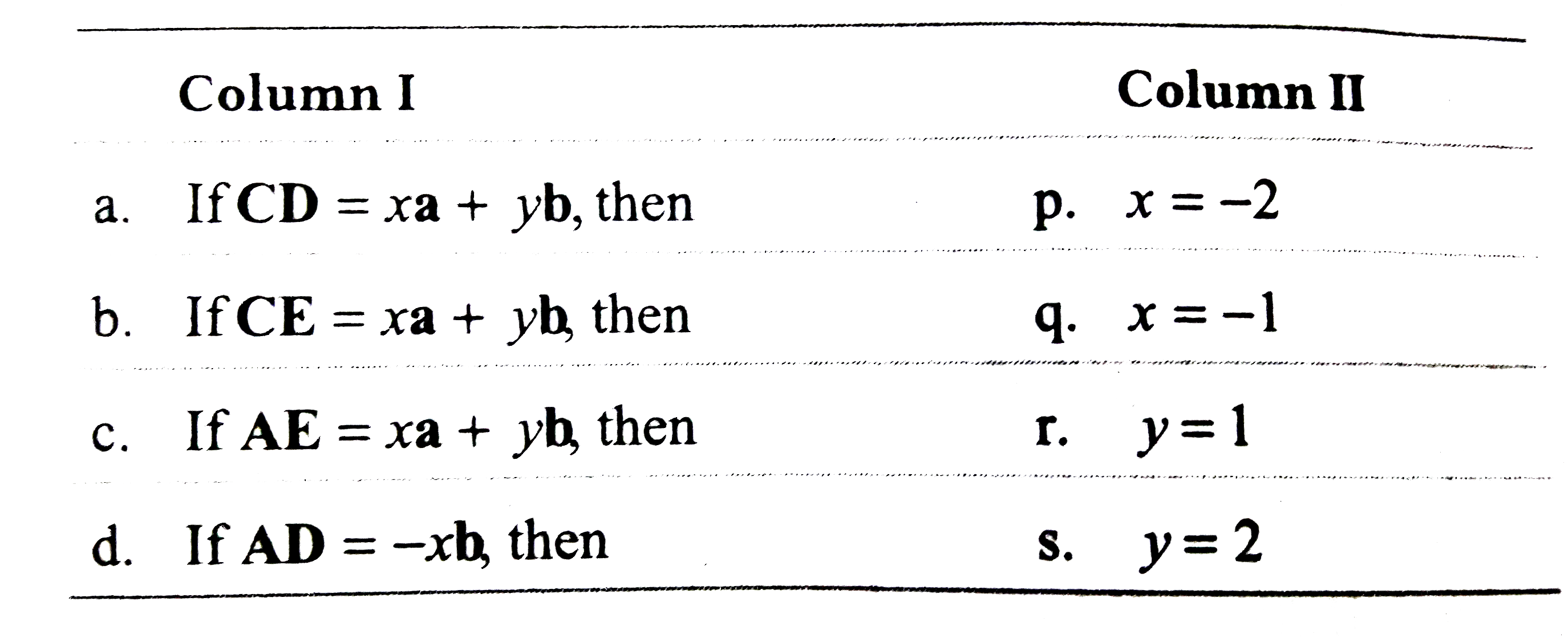
a and b form the consecutive sides of a regular hexagon ABCDEF.

Text Solution

Verified by Experts

The correct Answer is:
`a to q, r; b to p, r; c to q, s; d to p`


`vec(AB) = veca, vec(BC) = vecb` ltvrgt `therefore vec(AC) =vec(AB) + vec(BC) = veca + veca" "` (i)
` vec(AD) =2 vec(BC) = 2 vecb" "` (ii)
(because AD is parallel to BC and twice its length).
`vec(CD) = vec(AD) - vec(AC) = 2 vecb - ( veca + vecb)`
`= vecb - veca`
`" " vec(FA) = - vec(CD) = veca - vecb" "`(iii)
`vec(DE) = - vec(AB) = - veca" "`(iv)
`vec(EF ) =- vec(BC) = -vecb" "` (v)
` vec(AE) = vec(AD) + vec(DE) = 2vecb - veca" "` (vi)
`vec(CE) = vec(CD) + vec(DE) = vecb- veca - veca = vecb - 2 veca ` (vii)
Promotional Banner

Topper's Solved these Questions

  • INTRODUCTION TO VECTORS

    CENGAGE ENGLISH|Exercise TRUE OR FALSE|1 Videos
  • INTEGRALS

    CENGAGE ENGLISH|Exercise All Questions|764 Videos
  • INVERSE TRIGONOMETRIC FUNCTIONS

    CENGAGE ENGLISH|Exercise Archives (Numerical Value type)|2 Videos

Similar Questions

Explore conceptually related problems

In a regular hexagon ABCDEF, vec(AE)

The coordinates of two consecutive vertices A and B of a regular hexagon ABCDEF are (1,0) and (2,0) respectively. The equation of the diagonal CE is:

AB, BC and CD are the three consecutive sides of a regular polygon. If angleBAC= 15^(@) , find, number of sides of the polygon

AB, BC and CD are the three consecutive sides of a regular polygon. If angleBAC= 15^(@) , find, each exterior angle of the polygon

If vec a ,\ vec b are the vectors forming consecutive sides of a regular of a regular hexagon A B C D E F ,\ then the vecrtor representing side C D is a. vec a+ vec b b. vec a- vec b c. vec b- vec a d. -( vec a+ vec b)

If veca and vecb are the vectors determined by two adjacent sides of a regular hexagon ABCDEF, find the vector determined by the ther sides taken in order. Also find vec(AD) and vec(CE) in terms of veca and vecb .

Consider the regular hexagon ABCDEF with centre at O (origin). Q. Five forces AB,AC,AD,AE,AF act at the vertex A of a regular hexagon ABCDEF. Then, their resultant is (a)3AO (b)2AO (c)4AO (d)6AO

If a and b are the vectors AB and BC determined by the adjacent sides of a regular hexagon. What are the vectors determined by the other sides taken is order?

Three vertices are chosen at random from the vertices of a regular hexagon then The probability that the triangle has exactly two sides common with the side of the hexagon is

A particle moves with constant speed v along a regular hexagon ABCDEF in the same order. Then the magnitude of the avergae velocity for its motion form A to

