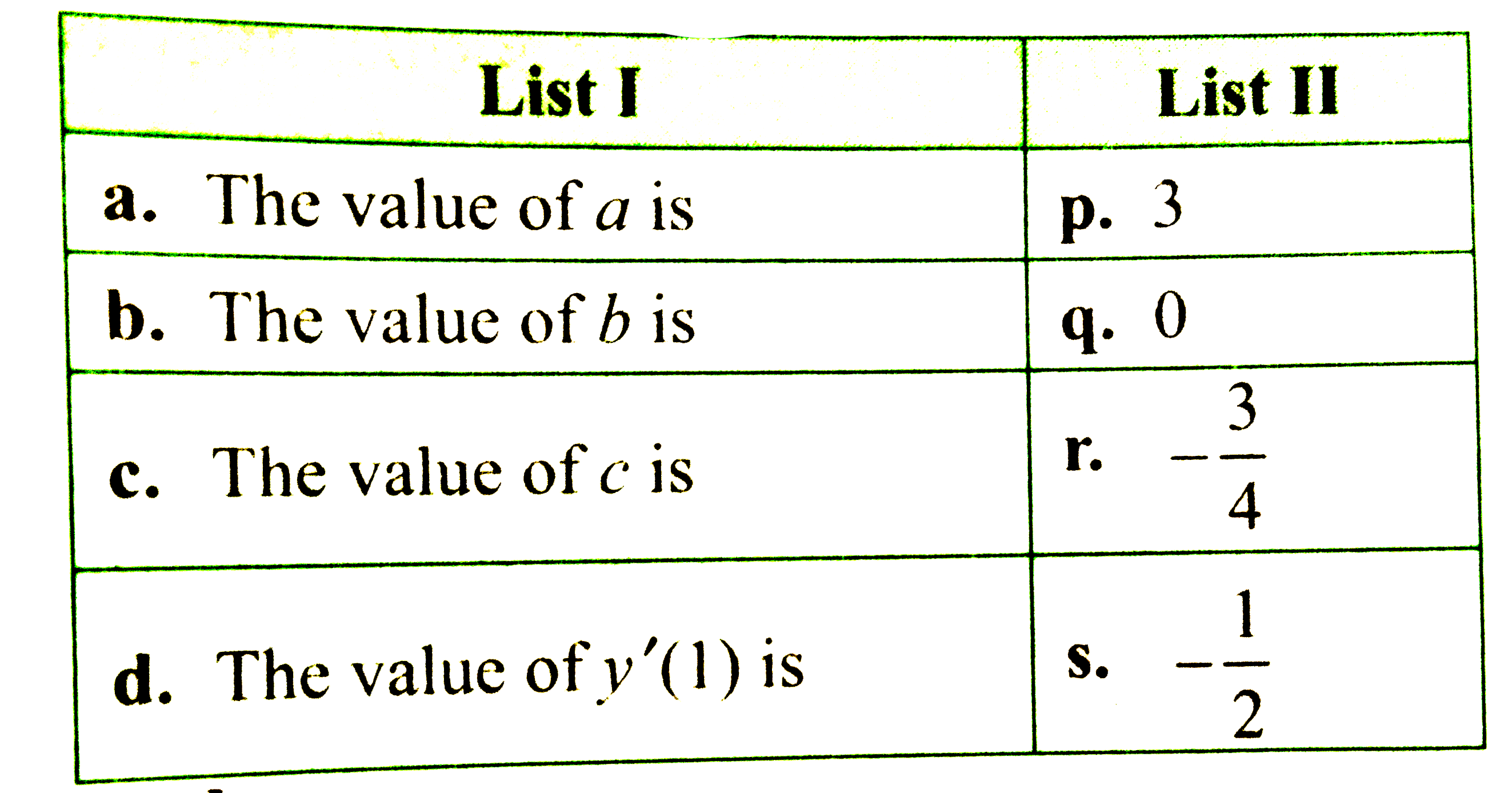
The curve `y=ax^(2)+bx^(2)+cx+5` touches the x-axis at `P(-2,0)` and cuts the y-axis at point Q, where its gradient is 3. Now, match the following lists and then choose the correct code.
The curve y=a x^3+b x^2+c x+5 touches the x-axis at P(-2,0) and cuts the y-axis at the point Q where its gradient is 3. Find the equation of the curve completely.
The curve y=a x^3+b x^2+c x+5 touches the x-axis at P(-2,0) and cuts the y-axis at the point Q where its gradient is 3. Find the equation of the curve completely.
The curve y=a x^3+b x^2+c x+5 touches the x-axis at P(-2,\ 0) and cuts the y-axis at the point Q where its gradient is 3. Find the equation of the curve completely.
The curve y=ax^(3)+bx^(2)+cx is inclined at 45^(@) to x-axis at (0,0) but it touches x-axis at (1,0) , then a+b+c+10 is
If the curve y=ax^(3) +bx^(2) +c x is inclined at 45^(@) to x-axis at (0, 0) but touches x-axis at (1, 0) , then
Consider lim_(x to oo)((x^(3)+x^(2)+x+sinx)/(x^(2)+2cosx)-asinx-bx+c)=4 . Now, match the following lists and then choose the correct code.
A circle touches x-axis at (2, 0) and has an intercept of 4 units on the y-axis. Find its equation.
If x^(2)+y^(2)+6x+2ky+25=0 to touch y-axis then k=
If the curve y=ax^(2)+bx+c passes through the point (1, 2) and the line y = x touches it at the origin, then
The graph of 3x+2y=6 meets the x= axis at point P and the y-axis at point Q. Use the graphical method to find the co-ordinate of points P and Q.
CENGAGE ENGLISH-APPLICATION OF DERIVATIVES-MATRIX MATCH TYPE