Home
Class 11
PHYSICS
The coefficient of static friction betwe...

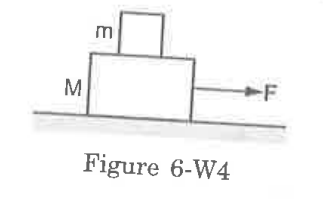
The coefficient of static friction between the two blocks shown in figure is `mu` and the table is smooth. What maximum horizontal forced F can be applied to he block of mass M so that the block move together?

Text Solution

Verified by Experts

When the maximum force F is applied, bothteh blocks move together towards right. The only horizontal force on the upper block of mass m is tht due to the friction by thelower block of mass M.Hence this force onm should be towads right. The force of friction on M by should be towards left by Newton's third law. As we are talking of the maximum possible force F that can be applied, the friction is limiting and hence `f=muN where N` is the normal force between the blocks.
consider the motion of m. The forces on m are ure.

a. mg downward by the earth (gravity),
b.N upward by the block M(normal force ) and
c. `f=mu N`(friction) towards right by the block M.
In the vertical direction there is no acceleration. This gives
N=mg.........i
IN the horizontal direction, let the acceleration be a then
`muN=ma`
or` mumg=ma`
or, `a=mug`.......ii
Next consider the motion of M ure.

Teh forces on M are
a. Mg downward by the earth (gravity) ltbRgt `N_1` upward by the table (normal force),
c. N downward by m (normal force),
`f=muN` (friction) towards left by m and
e. F (aplied force) by the experimenter. The equation of motion is
`F-muN=Ma`
or, F-mu mg=M mug[Using i. and ii.]`
or, `F=mug(M+m)`.
Promotional Banner

Topper's Solved these Questions

  • FRICTION

    HC VERMA ENGLISH|Exercise Objective -1|10 Videos
  • FRICTION

    HC VERMA ENGLISH|Exercise Objective -2|5 Videos
  • FRICTION

    HC VERMA ENGLISH|Exercise Questions for short Answer|11 Videos
  • FLUID MECHANICS

    HC VERMA ENGLISH|Exercise All Questions|90 Videos
  • GRAVITATION

    HC VERMA ENGLISH|Exercise Question for short Answers|18 Videos

Similar Questions

Explore conceptually related problems

The friction coefficient between the two blocks shown in figure is mu but the floor is smooth. A. What maximum horizontal force F can be applied without disturbing the equilibrium of the systme? b.suppose the horizontal force applied is double of that found in part a. Findthe accelerations of the two masses.

A block of mass m is placed on another block of mass M lying on a smooth horizontal surface as shown in the figure. The co-efficient of friction between the blocks is mu . Find the maximum horizontal force F (in Newton) that can be applied to the block M so that the blocks together with same acceleration? (M=3kg, m=2kg, mu=0.1, g=10m//s^(2))

A block of mass m is placed on another block of mass M which itself is lying on a horizontal surface .The coefficient of friction between two blocks is mu_(1) and that between the block of mass M and horizontal surfece is mu_(2) What maximum horizontal force can be applied to the lower block move without separation?

A small block of mass m is placed on a plank of masss M .The block is connected to plank with the help of a light string passing over a light smooth pulley shown in fig. The co-efficient of static friction between the plank is mu The co-efficient of friction between the plank and the maximum horizontal force F applied on the block of mass m can make block not to slide relatively?

On a smooth table two blocks of masses 2.5kg and 1.5kg are placed one over the other as shown in figure. If the coefficient of static friction between two blocks is 0.2, the maximum horizontal force to be applied on the lower block so that the two blocks move together is (g = ms^(-2) )

Four block are arranged on a smooth horizontal surface as shown in figure .The masses of the blocks are given (see the fig ) The coefficient of static friction between the top and the bottom blocks is mu_(s) What is the maximum value of the horizontal force F applied to one of the bottom blocks as shown that makes all four block with the same acceleration ?

A small block of mass 'm' is placed on a plank of mass 'M'. The block is connected to plank with the help of a light string passing over a light smooth pulley as shown in figure. The co-efficient of static friction between the block and plank is mu . The co-efficient of friction between the plank and the horizontal surface is zero. What maximum horizontal force F applied on the block of mass m can make the block and plank not to slide relatively?

Two block of masses m_(1) and m_(2) connected by a light spring rest on a horizontal plane. The coefficient of friction between the block and the surface is equal to mu . What minimum constant force has to be applied in the horizontal direction to the block of mass m_(1) in order to shift the other block?

A bar of mass m is placed on a triangular block of mass M as shown in figure The friction coefficient between the two surface is mu and ground is smooth find the minimum and maximum horizontal force F required to be applied on block so that the bar will not slip on the inclined surface of block

The coefficient of static friction between a block of mass m and an incline is mu_s=0.3 , a. What can be the maximum angle theta of the incline with the horizontal so that the block does not slip on the plane? b. If the incline makes an angle theta/2 with the horizontal, find the frictional force on the block.

