Home
Class 11
PHYSICS
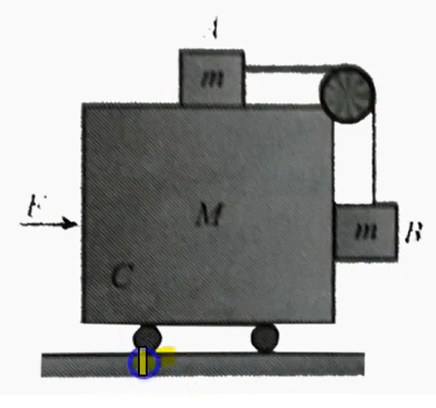
Consider the situation shown in figure. ...

Consider the situation shown in figure. The horizontal surface below the bigger block is smooth. The coefficient of friction between the blocks is `mu`. Find the minimum and the maximum force F that can be applied in order to keep the smaller block at rest with respect to the bigger block.

Text Solution

Verified by Experts

If no force is applied, the block A will slip on C towards right and the block B will move downward. Suppose the minimum force needed to prevent sliping is F. Taking A+B+C as the system, the obly exterN/Al horizontal force on the system is F. Hence the acceleratioinof the system is
` a=F/(M+2m)`..........i
Now take the block a as the system. The forces on A are.
,

i. tension t by the string towards right,
ii. friction fi by the block C towards left,
iii. weight mg downward and
normal force N upward
For veticla equilibrium N=mg
As the minimum force neede dto prevent slipping is appied, the fricton is limiting. Thus,
f=mu N=mu mg`
As the block moves towards right with an acceleration a
`T-f=ma`
or `T-mu mg=ma`.........ii
Now take the block B as the system. The forces are,
i. Tension T upward
ii. weight mg downward
iii. normal force N towards right and
friction f upward
As the block moves towards right with an acceleration a,
`N'=ma`
As the friction is limiting `f'=mu N'=mu ma`
For vertical equilibrium
`T+f'=mg`
or `T+mu ma =mg` ..........iii
ElimiN/Ating T from ii. and iii
`a_(min)=(1-mu)/(1+mu) g`.
When a large force is appied the block A slips on C towards left and the block B slips on C in the upward directin. The friction on A is towards right and that on B is downwards. Solving as above, the acceleration in this case is
`a_(max)=(1+mu)/(1-mu)g`
Thus, a lies between `(1-mu)/(1+mu)g and (1+mu)/(1-mu)g`
from the force F should be between
` (1-mu)/(1+mu)(M+2m) g and (1+mu)/(1-mu)(M+2m)g`.
Promotional Banner

Topper's Solved these Questions

  • FRICTION

    HC VERMA ENGLISH|Exercise Objective -1|10 Videos
  • FRICTION

    HC VERMA ENGLISH|Exercise Objective -2|5 Videos
  • FRICTION

    HC VERMA ENGLISH|Exercise Questions for short Answer|11 Videos
  • FLUID MECHANICS

    HC VERMA ENGLISH|Exercise All Questions|90 Videos
  • GRAVITATION

    HC VERMA ENGLISH|Exercise Question for short Answers|18 Videos

Similar Questions

Explore conceptually related problems

Consider the situation shown in Fig. The hirizontal surface below the bigger block is smooth the coefficient of friction between the block is mu find the minimum and the maximum force F that can be applied in order to keep the smaller blocks at rest with respoct to the bigger block

In the adjoining figure, the coefficient of friction between wedge (of mass M ) and block (of mass m ) is mu . Find the minimum horizontal force F required to keep the block stationary with respect to wedge.

A block of mass m is placed on another block of mass M lying on a smooth horizontal surface as shown in the figure. The co-efficient of friction between the blocks is mu . Find the maximum horizontal force F (in Newton) that can be applied to the block M so that the blocks together with same acceleration? (M=3kg, m=2kg, mu=0.1, g=10m//s^(2))

The coefficient of static friction between the two blocks shown in figure is mu and the table is smooth. What maximum horizontal forced F can be applied to he block of mass M so that the block move together?

The coefficient of static friction between the two blocks shown in figure is mu and the table is smooth. What maximum horizontal forced F can be applied to he block of mass M so that the block move together?

Four block are arranged on a smooth horizontal surface as shown in figure .The masses of the blocks are given (see the fig ) The coefficient of static friction between the top and the bottom blocks is mu_(s) What is the maximum value of the horizontal force F applied to one of the bottom blocks as shown that makes all four block with the same acceleration ?

A block of mass m is kept over another block of mass 2 m and the system rests on a smooth horizontal surface. The coefficient of friction between the blocks is 0.50. Find the work done by the force of friction on the smaller block by the bigger block during a displacement d of the system, when a force mg is applied to the lower block.

Two blocks A and B are lying on the table as shown in the figure. The coefficient of friciton between block A and block B is mu . The coefficient of friction between block B and ground also mu . An external force F is applied in the direction shown. The maximum value of the force F that can be applied without moving the blocks.

For the arrangement shown in the figure the coefficient of friction between the two blocks is mu . If both the blocks are identical and moving ,then the acceleration of each block is

A small block of mass 'm' is placed on a plank of mass 'M'. The block is connected to plank with the help of a light string passing over a light smooth pulley as shown in figure. The co-efficient of static friction between the block and plank is mu . The co-efficient of friction between the plank and the horizontal surface is zero. What maximum horizontal force F applied on the block of mass m can make the block and plank not to slide relatively?

