Home
Class 11
PHYSICS
Figure shows a large tank of water at a...

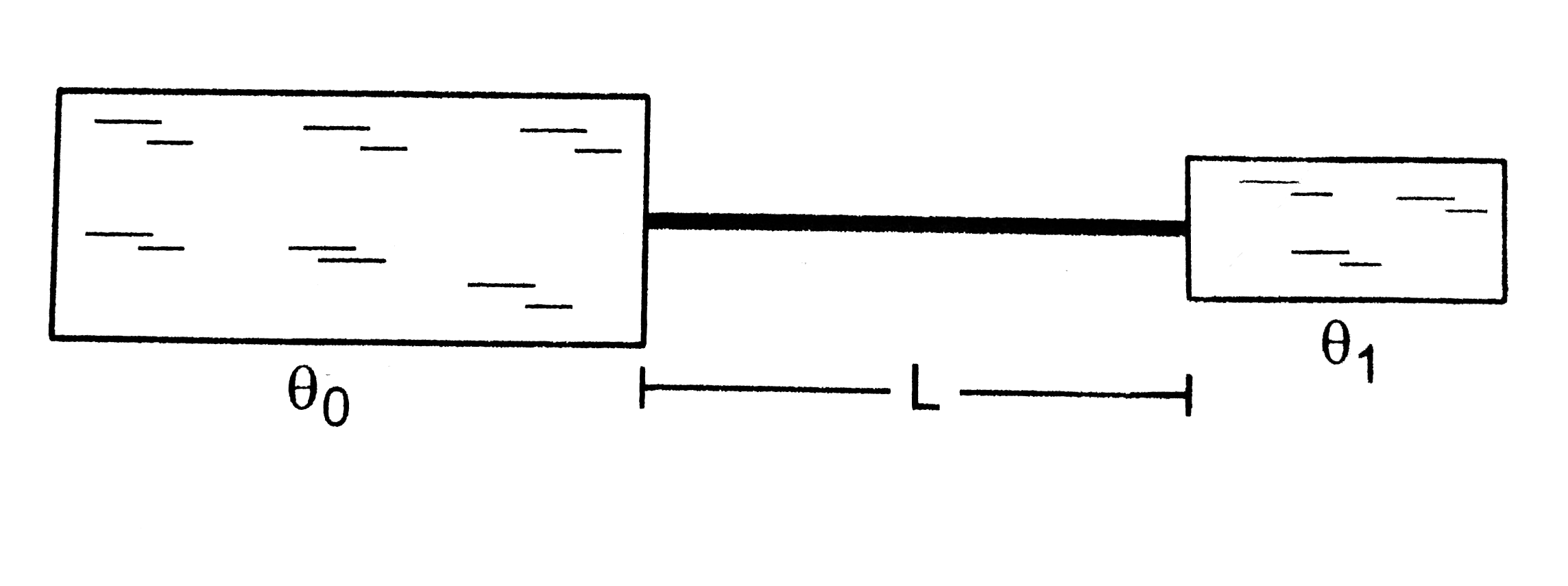
Figure shows a large tank of water at a constant temperature `theta_(0)` and a small vessel containing a mass `m` of water at an initial temperature `theta_1``(lt theta_(0))`. A metal rod of length `L`, area of cross section `A` and thermal conductivity `K` connects the two vessels. Find the time taken for the temperature of the water in the smaller vessel to become `theta_(2)``(theta_(1)lt theta_(2)lt theta_(0))` . Specific heat capacity of water is `s` and all other heat capacities are negligible.

Text Solution

Verified by Experts

Suppose, the temperature of the water in the smaller vessel is theta at time t. In the next time interval dt, a heat (DeltaQ) is transferred to it where
`DeltaQ=(KA)/(L)(theta_(0)-theta)dt` . This heat increases the temperature of the water of mass m to `theta+d theta where `DeltaQ=msd theta` . From (i) and (ii),
(KA)/L(theta_(0)-theta)dt=msd theta` . or, `dt=(Lms)/(KA)(d theta)/(theta_(0)-theta` . or, `int_(0)^(T)dt=(Lms)/(KA)int_(theta_(1))^(theta^(2))(d theta)/(theta_(0)-theta)` . where T is the time requierd for the temperature of the water to become `theta_(2)` . Thus, `T=(Lms)/(KA) ln `(theta_(0)-theta_(1))/(theta_(0)-theta_(2))` .
Promotional Banner

Topper's Solved these Questions

  • HEAT TRANSFER

    HC VERMA ENGLISH|Exercise OBJECTIVE I|10 Videos
  • HEAT TRANSFER

    HC VERMA ENGLISH|Exercise OBJECTIVE II|6 Videos
  • HEAT TRANSFER

    HC VERMA ENGLISH|Exercise QUESTIONS FOR SHORT ANSWER|11 Videos
  • HEAT AND TEMPERATURE

    HC VERMA ENGLISH|Exercise Objective 2|6 Videos
  • INTRODUCTION TO PHYSICS

    HC VERMA ENGLISH|Exercise Question for short Answer|4 Videos

Similar Questions

Explore conceptually related problems

Figure shown two adiabatic vessels, each containing a mass m of water at different temperature. The ends of a metal rod of length L, area of cross section A and thermal conductivity K, are inserted in the water as shown in the figure. Find the time taken for the difference between the temperature in the vessels to become half of the original value. The specific heat capacity of water is s. Neglect the heat capacity of the rod and the container and any loss of heat to the atmosphere.

Integrate the following functions int_(theta_(1))^(theta_(2)) (d theta)/( theta -theta_(0))

Two liquids of specific heat ratio 1:2 are at temperature 2theta and theta

Two thin metallic spherical shells of radii r_(1) and r_(2) (r_(1)lt r_(2)) are placed with their centres coinciding. A material of thermal conductivity K is filled in the space between the shells. The inner shells is maintained at temperature theta_(1) .and the outer shell at temperature theta_(2) (theta_(1)lt theta_(2)) . Calculate the rate at which heat flows radially through the material.

Two thin metallic spherical shells of radii r_(1) and r_(2) (r_(1)lt r_(2)) are placed with their centres coinciding. A material of thermal conductivity K is filled in the space between the shells. The inner shells is maintained at temperature theta_(1) and the outer shell at temperature theta_(2) (theta_(1)lttheta_(2)) . Calculate the rate at which heat flows radially through the material.

If 0 lt theta lt pi//2 then .find the least value of tan theta + cot theta

Two materials having coefficients of thermal conductivity '3k' and 'k' and thickness 'd' and '3d' respectively, are joined to form a slab as shown in the figures. The temperatures of the outer surfaces are theta_(2) and theta_(1) respectively (theta_(2) gt theta_(2)) . The temperature at the interface is :

Find the rate of heat flow through a cross section of the rod shown in figure (theta_(2)gttheta_(1)) . Thermal conductivity of the material of the rod is K.

Solve : 5cos2theta+2cos^2(theta/2)+1=0,-pi lt theta lt pi

A body with an initial temperature theta_(1) is allowed to cool in a surrounding which is at a constant temperature of theta_(0) (theta lt theta_(1)) Assume that Newton's law of cooling is obeyed Let k = constant The temperature of the body after time t is best experssed by .

HC VERMA ENGLISH-HEAT TRANSFER-worked out examples
  1. The lower surface of a slab of stone of face-area 3600cm^(2) and thick...

    Text Solution

    |

  2. An icebox made of 1.5cm thick styrofoam has dimensions 60cmxx60cmxx30c...

    Text Solution

    |

  3. A closed cubical box is made of perfectly insulating material and the ...

    Text Solution

    |

  4. A bar of copper of length 75cm and a bar of steel of length 125cm are ...

    Text Solution

    |

  5. Two parallel plates A and B are joined together to form a compound pla...

    Text Solution

    |

  6. A room has a 4mxx4mxx10cm concrete roof (K=1.26Wm^(-1)C^(-1)) . At som...

    Text Solution

    |

  7. An electric heater is used in a room of total wall area 137m^(2) to ma...

    Text Solution

    |

  8. Three rods of material x and three of material y are connected as show...

    Text Solution

    |

  9. A rod CD of thermal resistance 5.0KW^(-1) is joined at the middle of a...

    Text Solution

    |

  10. Two thin metallic spherical shells of radii r(1) and r(2) (r(1)lt r(2...

    Text Solution

    |

  11. On a cold winter day, the atmospheric temperature is -theta (on celsiu...

    Text Solution

    |

  12. Figure shows a large tank of water at a constant temperature theta(0)...

    Text Solution

    |

  13. One mode of an ideal monatomic gas is kept in a rigid vessel. The vess...

    Text Solution

    |

  14. A monatomic ideal gas is contained in a rigid container of volume V wi...

    Text Solution

    |

  15. Consider a cubical vessel of edge a having a small hole in one of its ...

    Text Solution

    |

  16. A blackbody of surface area 1cm^(2) is placed inside an enclosure. The...

    Text Solution

    |

  17. An electric heater emits 1000W of thermal radiation. The coil has a su...

    Text Solution

    |

  18. The earth receives solor radiation at a rate of 8.2Jcm^(-2)min^(-1) . ...

    Text Solution

    |

  19. The temperature of a body falls from 40^(@)C to 36^(@)C in 5 minutes w...

    Text Solution

    |

  20. A hot body placed in air is cooled down according to Newton's law of c...

    Text Solution

    |
