Home
Class 11
PHYSICS
Four identical rods AB, CD, CF and DE ar...

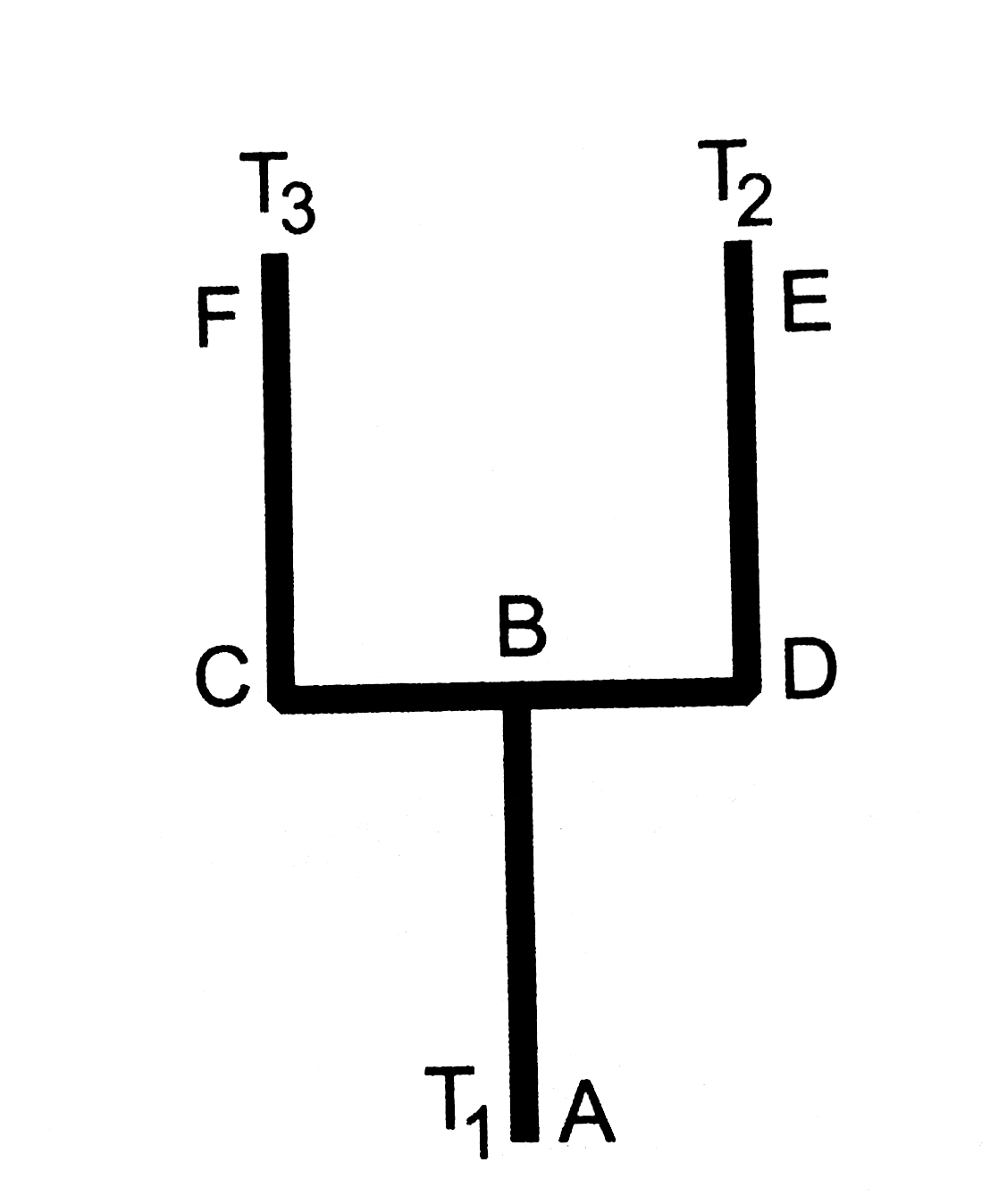
Four identical rods AB, CD, CF and DE are joined as shown in figure. The length, cross-sectional area and thermal conductivity of each rod are l, A and K respectively. The ends A, E and F are maintained at temperature `T_(1)` , `T_(2)` and `T_(3)` respectively. Assuming no loss of heat to the atmosphere, find the temperature at B.

Text Solution

Verified by Experts

The correct Answer is:
A, B, C

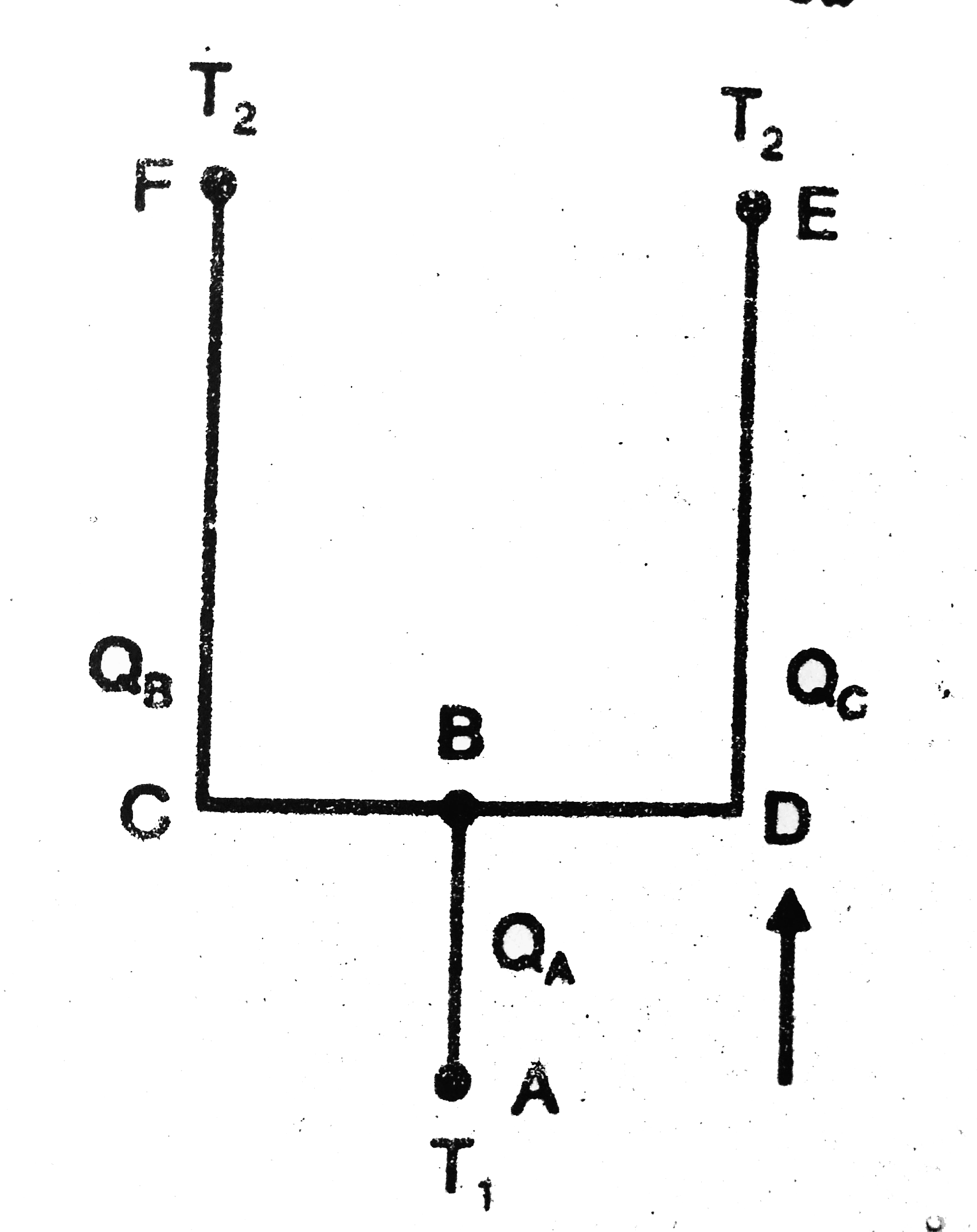
Let the tempareture at B be T
`(Q_A/t)=(Q_B/t)+(Q_C/t)`
`implies(KA(T-T_1))/l=(KA(T-T_2))/(l+l//2)+(KA(T-T_3))/(3l//2)`
`(T-T_1))/l=(T-T_2))/(l+l//2)+(T-T_3))/(3l//2)`
`implies T-T_1=(2/3)(2T-T_2-T_3)`
`implies3T=3T_1=4T-2(T_2+T_3)`
`implies-7=+3T_1-2(T_2+T_3)`
`impliesT=(-3T+2(T_2+T_3))/7`
Promotional Banner

Topper's Solved these Questions

  • HEAT TRANSFER

    HC VERMA ENGLISH|Exercise QUESTIONS FOR SHORT ANSWER|11 Videos
  • HEAT TRANSFER

    HC VERMA ENGLISH|Exercise OBJECTIVE II|6 Videos
  • HEAT AND TEMPERATURE

    HC VERMA ENGLISH|Exercise Objective 2|6 Videos
  • INTRODUCTION TO PHYSICS

    HC VERMA ENGLISH|Exercise Question for short Answer|4 Videos

Similar Questions

Explore conceptually related problems

Eleven identical rods are arranged as shown in Fig. Each rod has length l , cross sectional area A and thermal conductivity of material k. Ends A and F are maintained at temperatures T_1 and T_2(ltT_1) , respectively. If lateral surface of each rod is thermally insulated, the rate of heat transfer ((dQ)/(dt)) in each rod is

Four thin identical rods AB, AC, BD and EF made of the same material are joined as shown. The free-ends C,D and F are maintained at temperature T_(1),T_(2) and T_(3) respectively. Assuming that there is no loss of heat of the surroundings, the temperature at joint E when the steady state is attained is (1)/(K) (2T_(1)+2T_(2)+3T_(3)) . Find K (E is mid point of AB)

All the rods have same conductance 'K' and same area of cross section ' A' . If ends A and C are maintained at temperature 2T_(0) and T_(0) respectively then which of the following is // are correct?

Five rods of same material and same cross-section are joined as shown. Lengths of rods ab, ad and bc are l, 2l and 3l respectively. Ends a and c are maintained at temperatures 200^(@)C and 0^(@)C respectivelly. For what length x of rod dc there will be no heat flow through rod bd ?

A composite rod made of three rods of equal length and cross-section as shown in fig. The thermal conductivites of the materials of the rods are K//2 , 5K and K respectively. The end A and end B are at constant tempertures. All heat entering the face A goes out of the end B there being no loss of heat from the sides of the bar. The effective thermal conductivity of the bar is

Three rods AB, BC and BD having thermal conductivities in the ratio 1:2:3 and lengths in the ratio 2:1:1 are joined as shown in Fig. The ends A, C and D are at temperature T_1 , T_2 and T_3 respectively Find the temperature of the junction B. Assume steady state.

A circular ring (centre O) of radius a, and of uniform cross section is made up of three different metallic rods AB, BC and CA (joined together at the points A, B and C in pairs) of thermal conductivityies alpha_1 , alpha_2 and alpha_3 respectively (see diagram). The junction A, B and C are maintained at the temperatures 100^@C , 50^@C and 0^@C , respectively. All the rods are of equal lengths and cross sections. Under steady state conditions, assume that no heat is lost from the sides of the rods. Let Q_1 , Q_2 and Q_3 be the rates of transmission of heat along the three rods AB, BC and CA. Then

A circular ring (centre O) of radius a, and of uniform cross section is made up of three different metallic rods AB, BC and CA (joined together at the points A, B and C in pairs) of thermal conductivityies alpha_1 , alpha_2 and alpha_3 respectively (see diagram). The junction A, B and C are maintained at the temperatures 100^@C , 50^@C and 0^@C , respectively. All the rods are of equal lengths and cross sections. Under steady state conditions, assume that no heat is lost from the sides of the rods. Let Q_1 , Q_2 and Q_3 be the rates of transmission of heat along the three rods AB, BC and CA. Then

Seven rods A, B, C, D, E, F and G are joined as shown in figure. All the rods have equal cross-sectional area A and length l. The thermal conductivities of the rods are K_(A)=K_(C)=K_(0) , K_(B)=K_(D)=2K_(0) , K_(E)=3K_(0) , K_(F)=4K_(0) and K_(G)=5K_(0) . The rod E is kept at a constant temperature T_(1) and the rod G is kept at a constant temperature T_(2) (T_(2)gtT_(1)) . (a) Show that the rod F has a uniform temperature T=(T_(1)+2T_(2))//3 . (b) Find the rate of heat flowing from the source which maintains the temperature T_(2) .

A rod of length l and cross-section area A has a variable thermal conductivity given by K = alpha T, where alpha is a positive constant and T is temperature in kelvin. Two ends of the rod are maintained at temperature T_(1) and T_(2) (T_(1)gtT_(2)) . Heat current flowing through the rod will be

HC VERMA ENGLISH-HEAT TRANSFER-EXERCIESE
  1. The two rods show in figure have identical geometrical dimension.. The...

    Text Solution

    |

  2. The three rods shown in figure have identical dimensions. Heat flows f...

    Text Solution

    |

  3. Four identical rods AB, CD, CF and DE are joined as shown in figure. T...

    Text Solution

    |

  4. Seven rods A, B, C, D, E, F and G are joined as shown in figure. All t...

    Text Solution

    |

  5. Find the rate of heat flow through a cross section of the rod shown in...

    Text Solution

    |

  6. A rod of negligible heat capacity has length 20cm, area of cross secti...

    Text Solution

    |

  7. A hollow metallic sphere of radius 20cm surrounds a concentric metalli...

    Text Solution

    |

  8. Figure shown two adiabatic vessels, each containing a mass m of water ...

    Text Solution

    |

  9. Two bodies of masses m(1) and m(2) and specific heat capacities S(1) a...

    Text Solution

    |

  10. An amount n (in moles) of a monatomic gas at initial temperature T(0) ...

    Text Solution

    |

  11. Assume that the total surface area of a human body is 1.6m^(2) and tha...

    Text Solution

    |

  12. Calculate the amount of heat radiated per second by a body of surface ...

    Text Solution

    |

  13. A solid aluminium sphere and a solid copper sphere of twice the radius...

    Text Solution

    |

  14. A 100W bulb has tungsten filament of total length 1.0m and raidius 4xx...

    Text Solution

    |

  15. A spherical ball of surface area 20cm^(2) absorbs any radiation that f...

    Text Solution

    |

  16. A spherical tungsten pieces of radius 1.0cm is suspended in an evacuat...

    Text Solution

    |

  17. A cubical block of mass 1.0kg and edge 5.0cm is heated to 227^(@)C . I...

    Text Solution

    |

  18. A copper sphere is suspended in an evacuated chamber maintained at 300...

    Text Solution

    |

  19. A spherical ball A of surface area 20cm^(2) is kept at the centre of a...

    Text Solution

    |

  20. A cylindrical rod of length 50cm and cross sectional area 1cm^(2) is f...

    Text Solution

    |

