Home
Class 11
PHYSICS
Figure shown two adiabatic vessels, each...

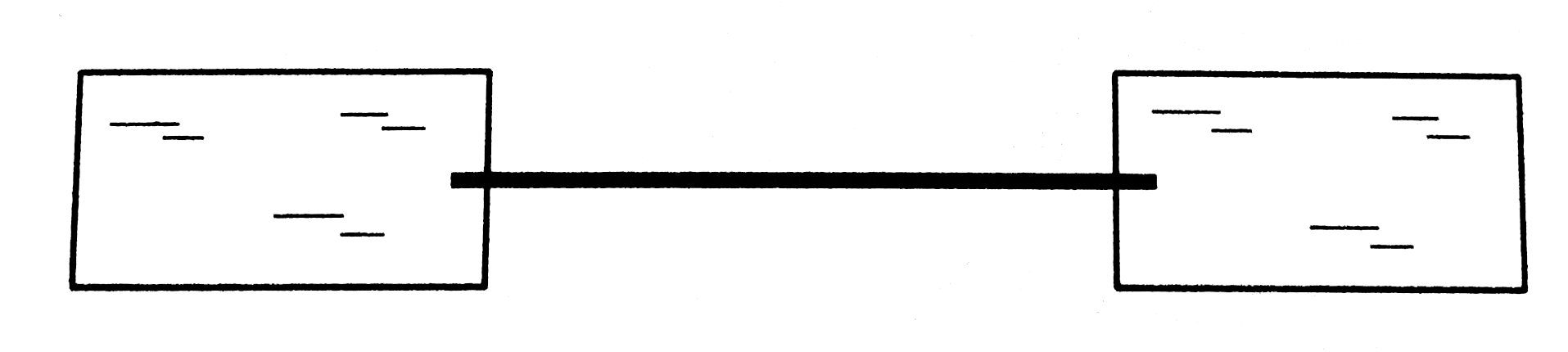
Figure shown two adiabatic vessels, each containing a mass m of water at different temperature. The ends of a metal rod of length L, area of cross section A and thermal conductivity K, are inserted in the water as shown in the figure. Find the time taken for the difference between the temperature in the vessels to become half of the original value. The specific heat capacity of water is s. Neglect the heat capacity of the rod and the container and any loss of heat to the atmosphere.

Text Solution

Verified by Experts

The correct Answer is:
A, B

`(Q/t)=(KA(T_1-T_2))/(Lms)`
`Rise in temperature in T_2=(KA(T_1-T_2))/(Lms)`
Fall in temperature om
`T_1=(KA(T_1-T_2))/(Lms)`
`Final temperture T_1=T_1-(KA(T_1-T_2))/(Lms)`
`Final temperature T_2=T_2+(KA(T_1-T_2))/(Lms)`
`implies(dT)/(dt)=(2KA(T_1-T_2))/(Lms)`
`impliesIn(T_1-T_2)/(2(T_1-T_2)=(2KA)/(Lms)t`
`In 2=(2KA)/(Lms)t`
`t=(Lms)/(2 KA)In 2`.
Promotional Banner

Topper's Solved these Questions

  • HEAT TRANSFER

    HC VERMA ENGLISH|Exercise QUESTIONS FOR SHORT ANSWER|11 Videos
  • HEAT TRANSFER

    HC VERMA ENGLISH|Exercise OBJECTIVE II|6 Videos
  • HEAT AND TEMPERATURE

    HC VERMA ENGLISH|Exercise Objective 2|6 Videos
  • INTRODUCTION TO PHYSICS

    HC VERMA ENGLISH|Exercise Question for short Answer|4 Videos

Similar Questions

Explore conceptually related problems

Figure shows a large tank of water at a constant temperature theta_(0) and a small vessel containing a mass m of water at an initial temperature theta_1 (lt theta_(0)) . A metal rod of length L , area of cross section A and thermal conductivity K connects the two vessels. Find the time taken for the temperature of the water in the smaller vessel to become theta_(2) (theta_(1)lt theta_(2)lt theta_(0)) . Specific heat capacity of water is s and all other heat capacities are negligible.

Three rods of the same dimension have thermal conductivity 3K , 2K and K. They are arranged as shown in the figure below Then , the temperature of the junction in steady - state is

Calculate the difference in temperature between the water at the top and bottom of a water fall 200 m high. Specific heat capacity of water 42000 J kg ^(-1) K ^(-1).

Three rods of equal length, area of cross section and thermal conductivity are connected as shown in the figure. There is no heat loss through lateral surface of the rods and temperature of ends are T_(A)=100^(@)C, T_(B)=70^(@)C and T_(C)=50^(@)C . Find the temperature of junction.

40 g of water at 60^@ C is poured into a vessel containing 50 g of water at 20°C. The final temperature of mixture is 30°C. Taking the specific heat capacity of water as 4.2 J g-K-1, calculate the heat capacity of the vessel.

The ends of a copper rod of length 1m and area of cross-section 1cm^2 are maintained at 0^@C and 100^@C . At the centre of the rod there is a source of heat of power 25 W. Calculate the temperature gradient in the two halves of the rod in steady state. Thermal conductivity of copper is 400 Wm^-1 K^-1 .

The ends of a copper rod of length 1m and area of cross-section 1cm^2 are maintained at 0^@C and 100^@C . At the centre of the rod there is a source of heat of power 25 W. Calculate the temperature gradient in the two halves of the rod in steady state. Thermal conductivity of copper is 400 Wm^-1 K^-1 .

A rod is heated at one end as shown in figure. In steady state temperature of different sections becomes constant but not same. Why so? .

Two bars of same length and same cross-sectional area but of different thermal conductivites K_(1) and K_(2) are joined end to end as shown in the figure. One end of the compound bar it is at temperature T_(1) and the opposite end at temperature T_(2) (where T_(1) gt T_(2) ). The temperature of the junction is

The area of cross section of the wider tube shown in figure is 900 cm^2 . If the boy standing on the piston weights 45 kg, find the difference in the levels of water in the two tubes.

HC VERMA ENGLISH-HEAT TRANSFER-EXERCIESE
  1. A rod of negligible heat capacity has length 20cm, area of cross secti...

    Text Solution

    |

  2. A hollow metallic sphere of radius 20cm surrounds a concentric metalli...

    Text Solution

    |

  3. Figure shown two adiabatic vessels, each containing a mass m of water ...

    Text Solution

    |

  4. Two bodies of masses m(1) and m(2) and specific heat capacities S(1) a...

    Text Solution

    |

  5. An amount n (in moles) of a monatomic gas at initial temperature T(0) ...

    Text Solution

    |

  6. Assume that the total surface area of a human body is 1.6m^(2) and tha...

    Text Solution

    |

  7. Calculate the amount of heat radiated per second by a body of surface ...

    Text Solution

    |

  8. A solid aluminium sphere and a solid copper sphere of twice the radius...

    Text Solution

    |

  9. A 100W bulb has tungsten filament of total length 1.0m and raidius 4xx...

    Text Solution

    |

  10. A spherical ball of surface area 20cm^(2) absorbs any radiation that f...

    Text Solution

    |

  11. A spherical tungsten pieces of radius 1.0cm is suspended in an evacuat...

    Text Solution

    |

  12. A cubical block of mass 1.0kg and edge 5.0cm is heated to 227^(@)C . I...

    Text Solution

    |

  13. A copper sphere is suspended in an evacuated chamber maintained at 300...

    Text Solution

    |

  14. A spherical ball A of surface area 20cm^(2) is kept at the centre of a...

    Text Solution

    |

  15. A cylindrical rod of length 50cm and cross sectional area 1cm^(2) is f...

    Text Solution

    |

  16. One end of a rod length 20cm is inserted in a furnace at 800K. The sid...

    Text Solution

    |

  17. A calorimeter of negligible heat capacity contains 100cc of water at 4...

    Text Solution

    |

  18. A body cools down from 50^(@)C to 45^(@)C in 5 minutes and to 40^(@)C ...

    Text Solution

    |

  19. A calorimeter containes 50g of water at 50^(@)C . The temperature fall...

    Text Solution

    |

  20. A metal ball of mass 1kg is heated by means of a 20W heater in a room ...

    Text Solution

    |

