Home
Class 12
PHYSICS
A wire of mass m and length I can freely...

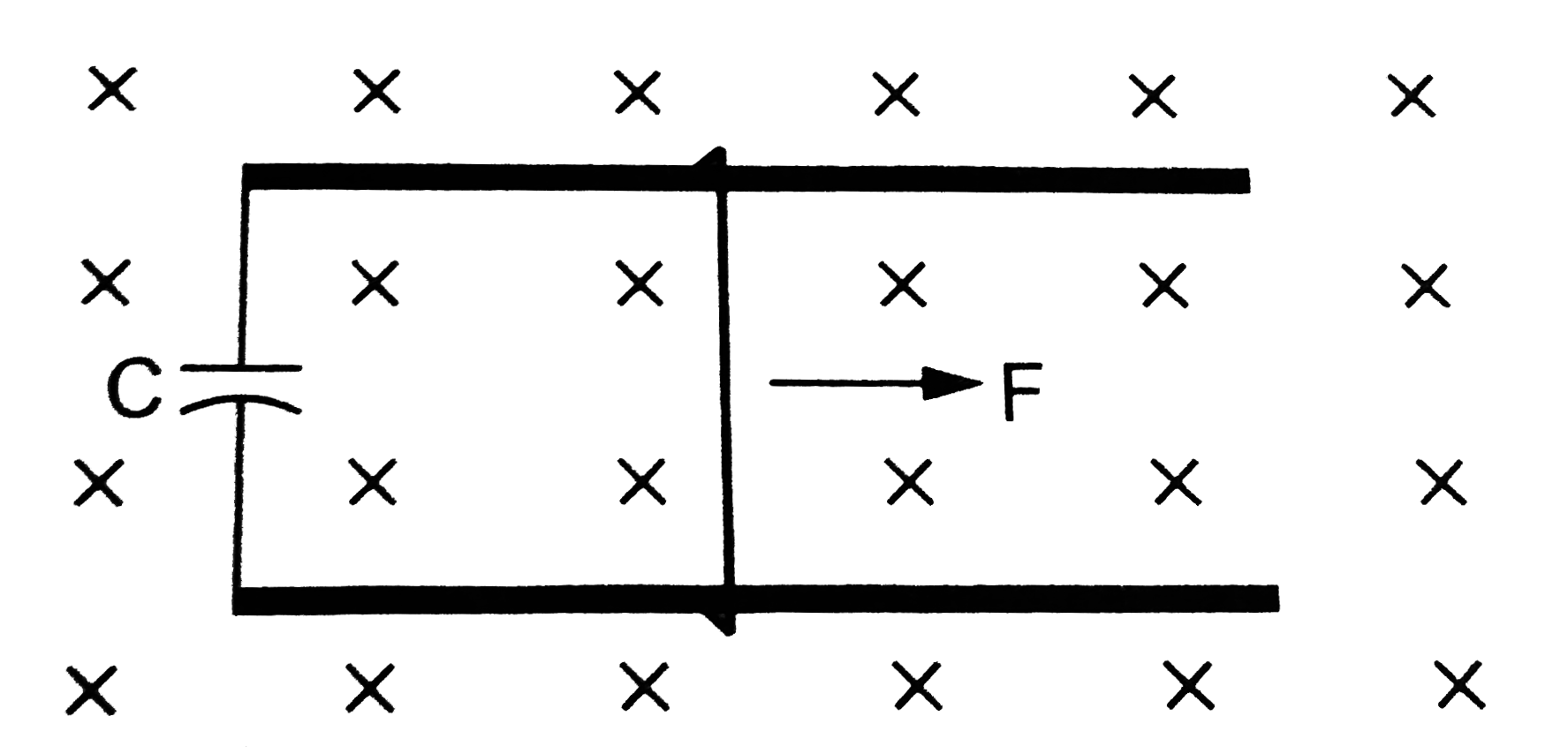
A wire of mass m and length I can freely slide on a pair of parallel, smooth, horizontal rails placed in a vertical magnetic field B . The rails are connected by a capacitor of capacitance C. The electric resistance of the rails and the wire is zero. If a constant force F acts on the wire as shown in the figure, find the acceleration of the wire.

Text Solution

Verified by Experts

Suppose the velocity of the wire is v at time t
The induced emf is epsilon = vBl
As there is no resistance anywhere, the charge on the capacitor will be ` q =Cepsilon = C v Bl` at time t
The current in the circuit will be a magnetic force `F ` = ilB = CB^2 l^2a towards left
The net force on the wire is `F - F' From Newton's law, `F -F' = ma or, F- Cb^2 l^2 a = ma or, `a= (F)/(m+CB^2l^2)
Promotional Banner

Topper's Solved these Questions

  • ELECTROMAGNETIC INDUCTION

    HC VERMA ENGLISH|Exercise Objective 1|11 Videos
  • ELECTROMAGNETIC INDUCTION

    HC VERMA ENGLISH|Exercise Objective 2|10 Videos
  • ELECTROMAGNETIC INDUCTION

    HC VERMA ENGLISH|Exercise Questions for short answer|9 Videos
  • ELECTRIC FIELD AND POTENTIAL

    HC VERMA ENGLISH|Exercise Objective 2|7 Videos
  • ELECTROMAGNETIC WAVES

    HC VERMA ENGLISH|Exercise Exercise|8 Videos

Similar Questions

Explore conceptually related problems

Figure shows a wire of resistance R sliding on two parallel, conducting fixed thick rails placed at a separation l. A magnetic fild B exist in a direction perpendicular to the plane of the rails. The wire is moving with a constant velocity v. Find current through the wire

A wire of mass m and length l can slide freely on a pair of fixed, smooth.vertical rails (figure).A magnetic field B exists in the region in the direction perpendicular to the plane of the rails.The rails are connected at the top end by an initially unchanged capacitor of capacitance C .Find the velocity of the wire at any time (t) after released.Neglecting any electric resistance.(initial velocity of wire is zero)

Figure shows a wire sliding on two parallel, conducting rails placed at a separation L . A magnetic field B exists in a direction perpendicular to the plane of the rails. What force is necessary to keep the wire moving at a constant velocity V ?

Shows a wire sliding on two parallel, conducting rails placed at a separaton l. A magnetic feld B exists in a direction perpendicular to the plane of the rails. What force is necessary to keep the wire moving at a constatn velocity v ?

Consider three long straight parallel wire as shown in figure. Find the force experienced by a 25 cm length of wire C .

A wire of length l , mass m and resistance R slides without any friction down the parallel conducting rails of negligible resistance . The rails are connected to each other at the bottom by a resistanceless rail parallel to the wire so that the wire and the rails form a closed rectangualr conducting loop. The plane of the rails makes an angle theta with the horizontal and a uniform vertical magnetic field of the inducetion B exists throughout the rregion. Find the steady state velocity of the wire.

A conducting wire of length l and mass m can slide without friction on two parallel rails and is connected to capacitance C . The whole system lies in amagnetic field B and a constant force F is applied to the rod . Then

A conducting wire of length l and mass m can slide without friction on two parallel rails and is connected to capacitance C . Whole system lies in a magnetic field B and a constant force F is applied to the rod. Then

Two infinite parallel wire, having the cross sectional area 'a' and resistivity 'k' are connected at a junction point 'p' (as shown in the figure). A slide wire of negligible resistance and having mass 'm' and length 'l' can slide between the parallel wires, without any frictional resistance. If the system of wires is introduced to a magnetic field of intensity 'B' (into the plane of paper) and the slide wire is pulled with a force which varies with the velocity of the slide wire as F=F_(0)v , then find the velocity of the slide wire as a function of the distance travelled. (The slide wire is initially at origin and has a velocity v_(0) )

Consider a situation similar ot that of the previous problem except that the ends of the rod slide on a pair of thick metallic rails laid parallel to the wire. At one end the rails are connected by resistor of resistance R. (a) what force is needed ot keep the rod sliding at a constant speed v? (b) in this situation what is the current in the resistance R? (c) Find the rate of heat developed in the resistor. (d) find the power delivered by the external agent exerting the force on the rod.

HC VERMA ENGLISH-ELECTROMAGNETIC INDUCTION-Worked out examples
  1. Shows a horizontal magnetic field which is uniform above the dotted li...

    Text Solution

    |

  2. Shows a wire of length l which can slide on a U- shaped rail of neglig...

    Text Solution

    |

  3. A rod of length l is translating at a velocity v making an angle theta...

    Text Solution

    |

  4. The horizontal component of the earth's magnetic field at a place is 3...

    Text Solution

    |

  5. An angle aob made of a conducting wire moves along its bisector throu...

    Text Solution

    |

  6. Shows a wire ab of length l and resistance R which can slide on a smoo...

    Text Solution

    |

  7. A square loop of side 10 cm and resistance 1 Omega is moved towards ri...

    Text Solution

    |

  8. A metal rod length l rotates about on end with a uniform angular velo...

    Text Solution

    |

  9. Shows a conducting circular loop radius a placed in a uniform, perpend...

    Text Solution

    |

  10. shows a conducitng loop abcdefa made of six segment ab, bc cd, de, ef ...

    Text Solution

    |

  11. A wire of mass m and length I can freely slide on a pair of parallel, ...

    Text Solution

    |

  12. An inductor coil stores 32 J of magnetic field energy and dissiopates ...

    Text Solution

    |

  13. A 12 V battery connected ot a 6 Omega, 10 H coil through a switch driv...

    Text Solution

    |

  14. A solenoid of inductance 50 mH and resistance 10 Omega is connected ...

    Text Solution

    |

  15. An LR circuit having L = 4.0 H, R = 1.0 Omega and epsilon = 6.0 V is s...

    Text Solution

    |

  16. An LR combination is connected to an idal battery. If l = 10 mH, R = ...

    Text Solution

    |

  17. An inductor-resistance -battery circuit is switched on at t = 0. find...

    Text Solution

    |

  18. A coil of inductance 1.0 H and resistance 100 Omega is connected to a...

    Text Solution

    |

  19. An inducatane L and a resistance R are connected in series with a batt...

    Text Solution

    |

  20. Two conducting circular loops of radii R1 and R2 are placed in the sa...

    Text Solution

    |
