Home
Class 12
PHYSICS
The system containing the rails and the ...

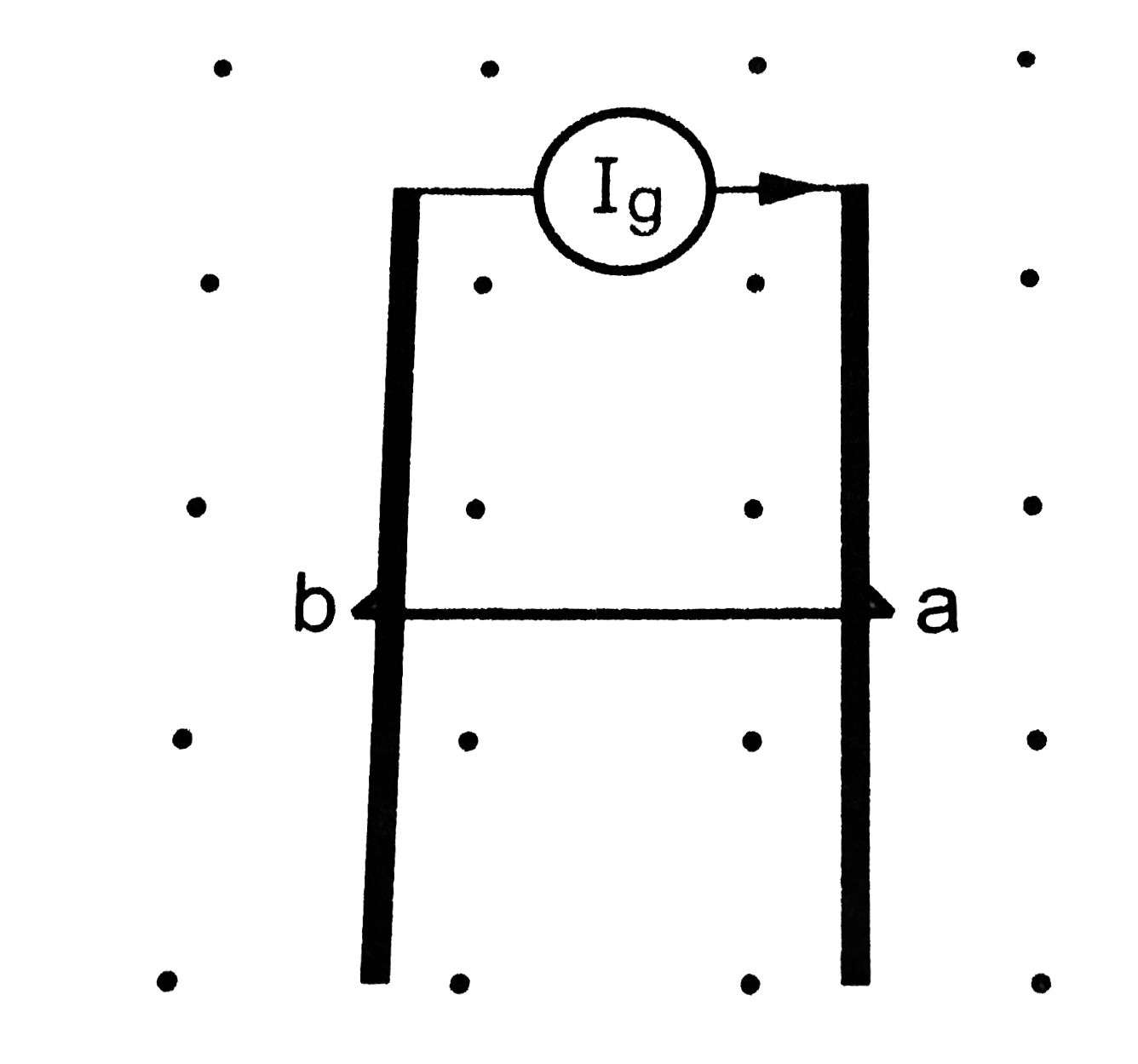
The system containing the rails and the wire of the previous problem is kept vertically in a uniform horizontal magnetic field B that is perpendicular to the plane of the rails. It is found that the wire stays in equilibrium. If the wire ab is replaced by another of double its mass, how long will it take in falling through a distance equal ot its length?

Text Solution

Verified by Experts

Given : Blv=mg
When wire is replace ,we have
`2mg-Blv=2 ma …(i)`
` implies a= (2mg-Blv)/(2m)`
`Now, s=ut+(1/2)at^2`
` implies l=(1/2)xx(2 mg-Blv)/(2m)xxt^2`
`[:. S=l]`
`t=sqrt((4 ml)/(2 mg-Blv))`
`=sqrt((4 ml)/(2mg-mg)) [from (1)] `
` =sqrt((21)/(g))`.
Promotional Banner

Topper's Solved these Questions

  • ELECTROMAGNETIC INDUCTION

    HC VERMA ENGLISH|Exercise Questions for short answer|9 Videos
  • ELECTROMAGNETIC INDUCTION

    HC VERMA ENGLISH|Exercise Objective 2|10 Videos
  • ELECTRIC FIELD AND POTENTIAL

    HC VERMA ENGLISH|Exercise Objective 2|7 Videos
  • ELECTROMAGNETIC WAVES

    HC VERMA ENGLISH|Exercise Exercise|8 Videos

Similar Questions

Explore conceptually related problems

Statement I: A resistance R is connected between the two ends of the parallel smooth conducting rails. A conducting rod lies on these fixed horizontal rails and a uniform constant magnetic field B exists perpendicular to the plane of the rails as shown in Fig. if the rod is given a velocity upsilon and released as shown in Fig. 3.188, it will stop after some time. the total work done by magnetic field negative. Statement II: If force acts opposite to direction of velocity its work done is negative.

Two parallel vertical metallic rails AB and CD are separated by 1m . They are connected at the two ends by resistances R_1 and R_2 as shown in the figure. A horizontal metallic bar l of mass 0.2 kg slides without friction, vertically down the rails under the action of gravity. There is a uniform horizontal magnetic field of 0.6 T perpendicular to the plane of the rails. It is observed that when the terminal velocity is attained, the powers dissipated in R_1 and R_2 are 0.76W and 1.2W respectively (g=9.8m//s^2) The terminal velocity fo the bar L will be

Two parallel vertical metallic rails AB and CD are separated by 1m . They are connected at the two ends by resistances R_1 and R_2 as shown in the figure. A horizontal metallic bar l of mass 0.2 kg slides without friction, vertically down the rails under the action of gravity. There is a uniform horizontal magnetic field of 0.6 T perpendicular to the plane of the rails. It is observed that when the terminal velocity is attained, the powers dissipated in R_1 and R_2 are 0.76W and 1.2W respectively (g=9.8m//s^2) The value of R_1 is

Two parallel vertical metallic rails AB and CD are separated by 1m . They are connected at the two ends by resistances R_1 and R_2 as shown in the figure. A horizontal metallic bar l of mass 0.2 kg slides without friction, vertically down the rails under the action of gravity. There is a uniform horizontal magnetic field of 0.6 T perpendicular to the plane of the rails. It is observed that when the terminal velocity is attained, the powers dissipated in R_1 and R_2 are 0.76W and 1.2W respectively (g=9.8m//s^2) The value of R_2 is

A conducting wire xy of lentgh l and mass m is sliding without friction on vertical conduction rails ab and cd as shown in figure. A uniform magnetic field B exists perpendicular to the plane of the rails, x moves with a constant velocity of

A conducting wire xy of lentgh l and mass m is sliding without friction on vertical conduction rails ab and cd as shown in figure. A uniform magnetic field B exists perpendicular to the plane of the rails, x moves with a constant velocity of

A copper wire bent in the shape of a semicircle of radius r translates in its plane with a constant velocity v. A uniform magnetic field B exists in the direction perpendicular to the plane of the wire. Find the emf induced between the ends of the wire if (a) the velocity is perpendicular ot the diameter joining free ends, (b) the velocity is parallel to this diameter.

A 2.5 m long straight wire having mass of 500 g is suspended in mid air by a uniform horizontal magnetic field B. If a current of 4 A is passing through the wire then the magnitude of the field is ("Take g "10 m s^(-2))

In a trapeze-shaped structure, two rigid wires of negligble mass support a conducting bar of mass m and length L as shown in Fig. A source of emf is applied to the wires so that a current I flows through the bar. A uniform magnetic field vec B is perpendicular to the plane of the wires and bar. a. Compute the current that the source of emf must provide so that there is no tension in the wires. b. If the current is reduced to half the value computed in (a) and the plane of the structure is moved through an angle theta , compute the tension in the wires and the magnitude of the net unbalanced force on the bar at the instant it is released from this angle.

A conducting wire of length l is placed on a rough horizontal surface, where a uniform horizontal magnetic field B perpendicular to the length of the wire exists. Least values of the forces required to move the rod when a current I is established in the rod are observed to be F_1 and F_2 (lt F_1) for the two possible directions of the current through the rod, respectively. Find the weight of the rod and the coefficient of friction between the rod and the surface.

HC VERMA ENGLISH-ELECTROMAGNETIC INDUCTION-EXERCISE
  1. The current generator I g, shown in . Sends a constant current I throu...

    Text Solution

    |

  2. The current generator ig, shown in , sends a constant current I throu...

    Text Solution

    |

  3. The system containing the rails and the wire of the previous problem i...

    Text Solution

    |

  4. The rectangualr wire- frame, shown in has a width d, mass m, resist...

    Text Solution

    |

  5. Shows a smooth pair of thick metallic rails connected across a battery...

    Text Solution

    |

  6. A conducting wire ab of length l, resistance r and mass m starts slidi...

    Text Solution

    |

  7. A bicycle is resting on its stand in the east - west direction and the...

    Text Solution

    |

  8. A conducting disc of radius r rotaes with a small but constant angul...

    Text Solution

    |

  9. shows a conducting disc rotating about its axis in a perpendicular ma...

    Text Solution

    |

  10. The magnetic field inn a region is given by vec B = veck (B0)/(L) y wh...

    Text Solution

    |

  11. shows a straight, long wire carrying a current I and a rod of length l...

    Text Solution

    |

  12. Consider a situation similar ot that of the previous problem except th...

    Text Solution

    |

  13. Shows a square frame of wire having a total resistance r placed coplan...

    Text Solution

    |

  14. A rectangular metallic loop of length l and width b is placed coplan...

    Text Solution

    |

  15. Shows a conducting circular loop of radius a placed in a uniform, perp...

    Text Solution

    |

  16. Consider the situation shown in the figure of the previous problem. Su...

    Text Solution

    |

  17. Consider a variation of the previous problem. Suppose the circular loo...

    Text Solution

    |

  18. Shows a situation similar to the previous problem. All parameters are...

    Text Solution

    |

  19. A wire of mass m and length l can slide freely on a pair of smooth, ve...

    Text Solution

    |

  20. A uniform magnetic field B exists in a cylindrical region, shown dotte...

    Text Solution

    |
