


Topper's Solved these Questions
Similar Questions
Explore conceptually related problems
SL ARORA-MECHANICS-Exercise
- The area under acceleration-time graph gives
Text Solution
|
- The displacement-time graph for two particles A and B are straight lin...
Text Solution
|
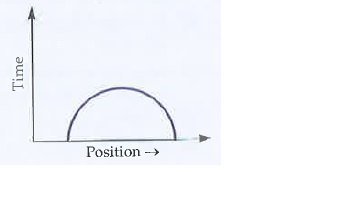
- Is the time variationof position, shown in the adjacent figure, observ...
Text Solution
|
- Displacement-time graph of any object is shown in the adjacent figure....
Text Solution
|
- Acceleration is defined as the rate of change of velocity. Suppose we ...
Text Solution
|
- What are the characteristics of uniform motion ?
Text Solution
|
- Use graphical method to derive the relation v^(2) - u^(2) = 2 as, wher...
Text Solution
|
- Prove that x = x0 + v0 t + 1/2 at^(2).
Text Solution
|
- Show that the slope of displacement-time graph is equal to the velcoit...
Text Solution
|
- Draw velocity-time graphof uniform motion and prove that the area unde...
Text Solution
|
- Using graphical method, derive the equations v = u + at and s = ut +...
Text Solution
|
- Use velocity time graph to derive the relation : v^(2)-u^(2)=2 as, whe...
Text Solution
|
- Distinguish between average velocity and instanteneous velocity. If th...
Text Solution
|
- Explain with example the distinction between the magnitude of average ...
Text Solution
|
- Derive the equations of motion given below: v=u+at
Text Solution
|
- Using graphical method, derive the equations v = u + at and s = ut +...
Text Solution
|
- Check the dimensional consistency of the following equations : (i) u...
Text Solution
|
- Prove the following relations by calculus method: v^2-u^2=2as
Text Solution
|
- Use integeration technique to prove that the distance travelled in nth...
Text Solution
|
- Show that area under the velocity-time graph of an object moving with ...
Text Solution
|