

Home
Class 11
PHYSICS
A block of mass m slides over a smooth w...

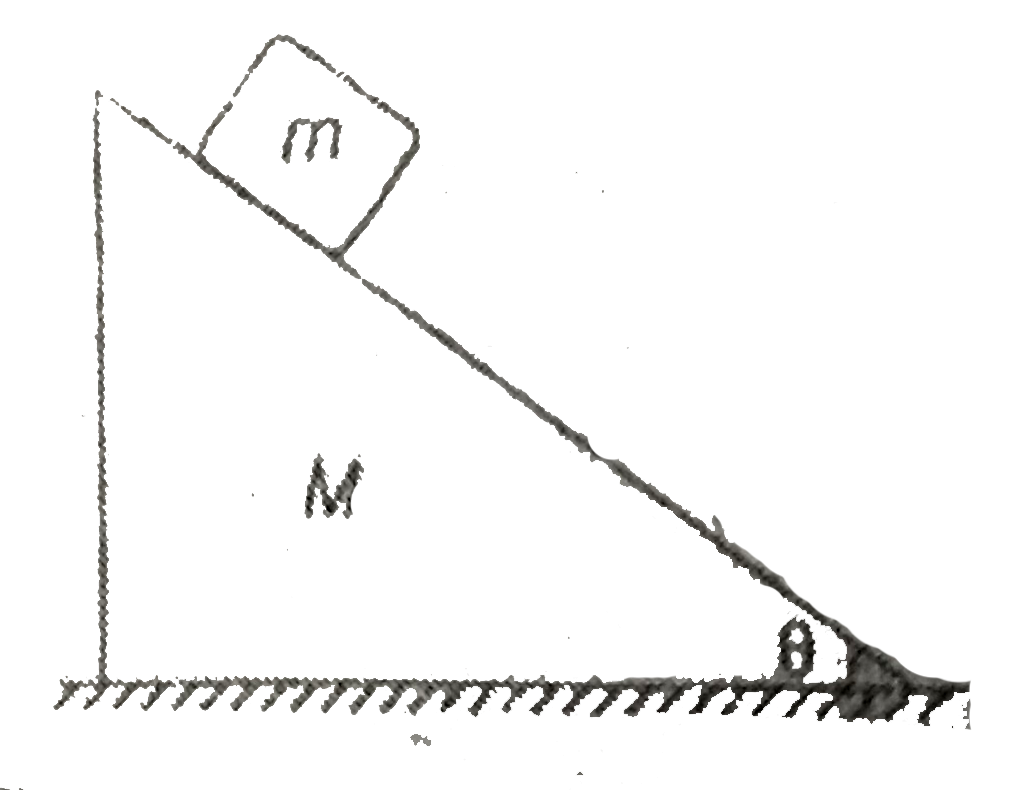
A block of mass m slides over a smooth wedge of mass M which is placed over a rough horizontal surface . The centre of mass of the system will move towards left

Here `mu` = coefficient of friction between the wedge and the ground .

Promotional Banner

Topper's Solved these Questions

  • Laws of Motion

    SL ARORA|Exercise Exercise|627 Videos
  • Kinetic Theory of gases

    SL ARORA|Exercise Example|47 Videos
  • LAWS OF MOTION : FRICTION

    SL ARORA|Exercise Self Practice|95 Videos

Similar Questions

Explore conceptually related problems

A block of mass m is placed at rest on a smooth wedge of mass M placed at rest on a smooth horizontal surface. As the system is released

A block of mass 2 kg is kept on a smooth wedge of mass 3 kg and wedge is kept on a rough horizontal surface. A vertical force of 60 N is applied on the minimum coefficient of friction between the wedge and horizontal surface, so that wedge remains at rest during the motion of block on the wedge ?

In the arrangement shown in figure, a block A of mass m has been placed on a smooth wedge B of mass M. The wedge lies on a horizontal smooth surface. Another block C of mass (M)/(4) has been placed in contact with the wedge B as shown. The coefficient of friction between the block C and the vertical wedge wall is mu= (3)/(4) . Find the ratio (m)/(M) for which the block C will not slide with respect to the wedge after the system is released?

A small block of mass m is placed at rest on the top of a smooth wedge of mass M, which in turn is placed at rest on a smooth horizontal surface as shown in figure. It h be the height of wedge and theta is the inclination, then the distacne moved by the wedge as the block reaches the foot of the wedge is

A block of mass m rests on a stationary wedge of mass M. The wedge can slide freely on a smooth horizontal surface as shown in figure. If the block starts from rest

The air of density rho and moving with a velocity v strikes perpendicular the inclined surface of area A and of a wedge kept on a horizontal surface. The mass of the wedge is m . Assuming the collisions to be perfectly inelastic, the minimum value of the coefficient of friction between the wedge and the ground so that the wedge does not move is (Assume mass of particles of air is negligible)

A block of mass m is at rest over the rough surface of the fixed wedge.

a Block of mass m is placed on a wedge of mass M there is no friction between the block and the wedge .The minmum coefficient of friction between the wedge and the gound so that wedge does not move is,

A homogenous block of mass m, width b and height h is resting on a rough horizontal surface A horizontal force F is applied to it , which makes it to move with a constant velocity . The coefficient of friction between block and surface is mu Find the greatest height at which force F may be applied to slide the block with out tipping over

SL ARORA-Laws of Motion-Exercise
  1. Friction is a necessary evil. Explain.

    Text Solution

    |

  2. A block of mass 4kg rests on a rough horizontal plane. The plane is gr...

    Text Solution

    |

  3. A block of mass m slides over a smooth wedge of mass M which is placed...

    Text Solution

    |

  4. Why does a cyclist lean to one side while going along a curve ? In wha...

    Text Solution

    |

  5. Obtain expression of energy of a particle at dfferent positions in the...

    Text Solution

    |

  6. Which law of Newton defines an 'inertial frame of reference' ? .

    Text Solution

    |

  7. What is inertia ? Discuss its types giving one example in each case.

    Text Solution

    |

  8. Newton's second law of motion is

    Text Solution

    |

  9. Define absolute and gravitational units of force state relation betwee...

    Text Solution

    |

  10. State Newton's Second law of motion. Derive a mathematical formula to ...

    Text Solution

    |

  11. State Newton's third law of motion. Derive the law of conservation of ...

    Text Solution

    |

  12. Why does a gun recoil on firing? Obtain an expression for recoil veloc...

    Text Solution

    |

  13. Name a varying mass system Drive the expressions the (i) for the veloc...

    Text Solution

    |

  14. Two masses M and m are connected at the two ends of an inextensible st...

    Text Solution

    |

  15. Is impulse a scalar or vector quantity ? Write its SI unit.

    Text Solution

    |

  16. State and establish impulse-momentum theorem.

    Text Solution

    |

  17. Explain the term impulse Show that impulse of a variable force is equa...

    Text Solution

    |

  18. What is friction ?

    Text Solution

    |

  19. Define coefficient of friction and angle of friction and hence derive ...

    Text Solution

    |

  20. Define angle of friction and angle of repose. Show that both are numer...

    Text Solution

    |