Home
Class 11
PHYSICS
A block P of mass m is placed on horizon...

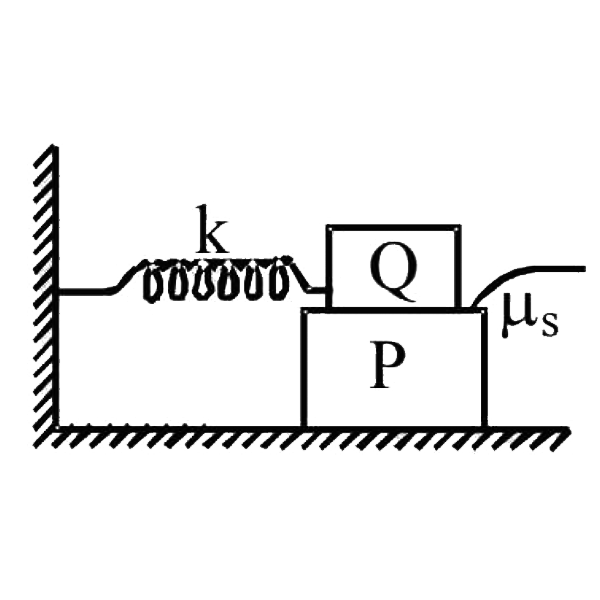
A block P of mass m is placed on horizontal frictionless plane. A second block of same mass m is placed on it and is connected to a spring of spring constant k, the two blocks are pulled by distance A. Block Q oscillates without slipping. What is the maximum value of frictional force between the two blocks.

A

`kA//2`

B

kA

C

`mu_s mg`

D

zero

Text Solution

Verified by Experts

Promotional Banner

Topper's Solved these Questions

  • Laws of Motion

    SL ARORA|Exercise Exercise|627 Videos
  • Kinetic Theory of gases

    SL ARORA|Exercise Example|47 Videos
  • LAWS OF MOTION : FRICTION

    SL ARORA|Exercise Self Practice|95 Videos

Similar Questions

Explore conceptually related problems

A block Q of mass 2m is placed on a horizontal frictionless plane. A second block of mass m is placed on it and is connected to a spring of spring constant K, the two block are pulled by distance A. Block Q oscillates without slipping. The work done by the friction force on block Q when the spring regains its natural length is:

A block P of mass m is placed on a smooth horizontal surface. A block Q of the same mass is placed over the block P and the coefficient of static friction between them is mu . A spring of spring constant K is attached to block Q. The blocks are displaced together to a distance A and released. The upper block oscillates without slipping over the lower block. The maximum frictional force between the block is:

There is no slipping between the two block. What is force of friction between two blocks?

A block A of mass m is placed on a frictionless horizontal surface. Another block B of the same mass is kept on A and connected to the wall with the helpf of a spring of force constant K as shown in the figure. The coefficient of friction between the blocks A and B is mu . The blocks move together execting simple harmonic motion of amplitude 'a'. What is the maximum value of the fricitional force between A and B ?

Two spring are connected toa block of mass M placed a frictionless surface as shown if both the spring have a spring constant k the frequency of oscillation block is

A block of mass m_1 resting on a frictionless horizontal surface is connected to a spring of spring constant k that is anchored in a near by wall. A block of mass m_2 is placed on the top of the first block. The coefficient of static friction between the two blocks is mu Assuming that the two blocks move together as a unit, find the period of oscillation of the system and also find maximum oscillation amplitude that permits the two bodies to move as a unit.

A block A of mass m_(1) is placed on a horizontal frictionless table. It is connected to one end of a light spring of force constant k whose other end is fixed to a wall. A small block B of mass m_(2) is placed on block A. The coefficient of static friction between the blocks is mu . The system is displaced slightly from its equilibrium position and released. What is the maximum amplitude of the resulting simple harmonic motion of the system so that the upper block does not slip over the lower block ?

A block of mass m is placed on a rough horizontal surface. If minimum force to pull the block is (mg)/(2) then coefficient of friction is :

In the system shown in fig. block of mass M is placed on a smooth horizontal surface. There is a mass less rigid support attached to the block. Block of mass m is placed on the first block and it is connected to the support with a spring of force constant K. There is no friction between the blocks. A bullet of mass m_(0) , moving with speed u hits the block of mass M and gets embedded into it. The collision is instantaneous. Assuming that m always stays over M, calculate the maximum extension in the spring caused during the subsequent motion. K=8960 N//m , u=400 m//s

SL ARORA-Laws of Motion-Exercise
  1. A block of mass m is at rest under the action of force F against a wal...

    Text Solution

    |

  2. What is the maximum value of the force F such that the block shown in ...

    Text Solution

    |

  3. A block P of mass m is placed on horizontal frictionless plane. A seco...

    Text Solution

    |

  4. A weight W rests on a rough horizontal plane,If the angle of friction ...

    Text Solution

    |

  5. An insect crawls up a hemispherical surface very slowly (see the figur...

    Text Solution

    |

  6. A long horizontal rod has a bead which can slide along its length and ...

    Text Solution

    |

  7. A car is moving in a circular horizonta track of radius 10m with a con...

    Text Solution

    |

  8. A small block is shot into each of the four tracks as shown below. Eac...

    Text Solution

    |

  9. The driver of a car travelling at velocity v suddenly see a broad wall...

    Text Solution

    |

  10. A stone tied to a string of length L is whirled in a vertical circle w...

    Text Solution

    |

  11. Two particles of mass m each are tied at the ends of a light string of...

    Text Solution

    |

  12. A block of base 10 cm xx 10 cm and height 15 cm is kept on an inclined...

    Text Solution

    |

  13. A block is stationary on an inclined plane If the coefficient of frict...

    Text Solution

    |

  14. A block of mass m is on an inclined plane of angle theta. The coeffici...

    Text Solution

    |

  15. A ball of mass (m) 0.5 kg is attached to the end of a string having le...

    Text Solution

    |

  16. A ball of mass 0.2 kg rests on a vertical post of height 5m. A bullet ...

    Text Solution

    |

  17. A reference frame attached to the earth

    Text Solution

    |

  18. The balls, having linear momenta vecp1=vecpi and vecp22=-vecpi, underg...

    Text Solution

    |

  19. A small block of mass of 0.1 kg lies on a fixed inclined plane PQ whic...

    Text Solution

    |

  20. In the following questions, each question contains Statement I(asserti...

    Text Solution

    |

