Home
Class 11
BIOLOGY
Do your know any step in the TCA cycle ...

Do your know any step in the TCA cycle where there is substrate level phosphorylation. Which one ?

Text Solution

Verified by Experts
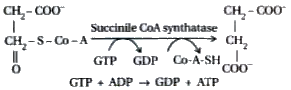
When Succinile CoA gets converted into succinic acid, one molecule of GTP is formed in stroma based phosphorylation.
`GTP + ADP to GDP + ATP `
Promotional Banner

Topper's Solved these Questions

  • RESPIRATION IN PLANTS

    KUMAR PRAKASHAN|Exercise Section - E (Solution of NCERT Examplar) (Long Answer Type Questions)|5 Videos
  • RESPIRATION IN PLANTS

    KUMAR PRAKASHAN|Exercise Questions from Module (Inportant MCQ for NEET)|4 Videos
  • RESPIRATION IN PLANTS

    KUMAR PRAKASHAN|Exercise Section - E (Solution of NCERT Examplar) (Very Short Type Questions)|7 Videos
  • PLANT KINGDOM

    KUMAR PRAKASHAN|Exercise OBJECTIVE SECTION (FILL IN THE BLANKS)|9 Videos
  • SAMPLE QUESTION PAPER FOR ANNUAL EXAM

    KUMAR PRAKASHAN|Exercise SECTION - D|2 Videos

Similar Questions

Explore conceptually related problems

At how many steps substrate level phophorylation occurs during glycolysis:

ATP produced during glycolysis is a result of substrate level phosphorylation . Explain.

Nucleophilic aliphatic substitution reaction is mainly of two types: S_(N)1 and S_(N)2 . The S_(N)1 mechanism is a two step process. Reaction velocity of S_(N)1 reaction depends only on the concentration of the substrate. Since product formation takes place by the formation of carbocation, optically active substrate gives (+) and (-) forms of the product. In most of the cases the product usually consists of 5-20% inverted product and 80-95% racemised species. The more stable the carbocation, the greater is the proportion of racemisation. In solvolysis reaction, the more nucleophilic the solvent, the greater is the proportion of inversion. Which one of the following compound will give S_(N)1 reaction predominantly?

Nucleophilic aliphatic substitution reaction is mainly of two types: S_(N)1 and S_(N)2 . The S_(N)1 mechanism is a two step process. Reaction velocity of S_(N)1 reaction depends only on the concentration of the substrate. Since product formation takes place by the formation of carbocation, optically active substrate gives (+) and (-) forms of the product. In most of the cases the product usually consits of 5-20% inverted product and 80-95% racemised species. The more stable the carbocation, the greater is the proportion of racemisation. In solvolysis reaction, the more nucleophilic the solvent, the greater is the proportion of inversion. For the gives reaction, Which substrate will give maximum racemisation?

A cycle followed by an engine (made of one mole of perfect gas in a cylinder with a piston) is shown in figure. A to B: volume constant B to C: adiabatic C to D: volume constant D to A: adiabatic V_C=V_D=2V_A=2V_B (a) In which part of the cycle heat is supplied to the engine from outside ? (b) In which part of the cycle heat is being given to the surrounding by the engine ? (c) What is the work done by the engine in one cycle ? Write your answer in term of P_A,P_B,V_A (d) What is the efficiency of the engine ? ( gamma=5/3 for the gas , C_V=3/2R for one mole )

Consider the numbers of the form 4^n where n is a natural number. Check whether there is any value of n for which 4^n ends with zero?

A ball is bouncing down a set of stairs. The coefficient of restitution is e. The height of each step is d and the ball bounces one step at each bounce. After each bounce the ball rebounds to a height h above the next lower step. Neglect width of each step in comparison to h and assume the impacts to be effectively head on. Which of the following relative is correct ?

(i) Temperature, pH and concentration of substrate can influence enzyme activity ? (ii) ES complex is short lived and dissociates into products (P) (iii) In exothermic reaction, the energy level of "P" is lower than "S" substrate (iv) Cofactors play a crucial role in the catalytic activity of the enzyme. Which of the above statements are correct ?

KUMAR PRAKASHAN-RESPIRATION IN PLANTS-Section - E (Solution of NCERT Examplar) (Short Answer Type Qeustion)
  1. The energy yield in terms of ATP is higher in aerobic respiration tha...

    Text Solution

    |

  2. Oxygen is an essential requirement for aerobic respiration but it en...

    Text Solution

    |

  3. Respiration is an energy releasing and enzymatically controlled catabo...

    Text Solution

    |

  4. Comment on the statement respiration is an energy producing process...

    Text Solution

    |

  5. The figure given below shows the steps in glycolysis. Fill in the mi...

    Text Solution

    |

  6. Discuss "The respiratory pathway is an amphibolic pathway "

    Text Solution

    |

  7. We commonly call ATP as the energy currency of the cell. Can you thi...

    Text Solution

    |

  8. ATP produced during glycolysis is a result of substrate level phosph...

    Text Solution

    |

  9. Do your know any step in the TCA cycle where there is substrate leve...

    Text Solution

    |

  10. In a way green plants and cyanobacteria have synthesised all the food...

    Text Solution

    |

  11. When a substrate is being metabolized, why does not all the energy t...

    Text Solution

    |

  12. Respiration requires O(2) . How did the first cells on the earth manag...

    Text Solution

    |

  13. It is known that red muscle fibres in animals can work for longer ...

    Text Solution

    |

  14. The energy yield in terms of ATP is higher in aerobic respiration tha...

    Text Solution

    |

  15. RuBP carboxylase, PEPcase, pyruvate dehydrogenase, ATPase, cytochrome ...

    Text Solution

    |

  16. How does a tree trunk exchange gases with the environment although ...

    Text Solution

    |

  17. Write two energy yielding reactions glycolysis

    Text Solution

    |

  18. Name the site (s) of pyruvate synthesis. Also, write the chemical rea...

    Text Solution

    |

  19. Respiratory pathway is believed to be a catabolic pathway. However, ...

    Text Solution

    |

  20. Mention the important series of events of aerobic respiration that o...

    Text Solution

    |

