Home
Class 12
CHEMISTRY
Xenon Fluorides : Xenon reacts directly ...

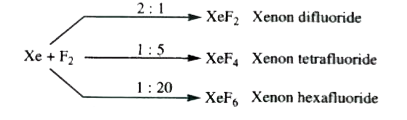
Xenon Fluorides : Xenon reacts directly with fluorine on heating at 675 K in a sealed nickel tube. The product obtained depends upon the amount of fluorine present.

`XeF_6` on complete hydrolysis gives

A

`XeO_4`

B

`XeOF_2`

C

`XeOF_4`

D

`XeO_3`

Text Solution

Verified by Experts

The correct Answer is:

D

`XeF_6 + 3H_2O to XeO_3 + 6HF`
Promotional Banner

Topper's Solved these Questions

  • NOBLE GASES

    AAKASH SERIES|Exercise LEVEL - II (LECTURE SHEET) (EXERCISE - III MATCH THE FOLLOWING QUESTIONS)|5 Videos
  • NOBLE GASES

    AAKASH SERIES|Exercise LEVEL - II (LECTURE SHEET) (EXERCISE - IV INTEGER ANSWER TYPE QUESTIONS)|10 Videos
  • NOBLE GASES

    AAKASH SERIES|Exercise LEVEL - II (LECTURE SHEET) (EXERCISE - I SIGGLE & ONE OR MORE THAN ONE CORRECT ANSWERS)|12 Videos
  • NITROGEN CONTAINING COMPOUNDS

    AAKASH SERIES|Exercise Conversions|18 Videos
  • NUCLEAR CHEMISTRY

    AAKASH SERIES|Exercise PRACTICE SHEET - 2 (Integer answer type Questions )|8 Videos

Similar Questions

Explore conceptually related problems

Xenon Fluorides : Xenon reacts directly with fluorine on heating at 675 K in a sealed nickel tube. The product obtained depends upon the amount of fluorine present. XeF_2 reacts with SbF_5 to form

Xenon reacts with fluorine at 873 K and 7 bar to form XeF_(4) . In this reaction, the ratio of xenon and fluorine required is

K_2Cr_2O_7 acts as a good oxidizing agent in acidic medium underset("Orange")(Cr_(2)O_(7)^(2-)) + 14H^(+) + 6e^(-) rarr underset("Green")(2Cr^(3+)) + 7H_2O In alkaline solution, orange colour of Cr_(2)O_(7)^(2-) chages to yellow colour due to formation of Cr_2O_(4)^(2-) and again yellow colour changes to orange colour on changing the solution to acidic medium underset("Orange")(Cr_2O_7^(2-))+2OH^(_) rarrunderset("Yellow")(Cr_2O_7^(2-))+H_2O underset("Yellow")(2CrO_(4)^(2_-)) + 2H^(+) rarr underset("Orange")(Cr_(2)O_(7)^(2-) + H_(2)O) Cr_(4)^(2-) and Cr_(2)O_(7)^(2-) exist in equilibrium at pH =4 and are interconvertible by altering the pH of the solution. When heated with H_2SO_4 and metal chloride K_2Cr_2O_7 gives vapour of chromyl chloride (CrO_2Cl_2) . Chromyl chloride (CrO_2Cl_2) when passed into aqueous NaOH solution, yellow colour solution of CrO_(4)^(2-) is obtained. This on reaction with lead acetate gives yellow ppt. PbCrO_4 . When H_2O_2 is added to an acidified solution of dichromate ion, a complicated reaction occurs. The products obtained depend on the pH and concentration of dichromate. Cr_2O_7^(2-)+2H^(+) + 4H_(2)O_(2) rarr 2Cr(O_2)+5H_2O A deep blue-violet coloured peroxo compound, CrO(O_2)_2, ' called chromic peroxide is formed. This decomposes rapidly in aqueous solution into Cr^(3+) and xygen. CrO_3 on reaction with HCl and the product on reaction with NaOH(aq) give respectively

K_2Cr_2O_7 acts as a good oxidizing agent in acidic medium underset("Orange")(Cr_(2)O_(7)^(2-)) + 14H^(+) + 6e^(-) rarr underset("Green")(2Cr^(3+)) + 7H_2O In alkaline solution, orange colour of Cr_(2)O_(7)^(2-) chages to yellow colour due to formation of Cr_2O_(4)^(2-) and again yellow colour changes to orange colour on changing the solution to acidic medium underset("Orange")(Cr_2O_7^(2-))+2OH^(_) rarrunderset("Yellow")(Cr_2O_7^(2-))+H_2O underset("Yellow")(2CrO_(4)^(2_-)) + 2H^(+) rarr underset("Orange")(Cr_(2)O_(7)^(2-) + H_(2)O) Cr_(4)^(2-) and Cr_(2)O_(7)^(2-) exist in equilibrium at pH =4 and are interconvertible by altering the pH of the solution. When heated with H_2SO_4 and metal chloride K_2Cr_2O_7 gives vapour of chromyl chloride (CrO_2Cl_2) . Chromyl chloride (CrO_2Cl_2) when passed into aqueous NaOH solution, yellow colour solution of CrO_(4)^(2-) is obtained. This on reaction with lead acetate gives yellow ppt. PbCrO_4 . When H_2O_2 is added to an acidified solution of dichromate ion, a complicated reaction occurs. The products obtained depend on the pH and concentration of dichromate. Cr_2O_7^(2-)+2H^(+) + 4H_(2)O_(2) rarr 2Cr(O_2)+5H_2O A deep blue-violet coloured peroxo compound, CrO(O_2)_2, ' called chromic peroxide is formed. This decomposes rapidly in aqueous solution into Cr^(3+) and xygen. Which of the following statements is wrong when a mixture of NaCI and K_2Cr_2O_2 is gently walmed with conc. H_2SO_4 ?

K_2Cr_2O_7 acts as a good oxidizing agent in acidic medium underset("Orange")(Cr_(2)O_(7)^(2-)) + 14H^(+) + 6e^(-) rarr underset("Green")(2Cr^(3+)) + 7H_2O In alkaline solution, orange colour of Cr_(2)O_(7)^(2-) chages to yellow colour due to formation of Cr_2O_(4)^(2-) and again yellow colour changes to orange colour on changing the solution to acidic medium underset("Orange")(Cr_2O_7^(2-))+2OH^(_) rarrunderset("Yellow")(Cr_2O_7^(2-))+H_2O underset("Yellow")(2CrO_(4)^(2_-)) + 2H^(+) rarr underset("Orange")(Cr_(2)O_(7)^(2-) + H_(2)O) Cr_(4)^(2-) and Cr_(2)O_(7)^(2-) exist in equilibrium at pH =4 and are interconvertible by altering the pH of the solution. When heated with H_2SO_4 and metal chloride K_2Cr_2O_7 gives vapour of chromyl chloride (CrO_2Cl_2) . Chromyl chloride (CrO_2Cl_2) when passed into aqueous NaOH solution, yellow colour solution of CrO_(4)^(2-) is obtained. This on reaction with lead acetate gives yellow ppt. PbCrO_4 . When H_2O_2 is added to an acidified solution of dichromate ion, a complicated reaction occurs. The products obtained depend on the pH and concentration of dichromate. Cr_2O_7^(2-)+2H^(+) + 4H_(2)O_(2) rarr 2Cr(O_2)+5H_2O A deep blue-violet coloured peroxo compound, CrO(O_2)_2, ' called chromic peroxide is formed. This decomposes rapidly in aqueous solution into Cr^(3+) and xygen. What happens when a solution of potassium chromate is treated with an excess of dilute nitric acid?

Xe reacts with F_(2) at different ratio to give different types of xenon fluorides. Xe+ Fe rarr XeF_(2) (2:1) Xe +F_(2) rarr XeF_(4) (1:5) Xe + F_(2) rarr XeF_(6) (1: 20) Which of the following option is correct regrading XeF_(2)

Xe reacts with F_(2) at different ratio to give different types of xenon fluorides. Xe+ Fe rarr XeF_(2) (2:1) Xe +F_(2) rarr XeF_(4) (1:5) Xe + F_(2) rarr XeF_(6) (1: 20) The sbape and hybridisation of XeF_(4 ) is
