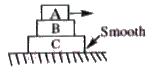
Text Solution
Verified by Experts
The correct Answer is:



Topper's Solved these Questions
WORK -POWER-ENERGY
AAKASH SERIES|Exercise PRACTICE SHEET (ADVANCED) (STRAIGHT OBJECTIVE TYPE QUESTIONS)|36 VideosWORK -POWER-ENERGY
AAKASH SERIES|Exercise ADDITIONAL PRACTICE EXERCISE (LEVEL -II LECTURE SHEET ADVANCED MATRIX MATCHING TYPE QUESTIONS)|1 VideosVISCOSITY
AAKASH SERIES|Exercise Questions for Descriptive Answers|3 VideosWORK POWER ENERGY
AAKASH SERIES|Exercise EXERCISE - 3|61 Videos
Similar Questions
Explore conceptually related problems
AAKASH SERIES-WORK -POWER-ENERGY-ADDITIONAL PRACTICE EXERCISE (LEVEL -II LECTURE SHEET ADVANCED INTEGER TYPE QUESTIONS)
- A horizontal plane supports a plank with a bar of mass m=1kg placed on...
Text Solution
|
- The free end of a flexible rope of length L and mass lamda per unit le...
Text Solution
|
- A wedge with a rough circular track AB, is fixed on the plane XX'. The...
Text Solution
|
- A particle is projected along a horizontal field whose coefficient of ...
Text Solution
|
- Three blocks A,B and C are kept as shown in the figure. The coefficien...
Text Solution
|
- The potential energy for field vecF is givenn by U(x,y)=sin(x+y). Find...
Text Solution
|
- A system consists of two cubes of masses m(1) and m(2) respectively, c...
Text Solution
|
- One end of a light spring of natural length d and spring constant k=64...
Text Solution
|
- Block A of mass 1 kg is placed on the rough surface of block B of mas ...
Text Solution
|
- A stationary body explodes into four identical fragments such that thr...
Text Solution
|