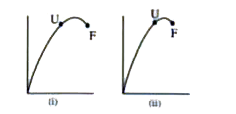
A
B
C
D
Text Solution
Verified by Experts
The correct Answer is:



Topper's Solved these Questions
MECHANICAL PROPERTIES OF SOLIDS
AAKASH SERIES|Exercise EXERCISE -IA (MATCHING)|4 VideosMECHANICAL PROPERTIES OF SOLIDS
AAKASH SERIES|Exercise EXERCISE -IA (ASCENDING OR DESCENDING ORDER)|4 VideosMECHANICAL PROPERTIES OF SOLIDS
AAKASH SERIES|Exercise EXERCISE - 3|26 VideosMECHANICAL PROPERTIES OF FLUIDS
AAKASH SERIES|Exercise EXERCISE-3|43 VideosMOTION IN A PLANE
AAKASH SERIES|Exercise Practice Exercise|84 Videos
Similar Questions
Explore conceptually related problems
AAKASH SERIES-MECHANICAL PROPERTIES OF SOLIDS-EXERCISE -IA
- Consider two cylindrical rods of identicaly dimensions, one of rubber ...
Text Solution
|
- A mild steel wire of length 2L and cross sectional area A is stretched...
Text Solution
|
- The stress-strain graphs for two materials are as shown.
Text Solution
|
- A wire is suspended from the ceiling and stretched under the action of...
Text Solution
|
- A copper wire and a steel wire of the same diameter and length are con...
Text Solution
|
- The Young's modulus of steel is more than that of rubber. For a given ...
Text Solution
|
- A wire of length 'L' and cross sectional area 'A' is made up of a mate...
Text Solution
|
- K is the force constant of a spring. The work done is increasing its e...
Text Solution
|
- Work done per unit volume is stretching a wire
Text Solution
|
- Which has more Young's modulus, a thin steel wire or thick steel wire
Text Solution
|
- The strain stress curves of three wires of different material as shown...
Text Solution
|
- The load verses elongation graph for four wires of the same material i...
Text Solution
|
- The property due to which a material can be hammered into thin sheet i...
Text Solution
|
- A beam of metal supported at the two ends is loaded at the centre. The...
Text Solution
|
- The potential energy U between two molecules as a function of the dist...
Text Solution
|
- A uniform rod is fixed at one end to a rigid support, its temperature ...
Text Solution
|
- Which of the following statements are correct? a) A wire is stiff...
Text Solution
|
- Identify the correct answer. When a very long rod suspended in ai...
Text Solution
|
- Identify the correct answer. When a wire is stretched to double its le...
Text Solution
|
- Arrange the following materials in the increasing order of elasticity ...
Text Solution
|