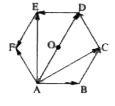
A
B
C
D
Text Solution
Verified by Experts
The correct Answer is:



Topper's Solved these Questions
VECTORS
AAKASH SERIES|Exercise Lecture Sheet (Exercise-I) (Addition of Vectors) (More than correct answer type Questions)|2 VideosVECTORS
AAKASH SERIES|Exercise Lecture Sheet (Exercise-I) (Integer Type Questions)|3 VideosUNITS AND MEASUREMENTS
AAKASH SERIES|Exercise ADDITIONAL PRACTICE EXERCISE (PRACTICE SHEET (ADVANCED))|14 VideosVISCOSITY
AAKASH SERIES|Exercise Questions for Descriptive Answers|3 Videos
Similar Questions
Explore conceptually related problems
AAKASH SERIES-VECTORS-Additional Practice Exercise (Practice Sheet (Advanced)) (Integer Type Questions)
- ABCDEF is a regular hexagon with point O as centre. Find the value of ...
Text Solution
|
- If bar(P) - bar(Q) vec(R ) and P = Q = R. Angle between bar(P) and bar...
Text Solution
|
- Three forces vec(P) = c hat(i) + hat(j) - k, vec(Q) = -2 hat(i) + a ha...
Text Solution
|
- Given |vec(A)(1)| =2, |vec(A)(2)|=3 and |vec(A)(1) + vec(A)(2)| =3. If...
Text Solution
|
- Let vec(A), vec(B) and vec(C ) be unit vectors. Suppose vec(A).vec(B) ...
Text Solution
|
- For a rectangle base is (hat(i) + hat(j) + hat(k)) and adjacent side i...
Text Solution
|
- For vectors vec(A) = (2i + 3j - 2k), vec(B) = (5i + nj + k) and vec(C ...
Text Solution
|