Home
Class 12
PHYSICS
Three immiscible liquids of densities d1...

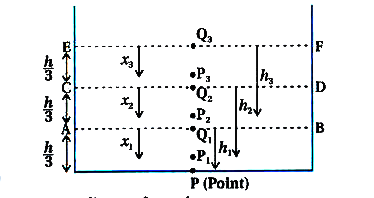
Three immiscible liquids of densities `d_1 gt d_2 gt d_3` and refractive indies `mu_1 gt mu_2 gt mu_3` are put in a beaker. The light of each liquid column is `(h)/(3)`. A dot is made at the bottom of the beaker. For near normal vision, find the apparent depth of the dot.

Text Solution

Verified by Experts

`rArr` According to formula,
`"Virtual depth " = ("Real depth")/("Refractive index of denser medium w.r.t rarer medium")` .....(1)
`rArr` From equation (i)
(i) For first medium :
`x_(1) = (h_1)/(((mu_1)/(mu_2)))=mu_2/(mu_1)(h/3) (because h_1 = h/3)`.........(2)
(ii) For second medium :
`x_2 = (h_2)/(((mu_2)/(mu_3)))`
`rArr` From figure `h_2 = (h)/(3) + x_1`
`therefore x_2 = (h/3 + x_1)/(mu_1/m_3)= (mu_3)/(mu_2){h/3 + (mu_2/mu_1 xx h/3)}.......(3)`
[ From equation (2)]
(iii) For the third medium
`x_3 = (h_3)/((mu_3/1))`
`rArr` Thus, from figure `h_3 = h/3 xx x_2`
`x_3 = ((h/3 +x_2))/(mu_3)`
`= (1)/(mu_3)[h/2 + mu_3/mu_2{h/3 + (mu_2/mu_1 xx h/3)}]`
[From equation (3)]
`= 1/(mu_3)(h/3) +(1)/(mu_2){h/3 + (mu_2/mu_1 xx h/3)}`
`= 1/mu_3(h/3) + 1/mu_2(h/3) + 1/(mu_1)(h/3)`
`therefore x_3 = h/3(1/mu_1 + 1/mu_2+1/m_3)`
Promotional Banner

Topper's Solved these Questions

  • RAY OPTICS AND OPTICAL INSTRUMENTS

    KUMAR PRAKASHAN|Exercise SECTION-C (NCERT EXEMPLAR SOLUTION) (SHORT ANSWER TYPE QUESITONS)|6 Videos
  • RAY OPTICS AND OPTICAL INSTRUMENTS

    KUMAR PRAKASHAN|Exercise SECTION-C (NCERT EXEMPLAR SOLUTION) (LONG ANSWER TYPE QUESITONS)|5 Videos
  • RAY OPTICS AND OPTICAL INSTRUMENTS

    KUMAR PRAKASHAN|Exercise SECTION-C (NCERT EXEMPLAR SOLUTION) (MULTIPLE CHOICE QUESTIONS (MCQs))|16 Videos
  • MOVING CHARGES AND MAGNETISM

    KUMAR PRAKASHAN|Exercise SECTION D (MCQs ASKED IN COMPETITIVE EXAMS)|34 Videos
  • SAMPLE QUESTION PAPER

    KUMAR PRAKASHAN|Exercise PART-B SECTION-C|5 Videos

Similar Questions

Explore conceptually related problems

A ray of light passes through four transparent media with refractive indices mu_1 , mu_2 , mu_3 and mu_4 as shown in the figure. The surfaces of all media are parallel. If the emergent ray CD is parallel to the incident ray AB, we must have

A vessel of depth d is half filled with liquid of refractive index mu_1 , and half filled with liquid of refractive index mu_2 . Bottom will be at depth ..... when viewed from top and perpendicularly to surface.

A beaker contains water up to a height h_(1) and kerosene of height h_(2) above water so that the total height of (water + kerosene) is (h_(1) + h_(2)) . Refractive index of water is mu_(1) and that of kerosene is mu_(2) . The apparent shift in the position of the bottom of the beaker when viewed from above is :-

A uniform solid cylinder of density 0.8g//cm^3 floats in equilibrium in a combination of two non-mixing liquids A and B with its axis vertical. The densities of the liquids A and B are 0.7g//cm^3 and 1.2g//cm^3 , respectively. The height of liquid A is h_A=1.2cm. The length of the part of the cylinder immersed in liquid B is h_B=0.8cm . (a) Find the total force exerted by liquid A on the cylinder. (b) Find h, the length of the part of the cylinder in air.

A vessel contains two immiscible liquids of density rho_(1)=1000 kg//m^(3) and rho_(2)=1500kg//m^(3) . A solid block of volume V=10^(3)m^(3) and density d=800kg//m^(3) is tied to one end of a string and the outer end is tied to the bottom of the vessel as shown in figure. The block is immersed with two fifths of its volume in the liquid of lower density. The entire system is kept in an elevator which is moving upwards with an acceleration of a=g/2 . Find the tension in the string.

The young's double slit experiment is done in a medium of refractive index 4//3 .A light of 600nm wavelength is falling on the slits having 0.45 mm separation .The lower slit S_(2) is covered by a thin glass sheet of thickness 10.4mu m and refractive index 1.5 .the intereference pattern is observed ona screen placed 1.5m from the slits are shown (a) Find the location of the central maximum (bright fringe with zero path difference)on the y-axis. (b) Find the light intensity at point O relative to the maximum fringe intensity. (c )Now,if 600nm light is replaced by white light of range 400 to700 nm find the wavelength of the light that from maxima exactly point O .[All wavelengths in this problem are for the given medium of refractive index 4//3 .Ignore dispersion]

A right angled prism of refractive index mu_(1) is placed in a rectangular block of refractive index mu_(2) , which is surrounded by a medium of refractive index mu_(3) ,as shown in the figure . A ray of light 'e' enters the rectangular block at normal incidence . depending upon the relationship between mu_(1) , mu_(2) "and" mu_(3) , it takes one of the four possible paths 'ef' , 'eg' , 'eh' or 'ef' Match the paths in List I with conditions of refractive indices in List II and select the correct answer using the codes given below the lists: {:("List" I , "List" II) , ( P. e rarr f , 1. mu_(1)gt sqrt(2mu_(2))) , ( Q. e rarr g , 2. mu_(2) gt mu_(1) "and" mu_(2) gt mu_(3)), ( R. e rarr f , 3. mu_(1) = mu_(2)), ( S. e rarr f , 4. mu_(2) lt mu_(1) lt sqrt(2mu_(2)) "and" mu_(2) gt mu_(3)):} Codes : {:( P , Q , R , S) , ((A) 2 , 3 , 1 , 4), ((B) 1 , 2 , 4 , 3) , ((C) 4 , 1 , 2 , 3) , ((D) 2, 3 , 4 , 1):}

A container of large uniform cross-sectional area A resting on a horizontal surface, holes two immiscible, non-viscon and incompressible liquids of densities d and 2d each of height H//2 as shown in the figure. The lower density liquid is open to the atmosphere having pressure P_(0) . A homogeneous solid cylinder of length L(LltH//2) and cross-sectional area A//5 is immeresed such that it floats with its axis vertical at the liquid-liquid interface with length L//4 in the denser liquid, The cylinder is then removed and the original arrangement is restroed. a tiny hole of area s(sltltA) is punched on the vertical side of the container at a height h(hltH//2) . As a result of this, liquid starts flowing out of the hole with a range x on the horizontal surface. The total pressure with cylinder, at the bottom of the container is
