Home
Class 12
PHYSICS
A cicular disc of radius R is placed co...

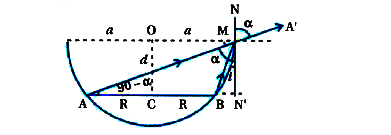
A cicular disc of radius R is placed co-axially and horizontally inside an opaque hemi spherical bowl of radius .a. (see figure). The faredge of the disc in just visible when viewed from the edge of the bowl . The bowl is filled with transparent liquid of refractive index `mu` and the near edge of the disc becomes just visible. How far below the top of the bowl is the disc placed ?

Text Solution

Verified by Experts

Consider situartion before pouring water in an opaque bowl of radius a. Now consider a circular disc of radius R and centre C which si placed inside the bowl horizontnally and coaxially with the bowl. Here we have to calculate OC=d .
`rArr` Here before filling bowl with water, incident light ray is AMA. . Now when water is paured in the hemispherical bowl completely, the nearer and B of the disc is seen for which inciden ray is `vec (BM)` and refracted ray is `vec(MA)`. Here NN. is perpedicular to water surface, drawn at point M. Hence `anlge (BMN)` = i (angle of incidence) and `angle NMA = alpha` (angle of refraction)
`rArr` Now, applying Snell.s law at point M ,
`u sin i = (1) sin r`
`therefore mu sin i = sin alpha (therefore r = alpha)`
`therefore 1/mu = (sin i)/(sin alpha)` ........(1) `[because r = alpha]`
Now, from , figure
`sin i = (BN.)/(BM)`
but `BN. = CN. - CB = OM -CB`
and `BM = sqrt(d^2 + (a-R)^2)`
`therefore sin i = sqrt(a-R)/(sqrt(d^2 + (a-R)^2))`...... (2)
and `sin alpha = cos(90^@ - alpha) = (AN.)/(AM) = (AC + CN.)/(AM)`
`therefore sin alpha = (AC +OM)/(AM)`
`= (a+R)/(sqrt(d^2(a+R)^2)) ........(3)`
`therefore` From equation (1),(2) and (3),
`1/mu = (a-R)/(sqrt(d^2 +(a-R)^2)) xx (sqrt(d^2 + (a+R)^2))/(a+R)`
`therefore mu(a-R)(sqrt(d^2 + (a+R)^2))=(a+R)(sqrt(d^2+(a-R)^2))`
Taking squares on the both sides,
`therefore mu^2(a-R)^2 {d^2 + (a+R)^2}=(a+R)^2{d^2 + (a-R)^2}`
`therefore {mu^2(a-R)^2d^2} + {mu^2(a-R)^2(a+R)^2} = {d^2(a+R)^2} + {(a+R)^2(a-R)^2}`
`therefore(a-R)^2(a+R)^2(mu^2 -1)=d^2{(a+R)^2-mu^2(a-R)^2}`
`therefore d^2 = ((mu^2-1){(a-R)(a+R)}^2)/((a+R)^2 - mu^2 (a-R)^2)`
`therefore d^2 = ((mu^2-1)(a^2-R^2)^2)/((a+R)^2-mu^2(a-R)^2)`
`therefore d=sqrt((mu^2-1)/((a+R)^2-mu^2(a-R)^2))xx (a^2 xxb^2)`
`rArr` Above equation gives required result.
Promotional Banner

Topper's Solved these Questions

  • RAY OPTICS AND OPTICAL INSTRUMENTS

    KUMAR PRAKASHAN|Exercise SECTION-C (NCERT EXEMPLAR SOLUTION) (LONG ANSWER TYPE QUESITONS)|5 Videos
  • RAY OPTICS AND OPTICAL INSTRUMENTS

    KUMAR PRAKASHAN|Exercise SECTION-D (MULTIPLE CHOICE QUESTIONS (MCQs))(MCQs FROM .DARPAN. BASED ON TEXTBOOK)|26 Videos
  • RAY OPTICS AND OPTICAL INSTRUMENTS

    KUMAR PRAKASHAN|Exercise SECTION-C (NCERT EXEMPLAR SOLUTION) (VERY SHORT ANSWER TYPE QUESITONS)|5 Videos
  • MOVING CHARGES AND MAGNETISM

    KUMAR PRAKASHAN|Exercise SECTION D (MCQs ASKED IN COMPETITIVE EXAMS)|34 Videos
  • SAMPLE QUESTION PAPER

    KUMAR PRAKASHAN|Exercise PART-B SECTION-C|5 Videos

Similar Questions

Explore conceptually related problems

How many litres of milk can a hemispherical bowl of diameter 10.5 cm hold ?

A hemispherical bowl is made of steel, 0.25 cm thick. The inner radius of the bowl is 5 cm. Find the outer curved surface area of the bowl.

From a circular disc of radius R , a triangular portion is cut (see figure). The distance of the centre of mass of the remainder from the centre of the disc is -

A hemispherical bowl has a radius of 3.5 cm. What would be the volume of water it would contain ?

A hemispherical bowl is made up of stone whose thickness is 5 cm. If the inner radius is 35 cm, find the total surface area of the bowl.

A circular disc of radius R is removed from a bigger circular disc of radius 2R such that the cirucmferences of the discs coincide. The centre of mass of the new disc is alpha/R from the center of the bigger disc. The value of alpha is

A vessel of depth d is half filled with liquid of refractive index mu_1 , and half filled with liquid of refractive index mu_2 . Bottom will be at depth ..... when viewed from top and perpendicularly to surface.

A particle is projected horizontally as shown from the rim of a large hemispherical bowl. The displacement of the particle when it strikes the bowl the first time is R. Find the velocity of the particle at that instant and the time taken.

A hemispherical bowl is made of brass .0.25 cm. thickness .The inner radius of the bowl is 5cm. Find the ratio of outer surface area to inner surface area.
