Home
Class 12
PHYSICS
In many experimental set-ups, the source...

In many experimental set-ups, the source and screen are fixed at a distance say D and the lens is movable. Show that there are two positions for the lens for which an image is formed on the screen. Find the distance between these pionts and the ratio of the image sizes for these two points.

Text Solution

Verified by Experts
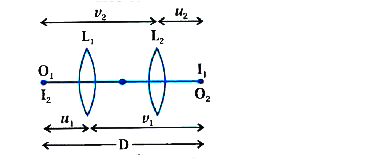

`rArr` According to law of reversibility of light , ray, we con interchange the positions of object and its image for a given convex lens. Now, according image for a given convex lens. Now , according to lens formula,
`1/f = 1/v - 1/u...... (1)`
Now,according to sign convetion in above figure,
`therefore - u + v= D ......(2)`
`therefore u = - (D - v)`
Placing above vlaue in equation (1),
`1/f = 1/v + 1/(D-v)`
`therefore 1/f = (D)/(v(D-v))`
`therefore 1/f = ((D-v)+v)/(v(D-v))`
`therefore D v - v^2 = Df`
`therefore Dv - v^2 = Df`
`therefore v^2 - Dv + Df= 0 `........(3)
`therefore v = (D pm sqrt(D^2 - 4Df)/(2))`
`rArr` Above is quadratic equaiton in terms of v whose two roots are,
`v = (-(-D) pm sqrt((-D)^2-4(1)(Df)))/(2(1))`
`therefore v= (D pm sqrt(D^2-4Df))/(2)`.....(4)
`rArr` From equation (2) and (4)
`u = - (D -(D pm sqrt(D^2-4Df))/(2))`
` = -((2D-D pm sqrt(D^2 - 4Df))/(2))`
`therefore u = - (D/2 pm sqrt(D^2 - 4Df)/(2))`......(5)
`rArr` From equations (4) and (5), we can say that
`(i) if u_1 = D/2 + (sqrt(D^2 - 4Df))/(2) ` then
`v_1 = D/2 + sqrt((D^2-4Df))/2`
(ii) if `u_2 = D/2 - (sqrt(D^2 - 4Df))/(2)` then
`v_2 = D/2 + sqrt(D^2 - 4Df)/(2)`
`rArr` Now, for above two object distances, if distance between corresponding tow positions of lens is d then ,
`d = D/2 + sqrt(D^2-4Df)/(2)-(D/2 - sqrt(D^2 - 4D f)/(2))`
`d = sqrt(D^2- 4Df)`
If `mu_1 = D/2 + d/2` then image distance is `v_1 = D/2 - d/2`
and magnification `m_1 = (v_1)/(u_1) = (D/2-d/2)/(D/2+d/2)= (D-d)/(D+d)`
Now if `u_2 = D/2 -d/2` then `v_2 = D/2 + d/2`
and magnification `m_2 = (v_2)/(u_2) = (D+d)/(D-d)`
`therefore ` Ration `(m_2)/(m_1) = ((D+d)/(D-d))^2`
`rArr` Note : Here for real roots of equation (3),
`D^2 - 4Dg gt 0`
`therefore D^2 gt 4Df`
`therefore D gt 4f`
`thererfore D_("min") = 4f`
`rArr` Minimum distance between object and its real image obtained by convex lens should be 4f (where f = focal length of that convex lens ).
Promotional Banner

Topper's Solved these Questions

  • RAY OPTICS AND OPTICAL INSTRUMENTS

    KUMAR PRAKASHAN|Exercise SECTION-C (NCERT EXEMPLAR SOLUTION) (LONG ANSWER TYPE QUESITONS)|5 Videos
  • RAY OPTICS AND OPTICAL INSTRUMENTS

    KUMAR PRAKASHAN|Exercise SECTION-D (MULTIPLE CHOICE QUESTIONS (MCQs))(MCQs FROM .DARPAN. BASED ON TEXTBOOK)|26 Videos
  • RAY OPTICS AND OPTICAL INSTRUMENTS

    KUMAR PRAKASHAN|Exercise SECTION-C (NCERT EXEMPLAR SOLUTION) (VERY SHORT ANSWER TYPE QUESITONS)|5 Videos
  • MOVING CHARGES AND MAGNETISM

    KUMAR PRAKASHAN|Exercise SECTION D (MCQs ASKED IN COMPETITIVE EXAMS)|34 Videos
  • SAMPLE QUESTION PAPER

    KUMAR PRAKASHAN|Exercise PART-B SECTION-C|5 Videos

Similar Questions

Explore conceptually related problems

An object and a screen are fixed at a distance d apart. When a lens of focal length f is moved between the object and the screen, sharp images of the object are formed on the screen for two positions of the lens. The magnifications produced at these two positions are M_(1) "and" M_(2) -

A convex lens is placed between an object and a screen which are at a fixed distance apart for one position of the lens. The magnification of the image obtained on the screen is m_(1) . When the lens is moved by a distance d the magnification of the image obtained on the same screen m_(2) , Find the focal length of the lens.

State two conditions to obtain sustained interference of light. In young's double slit experiment, using light of wavelength 400 nm, interference fringes of width X are obtained. The wavelength of light is increased to 600 nm and the separation between the slits is halved. if one wants the observed fringe width on the screen to be the same in the two cases, find the ratio of the distance between the screen and the plane of the slits in the two arrangements.

An object 25 cm high is placed in front of a convex lens of focal length 30 cm . If the height of image formed is 50 cm , find the distance between the object and the image (real and virtual)?

For normal eye vision what is the object distance and image-distance when the object is placed at a near point? (Take the distance between the eye lens and the retina as 2.3 cm.)

For normal eye vision what is the object distance and image-distance when the object is placed at a far point? (Take the distance between the eye lens and the retina as 2.3 cm.)

A convex lens forms an image of an object on a screen. The height of the image is 9 cm . The lens is now displaced until an image is again obtained on the screen. Then height of this image is 4 cm . The distance between the object and the screen is 90 cm.

Two coherent point sources S_1 and S_2 are separated by a small distance d as shown. The fringes obtained on the screen will be

In an optics experiment, with the position of the object fixed, a student varies the position of a convex lens and for each position, the screen is adjusted to get a clear image of the object. A graph between the object distance u and the image distance v, from the lens, is plitted using the same scale for the two axes. A straight line passing through the origin and making an angle of 45^circ with x-axis meets the experimental curve at P. The coordinates of P will be.

In a displacement method using lens, we obtain two images for separation of the lens d. One image is magnified as much as the other is diminshed . If m is the magnification of one image, find the focal length of the lens.

