Home
Class 12
PHYSICS
PQ type incident radiation and RS is the...

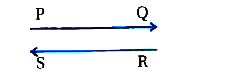
PQ type incident radiation and RS is the reflected ray. They are both parallel. So which mirror on the right makes this possible? There may be one or more reflections through the mirror.

A

Plane mirror

B

Convex mirror

C

Plane and concave mirror

D

An concave mirror

Text Solution

Verified by Experts

The correct Answer is:
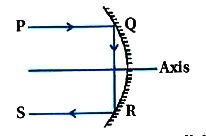
A, C, D


PQ and RS rays parallel to a given concave mirror.
Promotional Banner

Topper's Solved these Questions

  • RAY OPTICS AND OPTICAL INSTRUMENTS

    KUMAR PRAKASHAN|Exercise SECTION-D (MULTIPLE CHOICE QUESTIONS (MCQs))(MCQs FROM .DARPAN. BASED ON TEXTBOOK)(REFRACTION)|32 Videos
  • RAY OPTICS AND OPTICAL INSTRUMENTS

    KUMAR PRAKASHAN|Exercise SECTION-D (MULTIPLE CHOICE QUESTIONS (MCQs))(MCQs FROM .DARPAN. BASED ON TEXTBOOK)(TOTAL INTERNAL REFLECTION)|14 Videos
  • RAY OPTICS AND OPTICAL INSTRUMENTS

    KUMAR PRAKASHAN|Exercise SECTION-C (NCERT EXEMPLAR SOLUTION) (LONG ANSWER TYPE QUESITONS)|5 Videos
  • MOVING CHARGES AND MAGNETISM

    KUMAR PRAKASHAN|Exercise SECTION D (MCQs ASKED IN COMPETITIVE EXAMS)|34 Videos
  • SAMPLE QUESTION PAPER

    KUMAR PRAKASHAN|Exercise PART-B SECTION-C|5 Videos

Similar Questions

Explore conceptually related problems

Two plane mirrors A and B are aligned parallel to each other, as shown in the figure. A light ray is incident at an angle '30degree' at a point just inside one end of A. The plane of incidence coincides with the plane of the figure. The maximum number of times the ray undergoes reflections (including the first one) before it emerges out is

Two mirrors are inclined at angle theta as shown in figure. Light rays are incident parallel to one of mirrors. Light will start retracing its path after the reflection if

When two plane mirrors subtend an angle theta between them, then a ray of light incident parallel to one of them retraces its path afer n reflections such that ntheta=c (where c is constant) If the angle between mirrors is 60^(@) . Then light ray retraces its path after n reflections where n is

A ray of light moving parallel to the X-axis gets reflected from a parabolic mirror whose equation is (y-2)^2=4(x+1) . After reflection , the ray must pass through the point

When two plane mirrors subtend an angle theta between them, then a ray of light incident parallel to one of them retraces its path afer n reflections such that ntheta=c (where c is constant) What is the angle of c?

When two plane mirrors subtend an angle theta between them, then a ray of light incident parallel to one of them retraces its path afer n reflections such that ntheta=c (where c is constant) The graph between theta and n will

Two plane mirrors at an angle such that a ray incident on a mirror undergoes a total deviation of 240^(@) after two reflections:

Draw the ray diagrams showing incident ray and reflected ray for (1) a ray parallel to the principal axis and (2) a ray passing through the principal focus of a concave mirror.

Draw the ray diagrams showing incident ray and reflected ray for (1) a ray parallel to the principal axis and (2) a ray passing through the principal focus of a concave mirror.

A ray of light is incident on a concave mirror . It is parallel to the principal axis and its height from principal axis is equal to the focal length of the mirror. The ratio of the distance of point B to the distance of the focus from the centre of curvature is (AB is the reflected ray)

KUMAR PRAKASHAN-RAY OPTICS AND OPTICAL INSTRUMENTS-SECTION-D (MULTIPLE CHOICE QUESTIONS (MCQs))(MCQs FROM .DARPAN. BASED ON TEXTBOOK)
  1. A ray is incident at an angle 38^@ with a mirror. The angle between no...

    Text Solution

    |

  2. If a ray of light is incident on a plane mirror at an angle of 30^@, t...

    Text Solution

    |

  3. An object is placed at a distance of 25 cm on the axis of a concave mi...

    Text Solution

    |

  4. For a thin convex lens when the heights of the object is double than i...

    Text Solution

    |

  5. A point object O is placed midway between on the common axis of two co...

    Text Solution

    |

  6. For ..... mirror, height of image is always ...... than height of obje...

    Text Solution

    |

  7. An object is placed at a distance 40 cm in front of concave mirror. Fo...

    Text Solution

    |

  8. A convex mirror having focal length 20 cm is used as side glass in car...

    Text Solution

    |

  9. In which of the following mirrors can a person not see a reflection la...

    Text Solution

    |

  10. Object is placed 60 cm away from convex mirror. If magnification is 0....

    Text Solution

    |

  11. Lateral magnification of an object by spherical mirror is 0.3. If foca...

    Text Solution

    |

  12. Plane mirror is moving towards you at 5 cm//s. You can see your image ...

    Text Solution

    |

  13. PQ type incident radiation and RS is the reflected ray. They are both ...

    Text Solution

    |

  14. Focal length of concave mirror is f and ratio of heights of object to ...

    Text Solution

    |

  15. If f is focal length and v is image distance for spherical mirror, the...

    Text Solution

    |

  16. If f is focal length and u is object distance for spherical mirror, th...

    Text Solution

    |

  17. If image obtained from concave mirror of focal length f is (1/n)^(th) ...

    Text Solution

    |

  18. An image of an object obtained by a convex mirror is n times smaller t...

    Text Solution

    |

  19. If real image obtained from concave mirror of focal length f is n time...

    Text Solution

    |

  20. In an experiment to find focal length of a concave mirror a graph is d...

    Text Solution

    |

