Home
Class 12
PHYSICS
On a hot summer night, the refractive in...

On a hot summer night, the refractive index of air is smallest near the ground and increases with height from the ground. When a light beam is directed horizontally, the Huygens. principle leads us to conclude that as it travels, the light beam 1......

A

becomes narrower

B

goes horizontally without any deflection

C

bends downwards

D

bends upwards

Text Solution

Verified by Experts

The correct Answer is:
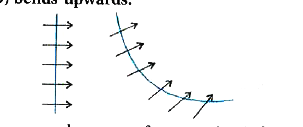
A, B, D


Assume a planar wavefront moving in horizontal direction. Its different parts will move with different speeds during its motion. Speed in rarer medium will be more and that in denser medium will be less hence its shape will be as shown.
Promotional Banner

Topper's Solved these Questions

  • RAY OPTICS AND OPTICAL INSTRUMENTS

    KUMAR PRAKASHAN|Exercise SECTION-D (MULTIPLE CHOICE QUESTIONS (MCQs))(MCQs FROM .DARPAN. BASED ON TEXTBOOK)(MCQs BASED ON TEXTUAL ILLUSTRATION AND EXERCISE)|24 Videos
  • MOVING CHARGES AND MAGNETISM

    KUMAR PRAKASHAN|Exercise SECTION D (MCQs ASKED IN COMPETITIVE EXAMS)|34 Videos
  • SAMPLE QUESTION PAPER

    KUMAR PRAKASHAN|Exercise PART-B SECTION-C|5 Videos

Similar Questions

Explore conceptually related problems

The mixture a pure liquid and a solution in long vertical column (i.e, horizontal dimensions lt lt vertical dimensions ) Produce diffusion of solute particles and hence refractive index gradient along the vertical dimesion . A ray of light entering the column I at right angles to the vertical is deviated from its original path. Find the deviated from its original path. Find the deviation in travelling a horizontal distance d lt lt h, the height of the coloumn.

Thin films, including soap bubbles and oil slicks, show patterns of alternating dark and bright regions resulting from interference among the reflected light waves. If two waves are in phase their crest and troughs will coincide. The interference will be constructive and the aplitude of the resultant wave will be greater than the amplitude of either constituent wave. if the two waves are out of phase, the crests of one wave will coincide with the troughs of the other wave. The interference will be destructive and the amplitude of the resultant wave will be less than that of either constituent wave. at the interface between two transparent media some light is reflected and some light is refracted. * When incident light, reaches the surface at point a, some of the light is reflected as ray R_(a) and and some is refracted following the path ab to the back of the film. *At point b some of the light is refracted out of the film and part is reflected back refracted out of the fiml as ray R_(c) . R_(a) and R_(c) are parallel. However, R_(c) has travelled the extra distance within the film of abc. if the angle of incidence is small then abc is approximately twice the film's thickness. if R_(a) and R_(c) are in phase they will undergo constructive interference and the region ac will be bright if R_(a) and R_(c) are out of phase, they will undergo destructive interference. * Refraction at an interface never changes the phase of the wave. * For reflection at the interface between two media 1 and 2, if n_(1)ltn_(2) the reflected wave will change phase by pi . if n_(1)gtn_(2) the reflected wave will not undergo a phase change. for reference n_(air)=1.00 * if the waves are in phase after refection at all interfaces, then the effects of path length in the film are Constructive interference occur when (n= refractive index) 2t=mlamda//n" "m=0,1,2,3... .. Destructive interference occurs when 2t=(m+1//2)lamda//n" "m=0,1,2,3... Q. A 600 nm light is perpendicularly incident on a soap film suspended in air. The film is 1.00 mum thick with n=1.35. Which statement most accurately describes the interference of the light reflected by the two surfaces of the film?

Thin films, including soap bubbles and oil slicks, show patterns of alternating dark and bright regions resulting from interference among the reflected light waves. If two waves are in phase their crest and troughs will coincide. The interference will be constructive and the aplitude of the resultant wave will be greater than the amplitude of either constituent wave. if the two waves are out of phase, the crests of one wave will coincide with the troughs of the other wave. The interference will be destructive and the amplitude of the resultant wave will be less than that of either constituent wave. at the interface between two transparent media some light is reflected and some light is refracted. * When incident light, reaches the surface at point a, some of the light is reflected as ray R_(a) and and some is refracted following the path ab to the back of the film. *At point b some of the light is refracted out of the film and part is reflected back refracted out of the fiml as ray R_(c) . R_(a) and R_(c) are parallel. However, R_(c) has travelled the extra distance within the film of abc. if the angle of incidence is small then abc is approximately twice the film's thickness. if R_(a) and R_(c) are in phase they will undergo constructive interference and the region ac will be bright if R_(a) and R_(c) are out of phase, they will undergo destructive interference. * Refraction at an interface never changes the phase of the wave. * For reflection at the interface between two media 1 and 2, if n_(1)ltn_(2) the reflected wave will change phase by pi . if n_(1)gtn_(2) the reflected wave will not undergo a phase change. for reference n_(air)=1.00 * if the waves are in phase after refection at all interfaces, then the effects of path length in the film are Constructive interference occur when (n= refractive index) 2t=mlamda//n" "m=0,1,2,3... .. Destructive interference occurs when 2t=(m+1//2)lamda//n" "m=0,1,2,3... Q. The average human eye sees colors with wavelengths between 430 nm to 680 nm. For what visible wavelength will a 350 nm thick n=1.35 soap film produce maximum destructive interference?

An intially parallel cyclindrical beam travels in a medium of refractive index mu (I) = mu_(0) + mu_(2) I , where mu_(0) and mu_(2) are positive constants and I is intensity of light beam. The intensity of the beam is decreasing with increasing radius. Answer the following questions : As the beam enters the medium, it will

A horizontal cylinderical tank (6)/(pi)m in diameter is half full of water. The space above the water is filled with a pressurized gas of unknown refractive index. A small laser can move along the curved bottom of the water and aims a light beam towards the centre of the water surface. When the laser has moved a distance s=1m or more (measured from curved face) from the lowest point in water, no light enters the gas. The refractive index of gas is (mu_("water") = 4//3)

In Young's double slit experiment the slits, S_(1) & S_(2) are illuminated by a parallel beam of light of wavelength 4000 Å from the medium of refractive index n_(1)=1.2 A thin film of thickness 1.2 mum and refractive index n=1.5 is placed infrom of S_(1) perpedicular to path of light. the refractive index of medium between plane of slits & screen is n_(2)=1.4 if the light coming from the film and S_(1)&S_(2) have equal intensities I then intensity at geometrical centre of the screen O is

An infinitely long cylinder of radius R is made of an unusual exotic material with refractive index-1 (see figure). The cyliner is palced between two planes whose normals are along the y- direction . The center of the cylinder O lies along the y - axis . A narrow laser beam is directed along the y direction from the lower plate. The laser source is at a horizontal distance x from the diameter in the y - direction. Find the range of x such that light emitted from the lower plane does not reach the upper plane.

An impluse laser may be treaed as a source of phtons that are emitted during the time interval of the pulse which is followrd by a time interval when no photons are produced. Pulse are periodically repeated. A laser beam of diameter d = 10 microns is directed upward and is perpendicular to the then foil surface which has an index of reflection rho = 0.50 (see the sketch of the experiment). The index of reflection of the surface is the ratio of the relected energy of foil that can be supported in the air solely by the light pressure of the laser beam ?

Two small balls having the same mass and charge and located on the same vertical at heights h_(1) and h_(2) are thrown in the same direction along the horizontal at the same velocity v. The first ball touches the ground at a horizontal distance R from the initial vertical position. At what height h_(2) will the second ball be at this instant? Neglect any frictional resistance of air and the effect of any induced charge on the ground.

KUMAR PRAKASHAN-RAY OPTICS AND OPTICAL INSTRUMENTS-SECTION-D (MULTIPLE CHOICE QUESTIONS (MCQs))(MCQs ASKED IN COMPETITIVE EXAMS)
  1. A green light is incident from the water to the air-water interface at...

    Text Solution

    |

  2. Monochromatic light is incident on a glass prism of angle A. If the re...

    Text Solution

    |

  3. On a hot summer night, the refractive index of air is smallest near th...

    Text Solution

    |

  4. An observer looks at a distant tree of height 10 m with a telescope of...

    Text Solution

    |

  5. A diverging lens with magnitude of focal length 25 cm is placed at a d...

    Text Solution

    |

  6. The eye can be regarded as a single refracting surface. The radius of ...

    Text Solution

    |

  7. A thin lens made of glass (refractive index = 1.5) of focal length f= ...

    Text Solution

    |

  8. If we need a magnification of 375 from a compound microscope of tube l...

    Text Solution

    |

  9. A telescope has a magnification equal to 5 and the length of its tube ...

    Text Solution

    |

  10. A plano-convex lens of radius of curvature 30 cm and refractive index ...

    Text Solution

    |

  11. If nij is reftactive index of medium i with respect to medium j n21 X ...

    Text Solution

    |

  12. Magnification of microscope of objective of focal length 5 mm is 400. ...

    Text Solution

    |

  13. Refractive index of a prism is root2. One side of prism is polished, i...

    Text Solution

    |

  14. Focal length of convex lens having refractive index 1.5 is 2 cm. If th...

    Text Solution

    |

  15. Minimum deviation of prism having refractive index mu and small angle ...

    Text Solution

    |

  16. For ...... light, focal length of convex lens is maximum.

    Text Solution

    |

  17. Point source of light is placed 4 m below water surface in the medium ...

    Text Solution

    |

  18. A lens is placed between a source of light and a wall . It forms image...

    Text Solution

    |

  19. Light passes through a glass slab of refractive index .n. and thicknes...

    Text Solution

    |

  20. An object is there on a wall. Now by help of convex lens, an image of ...

    Text Solution

    |

