Home
Class 11
CHEMISTRY
Guanidine (I) and its conjugate acid (II...

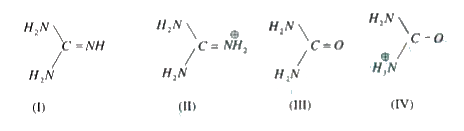
Guanidine (I) and its conjugate acid (II) are given below along with urea(III) and its conjugate base (IV)

Basic properties of I & II compounds are mainly influenced by resonance and the acidity of the bases depends upon lone pair of electrons.
Which of the following is more resonance stabilized

A

`(NH_(2))_(2)C=NH`

B

`(NH_(2))_(2)C=overset(oplus)(N)H_(2)`

C

`(H_(2)N)_(2)C-O`

D

Text Solution

Verified by Experts

The correct Answer is:

B
Promotional Banner

Topper's Solved these Questions

  • ELECTRONIC EFFECTS AND REACTION INTERMEDIATES

    AAKASH SERIES|Exercise LECTURE SHEET - EXERCISE-III (Matrix Matching Type Questions)|1 Videos
  • ELECTRONIC EFFECTS AND REACTION INTERMEDIATES

    AAKASH SERIES|Exercise LECTURE SHEET - EXERCISE-III (Integer Type Questions)|11 Videos
  • ELECTRONIC EFFECTS AND REACTION INTERMEDIATES

    AAKASH SERIES|Exercise LECTURE SHEET - EXERCISE-III (More than correct answer Type Questions)|6 Videos
  • ELECTRON MIGRATION EFFECTS

    AAKASH SERIES|Exercise QUESTIONS FOR DESCRIPTIVE ANSWERS|10 Videos
  • ELEMENTS OF BORON FAMILY

    AAKASH SERIES|Exercise OBJECTIVE EXERCISE - 3|7 Videos

Similar Questions

Explore conceptually related problems

Guanidine (I) and its conjugate acid (II) are given below along with urea(III) and its conjugate base (IV) Basic properties of I & II compounds are mainly influenced by resonance and the acidity of the bases depends upon lone pair of electrons. The strongest base of the following is

Guanidine (I) and its conjugate acid (II) are given below along with urea(III) and its conjugate base (IV) Basic properties of I & II compounds are mainly influenced by resonance and the acidity of the bases depends upon lone pair of electrons. The strongest base of the following is

Guanidine (I) and its conjugate acid (II) are given below along with urea(III) and its conjugate base (IV) Basic properties of I & II compounds are mainly influenced by resonance and the acidity of the bases depends upon lone pair of electrons. Urea is mono basic because

Guanidine (I) and its conjugate acid (II) are given below along with urea(III) and its conjugate base (IV) Basic properties of I & II compounds are mainly influenced by resonance and the acidity of the bases depends upon lone pair of electrons. Urea is mono basic because

Inductive effect influences the basic strength as well as acidic strength. -I effect increases acidic strength where as +I effect increases basic strength as they stabilize conjugate base and acid respectively. Which of the following is the strongest acid

Hyperconjugation describes the orbital interactions between the p-systems and the adjacent s-bond of the substituent group(s) in organic compounds. Hyperconjugation is also called as Baker and Nathen effect. The necessary and sufficient condition for the hyperconjugation are : i) Compound should have at least on sp2 hybrid carbon of either alkene, carbocation or alkyl free radical. ii) A-carbon with respect to sp2 hybrid carbon should have at least one hydrogen. Hyperconjugation are of three types: (i) s(C-H), p-conjugation. (iii) s(C-H), positive charge conjugation iv) s(C-H), odd electron conjugation The hyperconjugation may be represented as Number of resonating structures due to hyperconjugation = (n + 1) where n is the number of a-hydrogen. Greater is the number of such forms, more is the stability of the species under considersation. Which of the following carbocations will show highest number of Hyperconjugation forms?

Hyperconjugation describes the orbital interactions between the p-systems and the adjacent s-bond of the substituent group(s) in organic compounds. Hyperconjugation is also called as Baker and Nathen effect. The necessary and sufficient condition for the hyperconjugation are : i) Compound should have at least on sp2 hybrid carbon of either alkene, carbocation or alkyl free radical. ii) A-carbon with respect to sp2 hybrid carbon should have at least one hydrogen. Hyperconjugation are of three types: (i) s(C-H), p-conjugation. (iii) s(C-H), positive charge conjugation iv) s(C-H), odd electron conjugation The hyperconjugation may be represented as Number of resonating structures due to hyperconjugation = (n + 1) where n is the number of a-hydrogen. Greater is the number of such forms, more is the stability of the species under considersation. Which of the following carbocations will show highest number of Hyperconjugation forms?

Hyperconjugation describes the orbital interactions between the p-systems and the adjacent s-bond of the substituent group(s) in organic compounds. Hyperconjugation is also called as Baker and Nathen effect. The necessary and sufficient condition for the hyperconjugation are : i) Compound should have at least on sp2 hybrid carbon of either alkene, carbocation or alkyl free radical. ii) A-carbon with respect to sp2 hybrid carbon should have at least one hydrogen. Hyperconjugation are of three types: (i) s(C-H), p-conjugation. (iii) s(C-H), positive charge conjugation iv) s(C-H), odd electron conjugation The hyperconjugation may be represented as Number of resonating structures due to hyperconjugation = (n + 1) where n is the number of a-hydrogen. Greater is the number of such forms, more is the stability of the species under considersation. Hyperconjugation is possible in which of the following species ?
