Home
Class 9
MATHS
ABCD is a quadrilateral in which AD = BC...

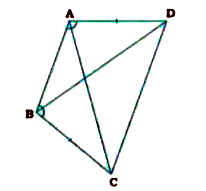
ABCD is a quadrilateral in which AD = BC and `angle DAB = angle CBA` (see the given figure). Prove that ( i ) `triangle ABD = triangle BAC, ( ii) BD = AC and (iii) angle ABD = angle BAC`

Text Solution

Verified by Experts

The correct Answer is:

`angleBAC`
Promotional Banner

Topper's Solved these Questions

  • TRIANGLES

    KUMAR PRAKASHAN|Exercise EXERCISE 7.2|8 Videos
  • TRIANGLES

    KUMAR PRAKASHAN|Exercise EXERCISE 7.3|5 Videos
  • SURFACE AREAS AND VOLUMES

    KUMAR PRAKASHAN|Exercise MULTIPLE CHOICE QUESTIONS|18 Videos

Similar Questions

Explore conceptually related problems

In quadrilateral ACBD. AC = AD and AB bisects angle A (see the given figure). Show that triangle ABC = triangle ABD . What can you say about BC and BD?

ABC is a triangle in which altitudes BE and CF to sides AC and AB are equal (see the given figure). Show that ( i ) triangle ABE ~= triangle ACF (ii) AB = AC i.e ABC is an isoceles triangle

In triangle ABC, AB = AC and the bisector of angle A lt intersects BC at D. Prove that, ( 1 ) triangle ADB = triangle ADC ( 2 ) angle ABC = angle ACB

ABCD is a quadrilateral in which AD = BC and /_ DAB = /_ CBA Prove that (i) DeltaABD ~= DeltaBAC (ii) BD = AC (iii) /_ ABD = /_ BAC

A quadrilateral ABCD is drawn to circumscribe a circle (see the given figure). Prove that AB+CD = AD+BC.

ABC and DBC are two isosceles triangles on the same base BC (see the given figure). Show that angle ABD = angle ACD .

In right triangle ABC, right angled at C, M is the midpoint of hypotenuse AB. C is joined to M and produced to a point D such that DM = CM. Point D is joined to point B (see the given figure). Show that: (i) triangle AMC = triangleBMD (ii) angle DBC is a right angle (iii) triangleDBC = triangleACB (iv) CM=1/2 AB

triangle ABC and triangle DBC are two isosceles triangles on the same base BC and vertices A and D are on the same side of BC (see the given figure). If AD is extended to intersect BC at P, show that, ( i ) triangle ABD = triangle ACD (ii) triangle ABP = triangle ACP (iii) AP bisects angle A as well as angle D. (iv) AP is the perpendicular bisector of BC

ABCD is a cyclic quadrilateral. If AD||BC and angle B = 70^(@), find the other angles of ABCD.

D is a point on side BC of triangle ABC such that AD = AC (see the given figure). Show that AB gt AD.
