Home
Class 9
MATHS
Ray 1 is the bisector of an angle angle ...

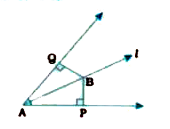
Ray 1 is the bisector of an angle `angle` A and B is any point on I. BP and BQ are perpendiculars from B to the arms of `angle` A (see the given figure). Show that:
(i) `triangleAPB=triangleAQB`
(ii) BP = BQ or B is equidistant from the arms of `angleA`

Text Solution

Verified by Experts

The correct Answer is:

`angle A`
Promotional Banner

Topper's Solved these Questions

  • TRIANGLES

    KUMAR PRAKASHAN|Exercise EXERCISE 7.2|8 Videos
  • TRIANGLES

    KUMAR PRAKASHAN|Exercise EXERCISE 7.3|5 Videos
  • SURFACE AREAS AND VOLUMES

    KUMAR PRAKASHAN|Exercise MULTIPLE CHOICE QUESTIONS|18 Videos

Similar Questions

Explore conceptually related problems

In triangle ABC , the bisector AD of angle A is perpendicular to side BC (see the given figure). Show that AB = AC and triangle ABC is isosceles.

ABCD is a parallelogram AP and CQ are perpendiculars drawn from vertices A and C on diagonal BD (see figure) show that (i) DeltaAPB ~= DeltaCQD (ii) AP = CQ

ABCD is a quadrilateral in which AD = BC and angle DAB = angle CBA (see the given figure). Prove that ( i ) triangle ABD = triangle BAC, ( ii) BD = AC and (iii) angle ABD = angle BAC

AB and CD are respec­tively the smallest and longest sides of a quadrilateral ABCD (see th e given figure). Show that angle A gt angle C and angle B gt angle D

In right triangle ABC, right angled at C, M is the midpoint of hypotenuse AB. C is joined to M and produced to a point D such that DM = CM. Point D is joined to point B (see the given figure). Show that: (i) triangle AMC = triangleBMD (ii) angle DBC is a right angle (iii) triangleDBC = triangleACB (iv) CM=1/2 AB

AB is a line segment. P and Q are points on opposite sides of AB such that each of them is equidistant from the points A and B (see the given figure). Show that the line PQ is the perpendicular bisector of AB.

triangle ABC and triangle DBC are two isosceles triangles on the same base BC and vertices A and D are on the same side of BC (see the given figure). If AD is extended to intersect BC at P, show that, ( i ) triangle ABD = triangle ACD (ii) triangle ABP = triangle ACP (iii) AP bisects angle A as well as angle D. (iv) AP is the perpendicular bisector of BC

Two circles intersect at two points B and c. Through B, two line segments ABD and PBQ are drawn to intersect the circles at A, D and P, Q respectively (see the given figure). Prove that angle ACP = angle QCD.

P is a point equidistant from two lines l and m intersecting at point A (see figure). Show that the line AP bisects the angle between them.

In the given figure, angle B lt angle A and angle C lt angle D . Show that AD lt BC.
