


Topper's Solved these Questions
CIRCLES
KUMAR PRAKASHAN|Exercise EXERCISE 10.6|3 VideosCIRCLES
KUMAR PRAKASHAN|Exercise SKILL TESTING EXERCISE|7 VideosCIRCLES
KUMAR PRAKASHAN|Exercise EXERCISE 10.4|6 VideosBOARD'S SAMPLE QUESTION PAPERS (QUESTION PAPER 1 : FOR THE FIRST TEST)
KUMAR PRAKASHAN|Exercise Section D (Solve the following) |4 VideosCONSTRUCTIONS
KUMAR PRAKASHAN|Exercise Skill Testing Exercise|2 Videos
Similar Questions
Explore conceptually related problems
KUMAR PRAKASHAN-CIRCLES -EXERCISE 10.5
- In the given figure, A, B and C are three points on a circle with cent...
Text Solution
|
- A chord of a circle is equal to the radius of the circle. Find the ang...
Text Solution
|
- In the given figure, angle PQR = 100^(@), where P, 9 and R are points...
Text Solution
|
- In the given figure, angle ABC = 69^(@), angle ACB= 31 ^(@),
Text Solution
|
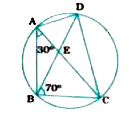
- In the given figure, A, B, C and D are four points on a circle. AC and...
Text Solution
|
- ABCD is a cyclic quadrilateral whose diagonals intersect at a point E....
Text Solution
|
- If diagonals of a cyclic quadrilateral are diameters of the circle thr...
Text Solution
|
- If the non-parallel sides of a trapezium are equal, prove that it is c...
Text Solution
|
- Two circles intersect at two points B and c. Through B, two line segme...
Text Solution
|
- If circles are drawn taking two sides of a triangle as diameters, prov...
Text Solution
|
- ABC and ADC are two right triangles with common hypotenuse AC. Prove t...
Text Solution
|
- Prove that a cyclic parallelogram is a rectangle.
Text Solution
|