

Home
Class 9
MATHS
The relative humidity (in %) of a certai...

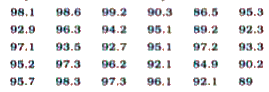
The relative humidity (in %) of a certain city for a month of 30 days was as follows:

(i) Construct a grouped frequency distribution table with classes 84-86, 86-88, etc. (ii) Which month or season do you think this data is about ? (iii) What is the range of this data ?

Promotional Banner

Topper's Solved these Questions

  • STATISTICS

    KUMAR PRAKASHAN|Exercise EXERCISE 14.3|9 Videos
  • STATISTICS

    KUMAR PRAKASHAN|Exercise EXERCISE 14.4|6 Videos
  • STATISTICS

    KUMAR PRAKASHAN|Exercise MULTIPLE CHOICE QUESTIONS|12 Videos
  • QUESTION PAPER 3 : FOR THE ANNUAL EXAMINATION

    KUMAR PRAKASHAN|Exercise SECTION -D|5 Videos
  • SURFACE AREAS AND VOLUMES

    KUMAR PRAKASHAN|Exercise MULTIPLE CHOICE QUESTIONS|18 Videos

Similar Questions

Explore conceptually related problems

The relative humidity (in %) of a certain City for a September month of 30 days was as follows: (i) Construct a grouped frequency distribution table with classes 84-86, 86,-88 etc. (ii) What is the range of the data?

A study was conducted to find out the concentration of sulphur dioxide in the air in parts per million (ppm) of a certain city. The data obtained for 30 days is as follows: (i) Make a grouped frequency distribution table for this data with class intervals as 0.00 -0.04, 0.04 -0.08, and so on. (ii) For how many days, was the concentration of sulphur dioxide more than 0.11 parts per million ?

The distance (in km) of 40 engineers from their residence to their place of work were found as follows : Construct a grouped frequency distribution table with class size 5 for the data given above taking the first interval as 0-5 (5 not included). What main features do you observe from this tabular representation ?

The heights of 50 students, measured to the nearest centimetres, have been found to be as follows: (i) Represent the data given above by a grouped frequency distribution table, taking the class intervals as 160 - 165,165-170, etc. (ii) What can you conclude about their heights from the table ?

Thirty children were asked about the number of hours they watched TV programmes in the previous week. The results were found as follows: (i) Make a grouped frequency distribution table for this data, taking class width 5 and one of the class intervals as 5 - 10. (ii) How many children watched television for 15 or more hours a week ?

In a particular section of Class IX, 40 students were asked about the month of their birth and the following graph was prepared for the data so obtained : Observe the bar graph given above and answer the following questions: ( i ) How many students were born in the month of November? (ii) in which month were the maximum number of students born ?

An insurance company selected 2000 drivers at random (i.e., without any preference of one driver over another) in a particular city to find a relationship between age and accidents. The data obtained is given in the following table: Find the probabilities of the following events for a driver chosen at random from the city: (i) The driver being in the age group 18-29 years and having exactly 3 accidents in one year. (ii) The driver being in the age group of 30-50 years and having one or more accidents in a year. (iii) Having no accidents in the year.

A student performs an experiment to determine how the range of a ball depends on the velocity with which it is projected. The "range" is the distance between the points where the ball lends and from where it was projected, assuming it lands at the same height from which it was projected. It each trial, the student uses the same baseball, and launches it at the same angle. Table shows the experimental results. |{:("Trail","Launch speed" (m//s),"Range"(m)),(1,10,8),(2,20,31.8),(3,30,70.7),(4,40,122.5):}| Based on this data, the student then hypothesizes that the range, R, depends on the initial speed v_(0) according to the following equation : R=Cv_(0)^(n) , where C is a constant and n is another constant. The student speculates that the constant C depends on :- (i) The angle at which the ball was launched (ii) The ball's mass (iii) The ball's diameter If we neglect air resistance, then C actually depends on :-