

Home
Class 9
MATHS
The heights of 50 students, measured to ...

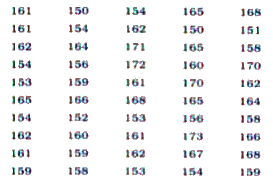
The heights of 50 students, measured to the nearest centimetres, have been found to be as follows:

(i) Represent the data given above by a grouped frequency distribution table, taking the class intervals as 160 - 165,165-170, etc. (ii) What can you conclude about their heights from the table ?

Promotional Banner

Topper's Solved these Questions

  • STATISTICS

    KUMAR PRAKASHAN|Exercise EXERCISE 14.3|9 Videos
  • STATISTICS

    KUMAR PRAKASHAN|Exercise EXERCISE 14.4|6 Videos
  • STATISTICS

    KUMAR PRAKASHAN|Exercise MULTIPLE CHOICE QUESTIONS|12 Videos
  • QUESTION PAPER 3 : FOR THE ANNUAL EXAMINATION

    KUMAR PRAKASHAN|Exercise SECTION -D|5 Videos
  • SURFACE AREAS AND VOLUMES

    KUMAR PRAKASHAN|Exercise MULTIPLE CHOICE QUESTIONS|18 Videos

Similar Questions

Explore conceptually related problems

The relative humidity (in %) of a certain City for a September month of 30 days was as follows: (i) Construct a grouped frequency distribution table with classes 84-86, 86,-88 etc. (ii) What is the range of the data?

Thirty children were asked about the number of hours they watched TV programmes in the previous week. The results were found as follows: (i) Make a grouped frequency distribution table for this data, taking class width 5 and one of the class intervals as 5 - 10. (ii) How many children watched television for 15 or more hours a week ?

The blood group of 36 students of IX class are recorded as follows Represent the data in the form of frequency distribution table. Which is the most common and which is the rarest blood group among these students?

The distance (in km) of 40 engineers from their residence to their place of work were found as follows : Construct a grouped frequency distribution table with class size 5 for the data given above taking the first interval as 0-5 (5 not included). What main features do you observe from this tabular representation ?

The relative humidity (in %) of a certain city for a month of 30 days was as follows: (i) Construct a grouped frequency distribution table with classes 84-86, 86-88, etc. (ii) Which month or season do you think this data is about ? (iii) What is the range of this data ?

A study was conducted to find out the concentration of sulphur dioxide in the air in parts per million (ppm) of a certain city. The data obtained for 30 days is as follows: (i) Make a grouped frequency distribution table for this data with class intervals as 0.00 -0.04, 0.04 -0.08, and so on. (ii) For how many days, was the concentration of sulphur dioxide more than 0.11 parts per million ?

A company manufactures car batteries of a particular type. The lives in years) of 40 such batteries were recorded as follows: Construct a grouped frequency distribution table for this data, using class intervals of size 0.5 starting from the interval 2 - 2.5.

A company manufactures car batteries of particular type. The life (in years) of 40 batteries was recorded as follows: Construct a grouped frequency distribution table with exclusive classes for this data, using class intervals of size 0.5 starting from the interval 2-2.5.

The length of 40 leaves of a plant are measured correct to one millimetre, and the obtained data is represented in the following table : (i) Draw a histogram to represent the given data. (ii) Is there any other suitable graphical representation for the same data ? (iii) Is it correct to conclude that the maximum number of leaves are 153 mm long? Why?

The following data on the number of girls (to the nearest ten) per thousand boys in different sections of Indian society is given below: (i) Represent the information above by a bar graph. (ii) In the classroom discuss what conclusions can be arrived at from the graph.