Home
Class 11
PHYSICS
Discuss the completely inelastic collisi...

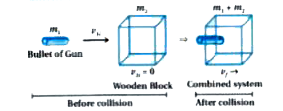
Discuss the completely inelastic collision in one dimension .

Text Solution

Verified by Experts

Here particle of mass `m_(1)` is moving speed `v_(1f)` in x direction .
` :. theta_(1)=theta_(2) = 0 `
From the law of conservation of momentum , momentum before collision and momentum after collision is same .
` :. M_(1)v_(1f)=(m_(1)+m_(2))v_(1f) " "...(1)`
Energy is dissipated during collision , `DeltaK` = kinetic energy before collision - kinetic energy after collision
` 1/2 m_(1)v_(1)^(2)i - 1/2 (m_(1)+m_(2))v_(f)^(2) " " [ :. v_(2i)=0] `
Substituting the value of equation (1) ,
`DeltaK = 1/2m_(1)v_(1i)^(2)-1/2(m_(1)+m_(2))xx(m_(1)/(m_(1)+m_(2)))^(2)v_(1i)^(2)`
`=1/2m_(1)v_(1i)^(2)[1-(m_(1))/(m_(1)+m_(2))] `
` :. DeltaK = 1/2 m_(1)m_(2)v_(1i)^(2)` is positive .
Note If particles moves in the same direction and speed of particle of mass `m_(1) v_(1i)` and if `v_(1i) gt v_(2i)` them , after inelastic both having speed `v_(f)`
`v_(f) = (m_(1)v_(1i)+m_(2)v_(2i))/(m_(1)+m_(2))`
Kinetic energy before collision ,
` K_(i) = 1/2 m_(1)v_(1i)^(2) +1/2 m_(2)v_(2i)^(2)`
Kinetic energy after collision ,
`K_(f) =1/2 (m_(1)+m_(2))v_(f)^(2)`
` :. K_(f) = 1/2(m_(1)+m_(2))((m_(1)v_(1i)+m_(2)v_(2i))^(2))/((m_(1)+m_(2))^(2))`
`= 1/2((m_(1)v_(1i)+m_(2)v_(2i))^(2))/((m_(1)+m_(2)))`
` :. ` Energy dissipated after collision ,
`K_(i)-K_(f) =1/2 m_(1)v_(1i)^(2)+1/2m_(2)v_(2i)^(2)`
`-1/2(-m_(1)v_(1i)+m_(2)v_(2i))^(2)/(m_(1)+m_(2))`
`{m_(1)^(2)v_(1i)^(2)+m_(1)m_(2)v_(2i)^(2)+m_(1)m_(2)v_(1i)^(2)+m_(2)^(2)v_(2i)^(2)=1/2} (-(m_(1)^(2)v_(1i)^(2)+2m_(1)m_(2)v_(1i)v_(2i)+m_(2)^(2)v_(2i)^(2))/((m_(1)+m_(2))))`
`m_(1)m_(2)v_(2i)^(2)+m_(1)m_(2)v_(1i)^(2)=1/2((-2m_(1)m_(2)v_(1i)v_(2i)+v_(2i)^(2)))/(m_(1)+m_(2))`
`=(m_(1)m_(2))/(2(m_(1)+m_(2)))(v_(1i)^(2)-2v_(1i)^(2)-2v_(1i)v_(2i)+v_(2i)^(2))`
`=(m_(1)m_(2))/(2(m_(1)+m_(2)))(v_(1i)^(2)-2v_(1i)v_(2i)+v_(2i)^(2))`
`=(m_(1)m_(2))/(2(m_(1)+m_(2)))[v_(1i)-v_(2i)]^(2)`.
Hence ,kinetic energy is conserved in inelastic collision .
Promotional Banner

Topper's Solved these Questions

  • WORK, ENERGY AND POWER

    KUMAR PRAKASHAN|Exercise SECTION - A Questions - Answers (Try Yourself (VSQs))|74 Videos
  • WORK, ENERGY AND POWER

    KUMAR PRAKASHAN|Exercise SECTION - B Numericals (Numerical From Textual Illustration)|29 Videos
  • WAVES

    KUMAR PRAKASHAN|Exercise SECTION-F (Questions From Module) (Sample questions for preparation of competitive exams)|23 Videos

Similar Questions

Explore conceptually related problems

Define inelastic collision.

Define elastic collision.

Discuss elastic collision in two dimesnsion .

Obtain expression for velocities of the two bodies after elastic collision in one dimension .

Explain the special caes of elastic collision in one dimension .

A particle of mass m is projected from the ground with an initial speed u_0 at an angle alpha with the horizontal. At the highest point of its trajectory, it makes a completely inelastic collision with another identical particle, which was thrown vertically upward from the ground with the same initial speed u_0. The angle that the composite system makes with the horizontal immediately after the collision is

After a completely inelastic collision two objects of the same mass and same initial speed are found to move away together at half their initial speed. Find the angle between the initial velocities of the objects.

Three objects A , B and C are kept in a straight line on a smooth horizontal surface. These have masses m , 2m and 3 m , respectively . The head - on elastic collision takes place between A and B and then B makes completely inelastic collision with C . All motions occur on the same straight line. The final speed of C will be
