Home
Class 11
PHYSICS
The potential energy function for a part...

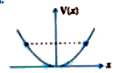
The potential energy function for a particle executing linear simple harmonic motion is given by `V(x) = (kx^(2))/2 ` where k is the force constant of the oscillator . For `k = 0.5 "Nm"^(-1)` , the graph of V(x) versus x is shown in figure . Show that a particle of total energy 1 J movng under this potential must 'turn back ' when it reaches `x = pm 2 m ` .

Text Solution

Verified by Experts

Total energy of a simple harmonic oscillator ,
`E = K+V`
` 1= 1/2 mv^(2)+1/2 kx^(2) " "…(1)`
When simple harmonic oscillator turn back , at this time its speed or velocity will be zero .
v = 0
` :. 1 = 0 + 1/2 (0.5)x^(2) " " [ :. "From equation (1)"]`
Promotional Banner

Topper's Solved these Questions

  • WORK, ENERGY AND POWER

    KUMAR PRAKASHAN|Exercise SECTION - B Numericals (Numerical From .DARPAN. Based On Textbook)|15 Videos
  • WORK, ENERGY AND POWER

    KUMAR PRAKASHAN|Exercise SECTION - C Objective Questions (VSQs)|52 Videos
  • WORK, ENERGY AND POWER

    KUMAR PRAKASHAN|Exercise SECTION - B Numericals (Numerical From Textual Illustration)|29 Videos
  • WAVES

    KUMAR PRAKASHAN|Exercise SECTION-F (Questions From Module) (Sample questions for preparation of competitive exams)|23 Videos

Similar Questions

Explore conceptually related problems

The total energy of a particle, executing simple harmonic motion is.

The potential energy function for a particle executing linear SHM is given by V(x) =1/2kx^(2) wher e k is the force constant of the oscillator (figure). For k = 0.5 N/m ,the graph ofV(x) versus x is shown in the figure . A particle of total energy E turns back when it reaches x = pm x_(m) . If V and K indicate the PE and KE , respectively of the particle at x = +x_(m) , then which of the following is correct ?

Give the formula of force acting on a particle executes simple harmonic motion.

Explain by plats the position of particle executing simple harmonic motion at different time.

A particle executing simple harmonic motion of amplitude 5 cm has maximum speed of 31.4 cm"/"s . The frequency of its oscillation is……….

A particle executes simple harmonic motion according to equation 4(d^(2)x)/(dt^(2))+320x=0 . Its time period of oscillation is :-

The potential energt of a particle of mass 0.1 kg, moving along the x-axis, is given by U=5x(x-4)J , where x is in meter. It can be concluded that

A particle executes simple harmonic motion with frequency f. The frequency of its potential and kinetic energy is………

Position-time relationship of a particle executing simple harmonic motion is given by equation x=2sin(50pit+(2pi)/(3)) where x is in meters and time t is in seconds. What is the position of particle at t=1s ?

Position-time relationship of a particle executing simple harmonic motion is given by equation x=2sin(50pit+(2pi)/(3)) where x is in meters and time t is in seconds. What is the position of particle at t=0 ?

KUMAR PRAKASHAN-WORK, ENERGY AND POWER -SECTION - B Numericals (Numerical From Textual Exercise)
  1. A body of mass 2 kg initially kg intially at rest moves under the acti...

    Text Solution

    |

  2. Given in figure are examples of some potential energy functions in on...

    Text Solution

    |

  3. The potential energy function for a particle executing linear simple h...

    Text Solution

    |

  4. The spring of a rocket in flight burns up due to friction .At whose ex...

    Text Solution

    |

  5. Comets move around the sun in highly elliptical orbits . The gravita...

    Text Solution

    |

  6. An artificial satellite orbiting the earth in very thin atmosphere lo...

    Text Solution

    |

  7. In figure (i) the man walks 2 m carrying a mass of 15 kg on his hands...

    Text Solution

    |

  8. When a conservative force does positive work on a body , the potential...

    Text Solution

    |

  9. Work done by a body against friction always results in a loss of its k...

    Text Solution

    |

  10. The rate of change of total momentum of a many -particle system is pro...

    Text Solution

    |

  11. In an inelastic collision of two bodies, the quantities which do not c...

    Text Solution

    |

  12. In an elastic collision of two bodies , the momentum and energy of eac...

    Text Solution

    |

  13. Total energy of a system is always conserved , no matter what internal...

    Text Solution

    |

  14. Work done in the motion of a body over a closed loop is zero for ever...

    Text Solution

    |

  15. In an elastic collision , the final kinetic energy is always less than...

    Text Solution

    |

  16. In an elastic collision of two bodies , the momentum and energy of eac...

    Text Solution

    |

  17. Explain the total linear momentum is conserved in an elastic collis...

    Text Solution

    |

  18. Practically, if 10kJ of energy is supplied to a device, how much energ...

    Text Solution

    |

  19. If the potential energy of two billiard balls depends only on the sepa...

    Text Solution

    |

  20. A body is initially at rest . It undergoes one - dimensional motion w...

    Text Solution

    |
