Home
Class 11
PHYSICS
The bob A of a pendulum released from 30...

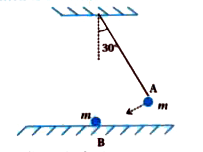
The bob A of a pendulum released from `30^(@)` to the vertical hits another bob B of the same mass at rest on a table as shown in figure . How high does the bob A rise after the collision ? Neglect the size of the bobs and assume the collision to be elastic .

Text Solution

Verified by Experts

Since collision is therefore A would come to rest and A would come to rest and B would begin to move the velocity of A.
The bob transfer its entire momentum to the ball on the table . The bob does not rise at all .
Promotional Banner

Topper's Solved these Questions

  • WORK, ENERGY AND POWER

    KUMAR PRAKASHAN|Exercise SECTION - B Numericals (Numerical From .DARPAN. Based On Textbook)|15 Videos
  • WORK, ENERGY AND POWER

    KUMAR PRAKASHAN|Exercise SECTION - C Objective Questions (VSQs)|52 Videos
  • WORK, ENERGY AND POWER

    KUMAR PRAKASHAN|Exercise SECTION - B Numericals (Numerical From Textual Illustration)|29 Videos
  • WAVES

    KUMAR PRAKASHAN|Exercise SECTION-F (Questions From Module) (Sample questions for preparation of competitive exams)|23 Videos

Similar Questions

Explore conceptually related problems

The bob A of a simple pendulum released from 30^(@) to the vertical hits another bobo B of the same mass at rest on a table as shown in figure. How high does the bob A rise after the collision ? Neglect the size of the bobs and assume the collision to be elastic.

Two identical ball bearings in contact with each other and resting on a frictionless table are hit heat-on by another ball bearing of the same mass moving initially with a speed V as shown in figure. If the collision is elastic, which of the following (figure) is a possible result after collision ?

Two identical ball bearing in contact each other and resting on a frictionless table are hit head - on by another ball bearing of the same mass moving intially with a speed c as shown in figure . If the collision is elastic mwhich of the following (figure ) is a possible result after collision ?

A bob of mass m is suspended from the ceiling of a train moving with an acceleration a as shown in figure. Find the angle theta in equilibrium position.

The bob of mass 50 gm of a pendulum is released from a horizontal position A as shown in the figure . .If the length of the pendulum is 1.5 m , what is its kinetic energy at the lower most point B ? (g = 10 m/(s^(2)))

Two fixed, identical conducting plates (a and (3), each of surface area S are charged to - Q and q, respectively, where Q > q > 0. A third identical plate ( lambda ), free to move Is located on the other side of the plate with charge q at a distance d as per figure. The third plate is released and collides with the plate f_3 . Assume the collision is elastic and the time of collision is sufficient to redistribute charge amongst beta and gamma . (a) Find the electric field acting on the plate gamma before collision. (b) Find the charges on beta and gamma after the collision. (c) Find the velocity of the plate gamma after the collision and at a distance d from the plate beta

A simple pendulum of bob of mass m and length L has one of its ends fixed at the centre O of a vertical circle, as shown in the figure. If 0=60^(@) at the point P , the minimum speed u that should be given to the bob so that it completes vetical circle is

On a frictionless surface , a block of mass . M moving at speed v collides elastically with another block of same mass M which is intially at rest /After collision the first block moes at an angle theta to its initial direction and has a speed v/3 The second block's speed after the collision is :

A block of mass 5 kg moves from left to right with a velocity of 2ms^(-1) and collides with another block of mass 3 kg moving along the same line in the opposite direction with velocity 4 ms^(-1) . (i) If the collision is perfectly elastic, determine velocities of both the blocks after their collision. (ii) If coefficient of restitution is 0.6, determine velocities of both the blocks after their collision.

KUMAR PRAKASHAN-WORK, ENERGY AND POWER -SECTION - B Numericals (Numerical From Textual Exercise)
  1. A body constrained to move along the z -axis of a coordinate system is...

    Text Solution

    |

  2. An electron and a proton are detected in a cosmic ray experiment , the...

    Text Solution

    |

  3. A rain drop of radius 2 mm falls from a height of 500 m above the grou...

    Text Solution

    |

  4. A molecule in a gas container hits a horizontal wall with speed 200 ms...

    Text Solution

    |

  5. A pump on the ground floor of a building can pump up water tofill a ta...

    Text Solution

    |

  6. Two identical ball bearings in contact with each other and resting on ...

    Text Solution

    |

  7. The bob A of a pendulum released from 30^(@) to the vertical hits anot...

    Text Solution

    |

  8. The bob of pendulum is released from a horizontal position . If the le...

    Text Solution

    |

  9. A trolley of mass 30 kg carrying a sandbag of 25 kg is moving uniform...

    Text Solution

    |

  10. A body of mass 0.5 kg travels in a straight line with velocity v = ax^...

    Text Solution

    |

  11. The blades of a windmill sweep out a circle of area A . (a) If the win...

    Text Solution

    |

  12. A person trying to lose weight (dieter ) lifts a 10 kg mass , one thou...

    Text Solution

    |

  13. A family uses 8 kW of power. Direct solar energy is incident on the ...

    Text Solution

    |

  14. A bullet of mass 0.012kg and horizontal speed 70 ms^(-1) strikes a blo...

    Text Solution

    |

  15. Two inclined frictionless tracks , one gradual and the other steep me...

    Text Solution

    |

  16. A 1 kg block situated on a rough incline is connected to a spring co...

    Text Solution

    |

  17. A bolt of mass 0.3 kg falls from the ceiling of an elevator moving dow...

    Text Solution

    |

  18. A trolley of mass 200 kg moves with a uniform speed of 36 km/h on a fr...

    Text Solution

    |

  19. Which of the following potential energy curves in figure cannot descri...

    Text Solution

    |

  20. Consider the decay of a free neutron at rest : n to p +e^(-) Sho...

    Text Solution

    |
