Home
Class 11
PHYSICS
Which of the following potential energy ...

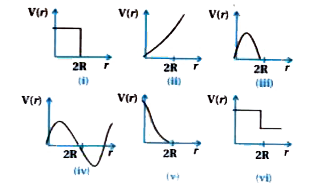
Which of the following potential energy curves in figure cannot describe the elastic collision of two billiard balls ? Here r is the distance between centres of the balls .

Text Solution

Verified by Experts

Distance between centre of balls is 2R when both ball collide .
During every elastic collision , the shape of ball slightly changes .
In elastic collision potential energy converted into kinetic energy .
The potential energy of a system of two masses is inversely proportional to the separation between them .
` :. V prop 1/r`
Out of the given graph , curve (v) only satisfies these two consitions .Therefore , all other curves cannot possibly describe the elastic collision of two billiard balls .
Promotional Banner

Topper's Solved these Questions

  • WORK, ENERGY AND POWER

    KUMAR PRAKASHAN|Exercise SECTION - B Numericals (Numerical From .DARPAN. Based On Textbook)|15 Videos
  • WORK, ENERGY AND POWER

    KUMAR PRAKASHAN|Exercise SECTION - C Objective Questions (VSQs)|52 Videos
  • WORK, ENERGY AND POWER

    KUMAR PRAKASHAN|Exercise SECTION - B Numericals (Numerical From Textual Illustration)|29 Videos
  • WAVES

    KUMAR PRAKASHAN|Exercise SECTION-F (Questions From Module) (Sample questions for preparation of competitive exams)|23 Videos

Similar Questions

Explore conceptually related problems

State if each of the following statements is true or false. Give reasons for your answer. In an elastic collision of two bodies, the momentum and energy of each body is conserved.

Answer carefully, with reasons : In an elastic collision of two billiard balls, is the total kinetic energy conserved during the short time of collision of the balls (i.e. when they are in contact)?

Figure shows the velocity-time graph for two masses R and S that collided elastically. Which of the following statements is true? i. R and S moved in the same direction after the collision. ii. The velocities of R and S were equal at the mid time of the collision. iii. The mass of R was greater than mass of S . Which of the following is true?

In an elastic collision of two billiard balls,which of the the following quantities remain conserved during the short time of collision of the balls ? (i.e. when they are in contact) (a) Kinetic energy. (b) Total linear momentum. Give reason for your answer in each case.

Which of the following is the graph of electric field versus distance r from the centre of charged spherical shell ? R is the radius of tr sphere shell, 'O' is centre of shell

Answer carefully, with reasons : If the potential energy of two billard balls depends only on the separation distance between their centres, is the collision elastic or inelastic? (Note, we are talking here of potential energy corresponding to the force during collision, not gravitational potential energy).

Answer carefully, with reasons : Is the total linear momentum conserved during the short time of an elastic collision of two balls?

Consider the collision depicted in figure to be between two billiard balls are equal masses m_(1)=m_(2) . The first ball is called the cue while the second ball is called the target . The billiard player wants to 'sink ' the target ball in a corner pocket , which is at angle theta_(2) = 37^(@) .Assume that the collision is elastic and that friction and rotational motion are not important . Obtain theta_(1) .

A ball collides elastically with a massive wall moving towards it with a velocity of v as shown. The collision occurs at a height of h above ground level and the velocity of the ball just before collision is 2v in horizontal direction. The distance between the foot of the wall and the point on the ground where the ball lands, at the instant the ball lands, will be :

If the potential energy of two billiard balls depends only on the separation distance between their centres , is the collision elastic or inelastic ? ( Note , we are talking here of potential energy corresponding to the force during collision , not gravitational potential energy ).

KUMAR PRAKASHAN-WORK, ENERGY AND POWER -SECTION - B Numericals (Numerical From Textual Exercise)
  1. A body constrained to move along the z -axis of a coordinate system is...

    Text Solution

    |

  2. An electron and a proton are detected in a cosmic ray experiment , the...

    Text Solution

    |

  3. A rain drop of radius 2 mm falls from a height of 500 m above the grou...

    Text Solution

    |

  4. A molecule in a gas container hits a horizontal wall with speed 200 ms...

    Text Solution

    |

  5. A pump on the ground floor of a building can pump up water tofill a ta...

    Text Solution

    |

  6. Two identical ball bearings in contact with each other and resting on ...

    Text Solution

    |

  7. The bob A of a pendulum released from 30^(@) to the vertical hits anot...

    Text Solution

    |

  8. The bob of pendulum is released from a horizontal position . If the le...

    Text Solution

    |

  9. A trolley of mass 30 kg carrying a sandbag of 25 kg is moving uniform...

    Text Solution

    |

  10. A body of mass 0.5 kg travels in a straight line with velocity v = ax^...

    Text Solution

    |

  11. The blades of a windmill sweep out a circle of area A . (a) If the win...

    Text Solution

    |

  12. A person trying to lose weight (dieter ) lifts a 10 kg mass , one thou...

    Text Solution

    |

  13. A family uses 8 kW of power. Direct solar energy is incident on the ...

    Text Solution

    |

  14. A bullet of mass 0.012kg and horizontal speed 70 ms^(-1) strikes a blo...

    Text Solution

    |

  15. Two inclined frictionless tracks , one gradual and the other steep me...

    Text Solution

    |

  16. A 1 kg block situated on a rough incline is connected to a spring co...

    Text Solution

    |

  17. A bolt of mass 0.3 kg falls from the ceiling of an elevator moving dow...

    Text Solution

    |

  18. A trolley of mass 200 kg moves with a uniform speed of 36 km/h on a fr...

    Text Solution

    |

  19. Which of the following potential energy curves in figure cannot descri...

    Text Solution

    |

  20. Consider the decay of a free neutron at rest : n to p +e^(-) Sho...

    Text Solution

    |
