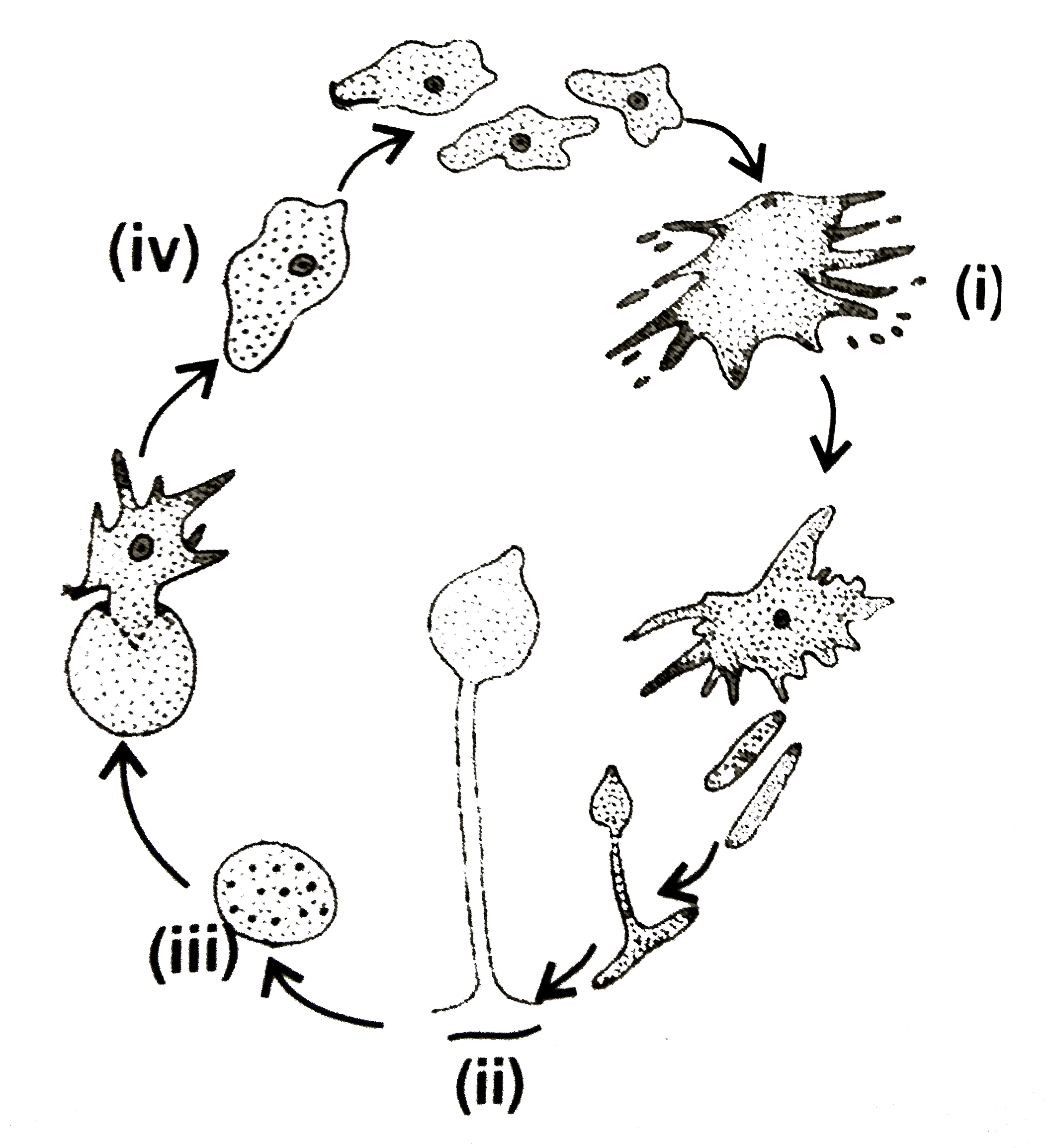
 P. Structure (i) is formed in response to drought conditions and exhaution of food supply.
 A
B
C
D
Text Solution
Verified by Experts
The correct Answer is:



Topper's Solved these Questions
BIOLOGICAL CLASSIFICATION
NCERT FINGERTIPS ENGLISH|Exercise KINGDON PROTISTA|40 VideosBIOLOGICAL CLASSIFICATION
NCERT FINGERTIPS ENGLISH|Exercise KINGDOM FUNGI|30 VideosANIMAL KINGDOM
NCERT FINGERTIPS ENGLISH|Exercise Animal Kingdom|148 VideosBIOMOLECULES
NCERT FINGERTIPS ENGLISH|Exercise Biomolecules|137 Videos
NCERT FINGERTIPS ENGLISH-BIOLOGICAL CLASSIFICATION-Biological Classification
- Sexual reproduction in fungi is carried out by the fusion of compatibl...
Text Solution
|
- Given diagram illustrates an evolutionary tree. Which of the foll...
Text Solution
|
- Study the given life cycle of cellular slime moulds and select the inc...
Text Solution
|
- In an experiment, common Tobacco Mosaic Virus (TMV) and its mutant str...
Text Solution
|
- All eukaryotic unicellular organisms belong to 1. Monera . 2. protista...
Text Solution
|
- The five kingdom classification was proposed by, 1. R.H. Whittker 2 C....
Text Solution
|
- Organisms living in salty areas are called as , 1.methanogens, 2.halop...
Text Solution
|
- Naked cytoplasm, multinucleated and saprophytic are the characteristic...
Text Solution
|
- An association between rots of higher plants and fungi is called, 1. ...
Text Solution
|
- A dikaryon is formed when, 1. meiosis arrested , 2. the two haploid ce...
Text Solution
|
- Contagium vivum fluidum was proposed by, 1. D J Ivanowsky , 2. M W Bei...
Text Solution
|
- Association between mycobiont and phycobiont are found in , 1.mycorrhi...
Text Solution
|
- Difference between virus and viroid is
Text Solution
|
- With respect to the fungal sexual cycle, choose the correct sequence o...
Text Solution
|
- Viruses are non-cellular organisms but relicate themselves one they in...
Text Solution
|
- Memebers of Phycomycetes are found in (i) aquatic habitats (ii) on...
Text Solution
|
- Assertion : Two kingdom classification was insufficient. Reason : Ma...
Text Solution
|
- Asseration : Archaebacteria are able to survive in harsh habitats. R...
Text Solution
|
- Assertion : Methanogens are present in the gut of several ruminant ani...
Text Solution
|
- Asseration : Cyanobacteria are photosynthetic autotrophs. Reason : C...
Text Solution
|